8 Top 3PL KPIs to Boost Your Logistics Efficiency
Your Third-Party Logistics (3PL) partner sends you monthly reports full of numbers, but how do you know if those numbers reflect results? Without clear benchmarks, you're flying blind – unable to identify whether your fulfillment operation is thriving or silently bleeding money.
Poor 3PL performance hits where it hurts. Research shows that 69% of shoppers are less likely to return after a late delivery, and 16% will abandon a retailer after just one incorrect shipment.
This guide breaks down nine key 3PL KPIs with benchmarks to help you measure performance and take action with confidence.
8 Top 3PL KPIs to Track for Logistics Success
#1. Dock-to-Stock Time
Dock-to-stock time is the time from the inventory’s arrival at your 3PL's loading dock until it's processed, put away, and available for sale in the warehouse management system.
This matters because inventory sitting in receiving limbo can't generate revenue. If your 3PL takes a week to process incoming shipments while your system shows zero stock, you're losing sales to stockouts that don't actually exist.
How to calculate: Dock-to-Stock Time = Timestamp inventory available in WMS - Timestamp shipment received at dock
Benchmarks:
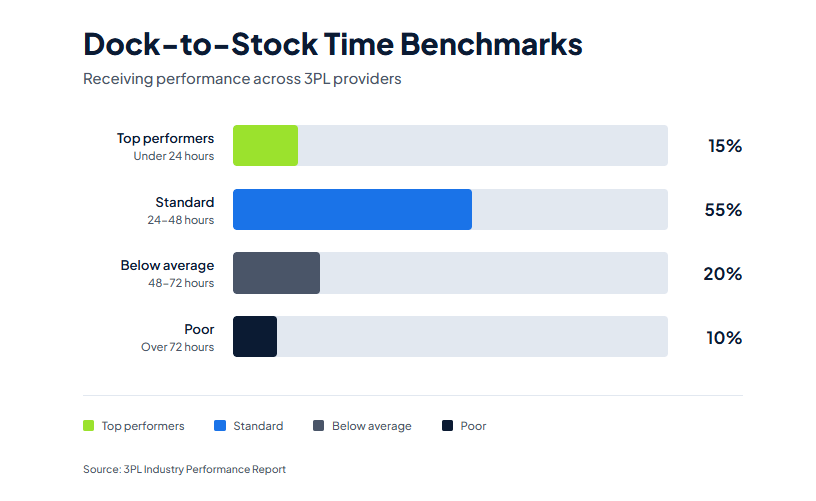
- Standard performance: 48 hours
- Top performers: Under 24 hours
- Red flag: More than 72 hours
Fast dock-to-stock times become critical during peak seasons, when inventory velocity increases. A slow receiving process in Q4 can lead to missed sales during your highest-revenue period.
#2. Fulfillment Speed
Fulfillment speed is the time from order placement to pick, pack, and hand off to a carrier. This is the portion of delivery time your 3PL directly controls.
How to calculate: Fulfillment Speed = Timestamp order handed to carrier - Timestamp order received
Benchmarks:
- Top performers: Same-day fulfillment for orders placed by the cutoff time
- Standard: Within 24 hours
- Acceptable: Within 48 hours
Most direct-to-consumer brands now aim for 2-3 day total delivery times, which means your 3PL needs to process orders within hours, not days. If your fulfillment speed lags, you'll either miss delivery commitments or pay premium rates for expedited shipping to make up for it.
#3. Order Accuracy
Order accuracy measures the percentage of orders shipped correctly: the right items, the right quantities, undamaged, and properly labeled. This is the foundation of customer satisfaction.
How to calculate: Order Accuracy Rate = (Error-free orders / Total orders shipped) × 100
Benchmarks:
- Top performers: 99.5% to 99.9%
- Good performance: 97% to 99%
- Industry median: 90% (meaning 1 in 10 orders has an issue)
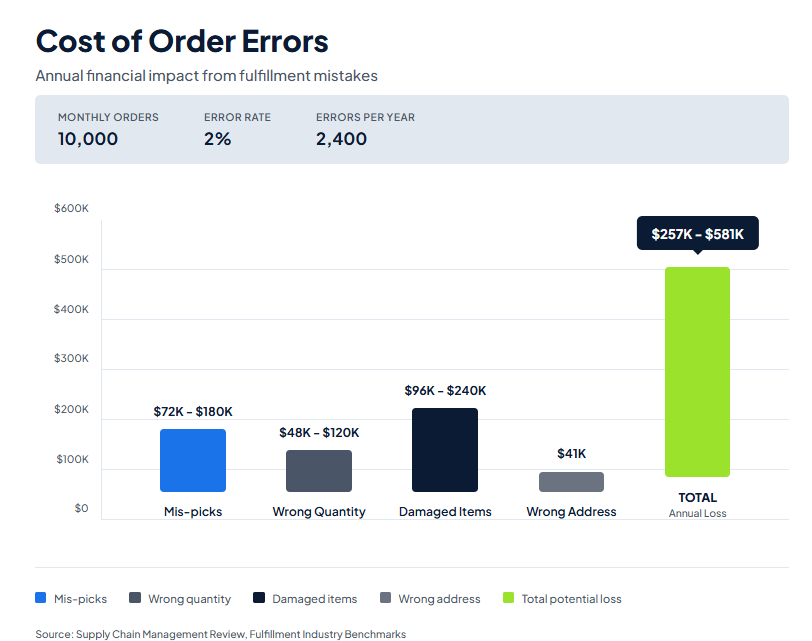
According to the OnRamp research, each order error can slash profitability by as much as 13% when you factor in returns processing, replacement shipping, and customer service costs.
 #4. Inventory Accuracy
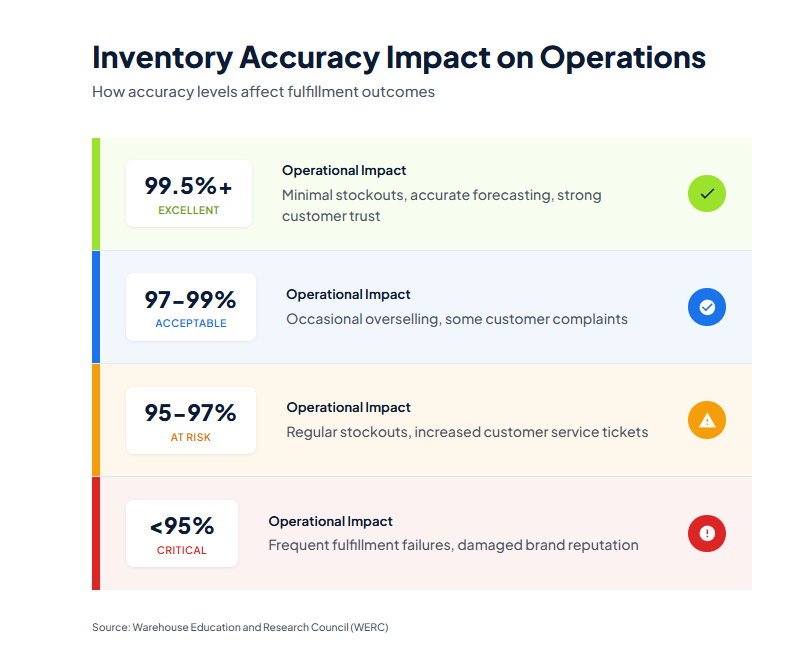
Inventory accuracy compares the actual physical inventory in your 3PL's warehouse against what's recorded in the system. Discrepancies cause overselling, unexpected stockouts, and fulfillment delays.
How to calculate: Inventory Accuracy = (Physical inventory count / Recorded system inventory) × 100
Benchmarks:
- Top performers: 99.5% or higher
- Target minimum: 98%
- Many operations without proper systems: 65-75%
Regular cycle counts (2-4 times per year) combined with annual physical audits keep this number high. Your 3PL should also track inventory shrinkage separately: the loss of inventory due to damage, theft, or administrative errors.
 #5. Transit Time
Transit time is the time it takes for packages to travel from your 3PL's facility to customers. While carriers control this after pickup, your 3PL's location strategy and carrier selection directly impact performance.
How to calculate: Average Transit Time = Sum of all delivery times / Total deliveries
Key factors affecting transit time:
- Distance between warehouse(s) and customer clusters
- Carrier performance and route efficiency
- Number of fulfillment locations in your network
Data collected by OpenSend shows that distributing inventory across multiple fulfillment centers can reduce shipping times by 71% compared to single-location fulfillment. This is worth discussing with your 3PL if you're seeing consistently long transit times.
#6. On-Time Delivery Rate
On-time delivery rate tracks whether orders arrive on time. This is what customers actually care about - not how fast you shipped, but whether you kept your promise.
How to calculate: On-Time Delivery Rate = (Orders delivered on or before promised date / Total orders) × 100
Benchmarks:
- Target: 98% or higher
- Minimum acceptable: 95%
Research indicates that 70% of shoppers are unlikely to purchase from a retailer again after experiencing a failed delivery, making on-time performance a direct retention metric.
#7. Return Processing Time
Return processing time measures how quickly returned items are received, inspected, and either restocked or dispositioned. Slow returns processing ties up inventory value and delays refunds.
How to calculate: Return Processing Time = Date item restocked or dispositioned - Date return received
Benchmarks:
- Ideal: 24 hours or less
- Standard: 48 hours
- Red flag: More than 72 hours
According to the NRF and Happy Returns 2024 Report, retail returns totaled $890 billion, representing 16.9% of annual sales. As a result, efficient reverse logistics is now a core 3PL competency rather than an afterthought.
#8. Cost per Unit Shipped
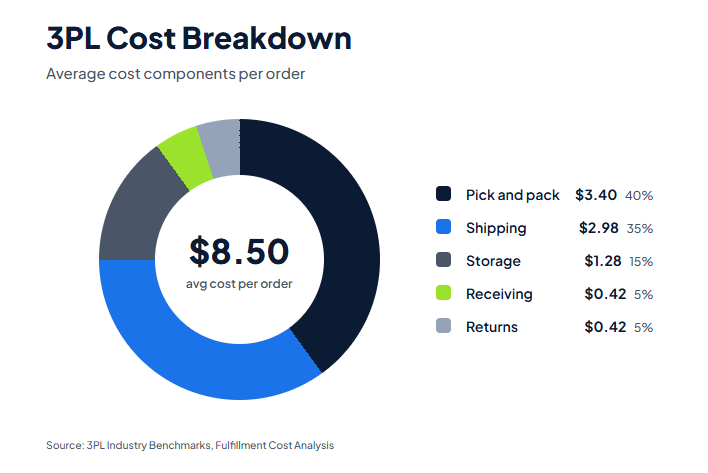
Cost per unit shipped combines all 3PL fees (receiving, storage, pick-and-pack, shipping) into a single metric that tracks efficiency over time.
How to calculate: Cost per Unit Shipped = (Total fulfillment costs for period) / (Total units shipped)
Benchmarks:
- Industry average for e-commerce fulfillment: Approximately $8.50 per order
- Pick and pack base fees: $1.50-2.50 per order
- Additional per-item charges: $0.50-1.00 per item
The blended metric helps you identify creeping costs that may not be apparent when reviewing individual line items. Track it monthly and investigate any upward trends.
 How to Manage 3PL Performance
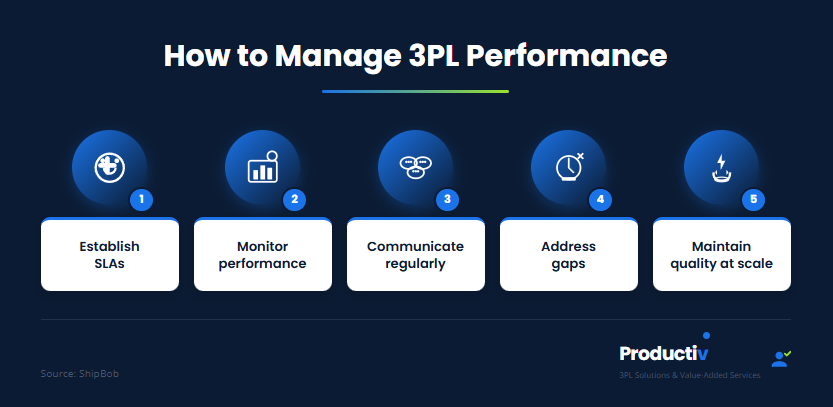
Tracking KPIs is only valuable if you act on them. Here's how to build a performance management system that drives results step-by-step:
- Establish clear performance expectations and SLAs. Document specific targets for each KPI before signing your contract. Include minimum thresholds (below which penalties apply), target performance levels, and stretch goals. Get specific: "high accuracy" means nothing without a number attached.
- Implement monitoring systems. Require your 3PL to provide dashboard access, supply chain analytics, or automated reports for all key metrics. Weekly operational reports on fulfillment speed and accuracy, plus monthly reviews of cost and inventory metrics, provide the visibility you need to catch issues early.
- Develop a consistent communication cadence. Schedule weekly operational check-ins for tactical issues and monthly strategy sessions for deeper performance analysis. Don't wait for quarterly business reviews to surface problems.
- Create action plans for performance gaps. When a KPI falls below target, work with your 3PL to identify root causes, implement best fulfillment practices, and document corrective actions with specific timelines. Require follow-up reporting on improvement progress.
- Scale operations while maintaining performance standards. Volume growth often strains 3PL capacity, making fulfillment scalability a key evaluation criterion. Build triggers into your contract that require proactive capacity planning when volume approaches certain thresholds, preventing performance degradation during peak periods.
7 Red Flags to Look for in 3PL Performance
Beyond the headline KPIs, watch for these warning signs that indicate deeper 3PL problems:
- Recurring "one-time" issues. The same problems surfacing repeatedly despite assurances they've been fixed signal systemic issues, not isolated incidents.
- Delayed or incomplete reporting. A 3PL that struggles to provide accurate data is likely to struggle with internal operational visibility.
- Resistance to SLA discussions. Partners confident in their performance welcome accountability; those who push back may know they can't deliver.
- High staff turnover in your account team. Constant changes in your point of contact mean institutional knowledge keeps walking out the door.
- Excuses that blame external factors. Weather, carrier issues, and supplier delays happen, but a pattern of blaming others suggests poor contingency planning.
- Inventory discrepancies they can't explain. Regular "system adjustments" to reconcile counts indicate inventory control issues.
- Communication only when you initiate it. Strong partners proactively surface issues before you discover them; silent partners are hiding problems.
Frequently Asked Questions
#1. What is the most important 3PL KPI to track?
Order accuracy is the most critical 3PL KPI because it directly impacts customer satisfaction, return rates, and repeat purchases. Research shows that 16% of customers will abandon a retailer after receiving just one incorrect order. While all KPIs matter, fulfillment errors create immediate customer-facing problems that damage your brand.
#2. How often should you review 3PL performance metrics?
Review operational metrics such as order accuracy and fulfillment speed weekly, and conduct monthly analyses of cost metrics, inventory accuracy, and overall trends. Hold quarterly business reviews to discuss capacity, technology investments, and contract adjustments.
#3. What should be included in a 3PL service level agreement?
A 3PL SLA should consist of specific performance targets for order accuracy (99%+), on-time shipping (98%+), inventory accuracy (98%+), and dock-to-stock time (48 hours or less). Include measurement methodologies, reporting requirements, penalty structures for underperformance, and bonus provisions for exceeding targets.
#4. How do returns affect 3PL performance metrics?
Returns impact multiple KPIs, including cost per unit (processing costs), inventory accuracy (restocking challenges), and fulfillment speed (diverted labor). With retail returns accounting for 16.9% of sales in 2024, efficient returns processing has become a core performance metric rather than a secondary concern.
#5. When should you switch 3PL providers?
Consider switching 3PL providers when you see persistent underperformance against SLAs without meaningful improvement, communication breakdowns that leave problems unresolved, capacity limitations that constrain your growth, or technology gaps that prevent visibility into your operations. Give your current partner 90-180 days to address documented issues before initiating a transition.
Key Takeaways
- The nine core 3PL KPIs to track are dock-to-stock time, fulfillment speed, order accuracy, shipping accuracy, inventory accuracy, transit time, on-time delivery rate, return processing time, and cost per unit shipped.
- Target 99%+ order accuracy, 98%+ on-time delivery, and under 48-hour dock-to-stock times to meet industry benchmarks for competitive performance.
- Document specific performance targets with clear measurement methods in your SLAs before signing contracts to build accountability.
- Review operational KPIs weekly, cost metrics monthly, and strategic alignment quarterly to catch issues early.
- Recurring issues, reporting delays, and communication gaps are red flags that signal deeper operational problems with your 3PL.
- KPIs only create value when you use them to drive improvement conversations and inform business decisions.
- Productiv reports KPIs to clients weekly — units produced per hour, order accuracy, SLA attainment, and cost per unit — and treats missed targets as an operator failure to diagnose and fix, not a metric to explain away.
20 Years of Kitting Excellence
Ready to Streamline Your Supply Chain?
Join industry leaders achieving 99%+ SLA performance with flexible kitting, fulfillment, and 3PL solutions.
Get in Touch