Strategic Perspective
The Future of Operations
Operations should improve over time—not just keep up. Productiv is built to prepare our clients for what's coming next.
The Industry Has Split Into Two Incomplete Models
The logistics industry is splitting in two: traditional 3PLs with infrastructure but no systems intelligence, and software platforms with analytics but no physical execution. Neither model delivers operations that improve over time.
Traditional 3PLs
- Physical infrastructure
- Labor and execution capacity
- No systems intelligence
- No continuous improvement
Software & AI Platforms
- Visibility and analytics
- Optimization algorithms
- No physical infrastructure
- No execution ownership
Productiv Is Fundamentally Different
Productiv combines physical execution with AI-driven systems. We own outcomes because we control both layers—a structural requirement for operations that improve over time.
Software That Runs the Work, Not Just Observes It
Most operations software is designed to track what's happening. Productiv's software is designed to run what's happening — built from inside live operations, by the people accountable for the outcome.
Software built from inside operations understands what software built from outside cannot: the gap between plans and reality.
Built from the Floor Up
We kept solving problems the WMS couldn't solve. The result is ProSuite — five proprietary tools built by the people running the operations, for the workflows standard software was never designed to handle.
The people building the software are the people using it. That's why it works.
Software vendors design for the average operation. We designed for ours — which means it works in the real world. From identified problem to deployed solution: next day.
100% B2B shipping accuracy. Scan-based single piece flow — label generated on case scan, pallet build directed per retailer routing guide.
Digital first article inspection and out-of-box audit recordkeeping. Defects caught before production runs.
Workforce management and gainshare program administration built for the way warehouse labor actually operates.
Dock scheduling that replaces spreadsheets: carrier self-booking, QR check-in, live dock board, automated notifications.
Shaping the Future, Not Reacting to It
Productiv Edge is our venture arm for identifying and deploying early-stage technologies. Unlike typical corporate VC, investments don't sit in labs—they're tested inside live operations. Partnerships with robotics, automation, and software companies are chosen to accelerate operational improvement, not expand a catalog.
Why Productiv Edge Exists
- >Stay ahead of industry shifts, not behind them
- >Provide real deployment paths for emerging technology
- >Create structural advantages for Productiv and its customers
- >Extend Productiv's operating philosophy into new domains
Scaling Sustainable Packaging
Started as a college project, TemperPack pivoted to 'Jutebox' compostable insulation. They needed to launch production on a 100k+ unit order instantly.
- [OPS]Built custom assembly lines and recruited a local labor force.
- [FIN]Provided working capital and material financing.
- [TECH]Assisted with product development for manufacturing.
Solving the Vinyl Supply Deficit
Founders saw a 24-week lead time crisis in vinyl manufacturing. They partnered with Productiv to pivot from brokering records to manufacturing them.
- [FIN]Purchased the first two automated vinyl presses.
- [SCM]Handled packaging, kitting, and fulfillment.
- [PTR]Facilitated real estate and sourcing partnerships.
Humanoid Robots in Warehousing
Our Dallas facility is one of the densest humanoid robot training environments in American logistics. The thesis: task variety matters more than task volume. Robots that can do eight different things are more deployable than robots that have done one thing eight million times.
Or explore our warehouse robotics & automation solutions.
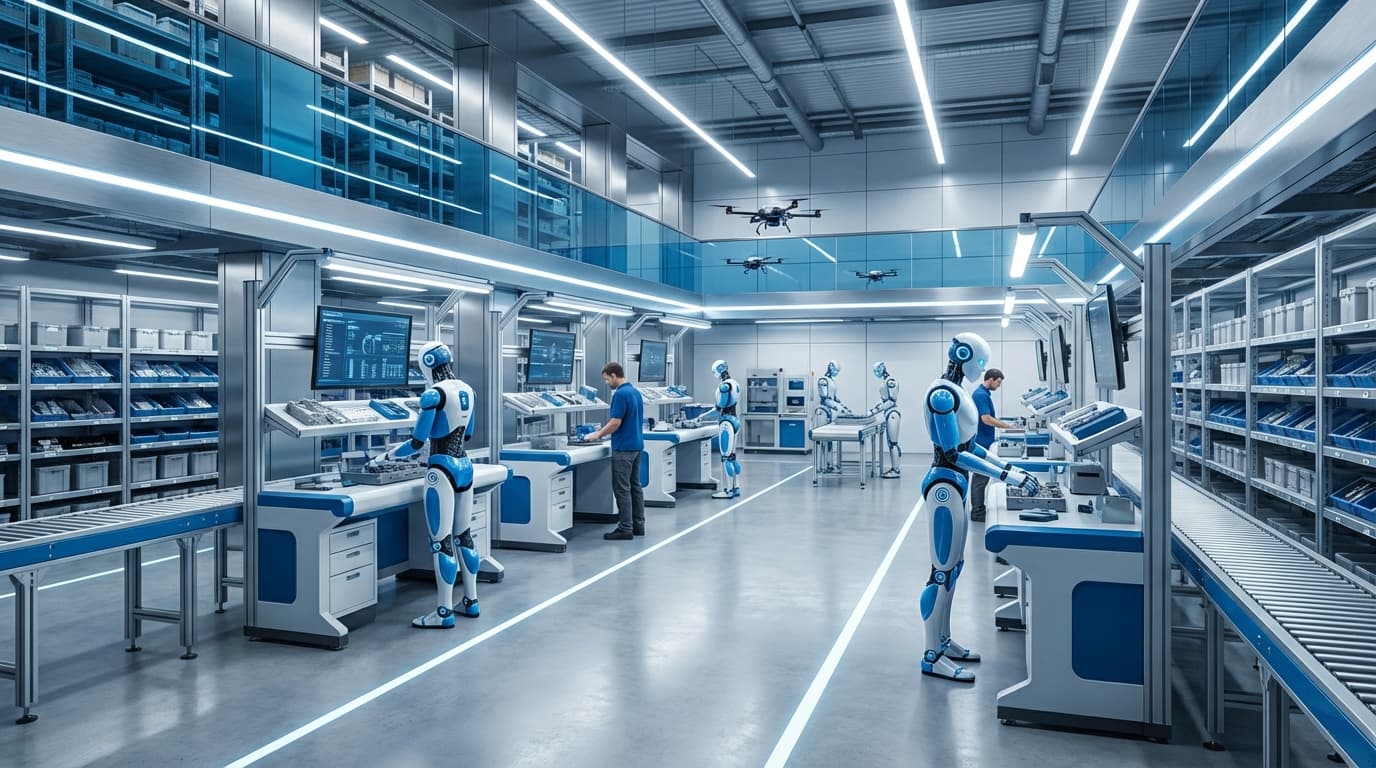
Task variety over task volume — the training signal that makes humanoid robots deployable at scale.
// FAQ
Common Questions
What is an intelligent operations company?
An intelligent operations company combines physical execution — warehouse infrastructure, labor, and logistics capacity — with proprietary software and automation systems built and operated by the same team. Productiv is the only 3PL that builds, deploys, and operates its own software inside the same operations clients hire it to run.
What is the difference between a traditional 3PL and an intelligent operations company?
Traditional 3PLs provide infrastructure and labor but rely on third-party WMS software and have no built-in continuous improvement mechanism. An intelligent operations company builds its own software inside its operations — shaped by actual workflows, not a vendor product roadmap. Operations improve over time rather than repeating at the same level.
How does ProSuite differ from a warehouse management system?
A WMS manages inventory transactions, order routing, and pick-pack-ship workflows. ProSuite handles everything a WMS wasn't designed for: retail compliance label generation (ProPallets), quality inspection recordkeeping (ProQuality), workforce scheduling and gainshare administration (ProShift + ProVantage), and dock scheduling (ProDocks). ProSuite fills the operational gaps the WMS leaves.
What is ProPallets and how does it achieve 100% B2B shipping accuracy?
ProPallets replaces WMS batch printing with scan-based single piece flow: each UCC-128 label is generated only when the case barcode is scanned, eliminating mismatches. The system directs the pallet build per the retailer's routing guide, shows visual label placement guides per retailer, and automatically sends the ASN (EDI 856) on closeout. Result: 100% B2B shipping accuracy.
Can a 3PL build its own proprietary software?
Most don't — they license WMS software and configure it. Productiv built ProSuite using Lovable, developed by the Global Head of Fulfillment with direct feedback from the operations teams using it daily. Because the builders are the users, the software is built around actual workflows. From identified problem to deployed solution: next day.
What role do humanoid robots play in the future of warehouse operations?
Humanoid robots require high task variety to train effectively — they learn by doing many different tasks, not by repeating one task at high volume. Productiv's Dallas facility runs 500+ workers across 8+ task categories and 15M+ kits per year, making it one of the densest humanoid robot training environments in American logistics. Task variety matters more than task volume.
The Future Belongs to Those Who Can Execute It
The future of operations won't be won by software alone or labor alone—but by companies that combine both with accountability. Productiv is building toward that future deliberately. If you're looking for an operator who thinks beyond the next contract cycle, we should talk.
Talk to Productiv