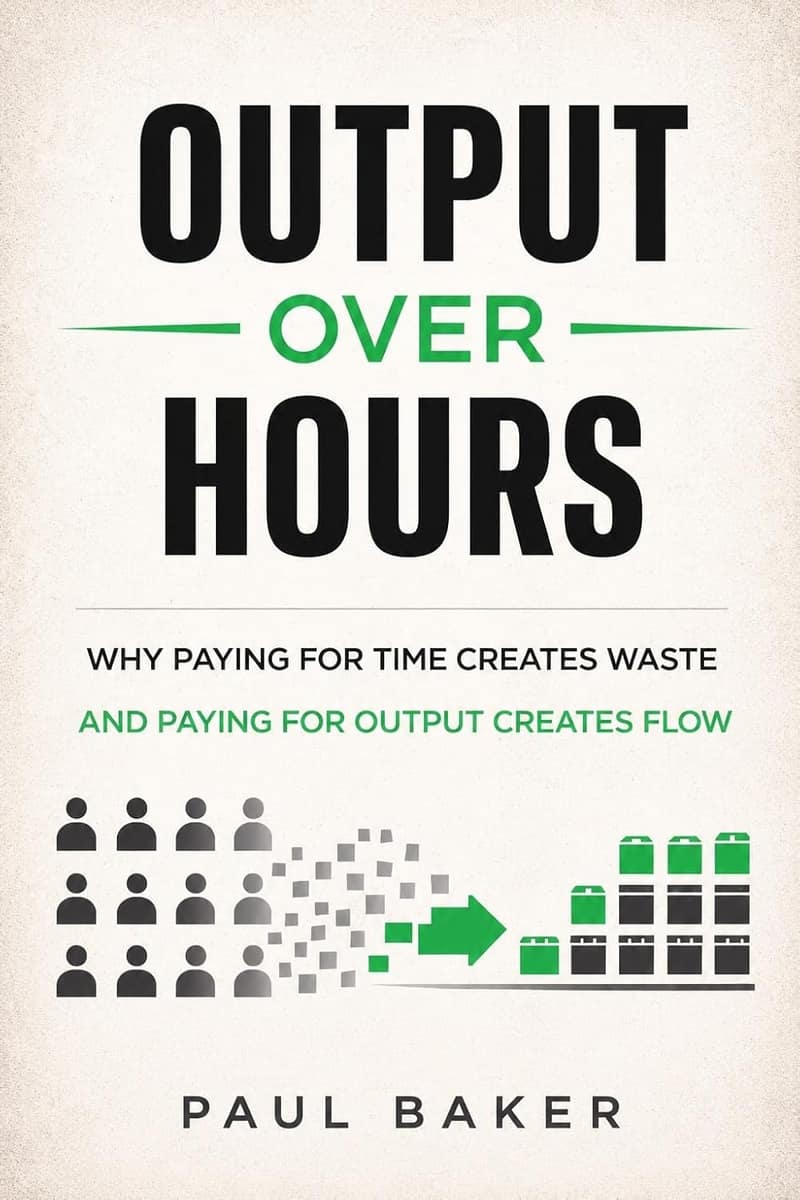
Output Over Hours
Why Paying for Time Creates Waste and Paying for Output Creates Flow
Most manufacturers pay for labor by the hour. Their suppliers are paid more when they're less efficient. The math is upside-down, and the costs hide in plain sight — turnover, overtime, downtime, supervisory bandwidth burned managing temp agencies that profit from staying inefficient. This book is the operator's playbook for fixing that, drawn from 20 years running labor-intensive operations on a cost-per-unit (CPU) model.
Cost-Plus Labor Is a Hidden P&L Leak
The cost-plus / hourly labor model — your rate plus a markup — gets defended on the grounds that it's simple. It is simple. It's also fundamentally misaligned: the agency profits when you're least efficient, the workers have no stake in throughput, and your CFO can't tell you what a unit of output actually costs. Cost-plus is the warehouse-floor equivalent of cost-plus contracting in defense — a model so structurally broken that the rest of the economy moved past it decades ago. This first part of the book makes the cost visible: turnover, training drag, supervisor bandwidth, overtime cascades, and the silent throughput tax that never shows up on an invoice because it's hiding inside your fixed costs.
Cost Per Unit Is the Only Number That Connects Labor to Output
If you can't state your CPU, you don't know what labor costs you. Hourly rate isn't the number — it's an input. CPU is the output. The middle section of the book walks the CFO calculation explicitly: how to derive CPU from your existing labor and production data, how to read it against industry benchmarks, what it tells you about line design, and why the moment you start contracting in CPU instead of hours is the moment your suppliers' incentives finally align with yours. The arithmetic isn't hard. The discipline is.
What Output-Based Labor Looks Like in Practice
Reframing the contract is the start, not the end. The third part of the book is the operational system that makes output-based labor work: single-piece flow on the line, just-in-time replenishment that keeps operators on task, gainsharing that aligns financial incentives, cobots and humanoid augmentation where they earn their place, and the lean process engineering — what we call The Productiv Way — that turns it into something that improves over time. This is the part most books skip. Reframing without operating system is just a slogan.
Who This Book Is For
This book is for the COO, VP of Operations, or GM at a manufacturer where labor is throughput-critical and the current model isn't working. If you're running fill lines, assembly, packaging, or any process where a temp agency or in-house labor pool is the bottleneck — and the cost of that bottleneck is showing up as turnover, downtime, and missed throughput targets — this is the playbook. It is not a book about staffing. It's a book about converting labor from a cost line into a productivity lever, with the operating system to make it real.
We Built Our Embedded Model On The Principles In This Book
Productiv operates inside manufacturers' own facilities under cost-per-unit contracts. We staff and run fill lines, packaging operations, surgical kit assembly, repack, and inspection — and we're only paid when units ship. If the book resonates and you want to see what this looks like applied to your operation, the next step is a conversation with one of our operations engineers.
[Get my free Cost Per Unit Analysis]