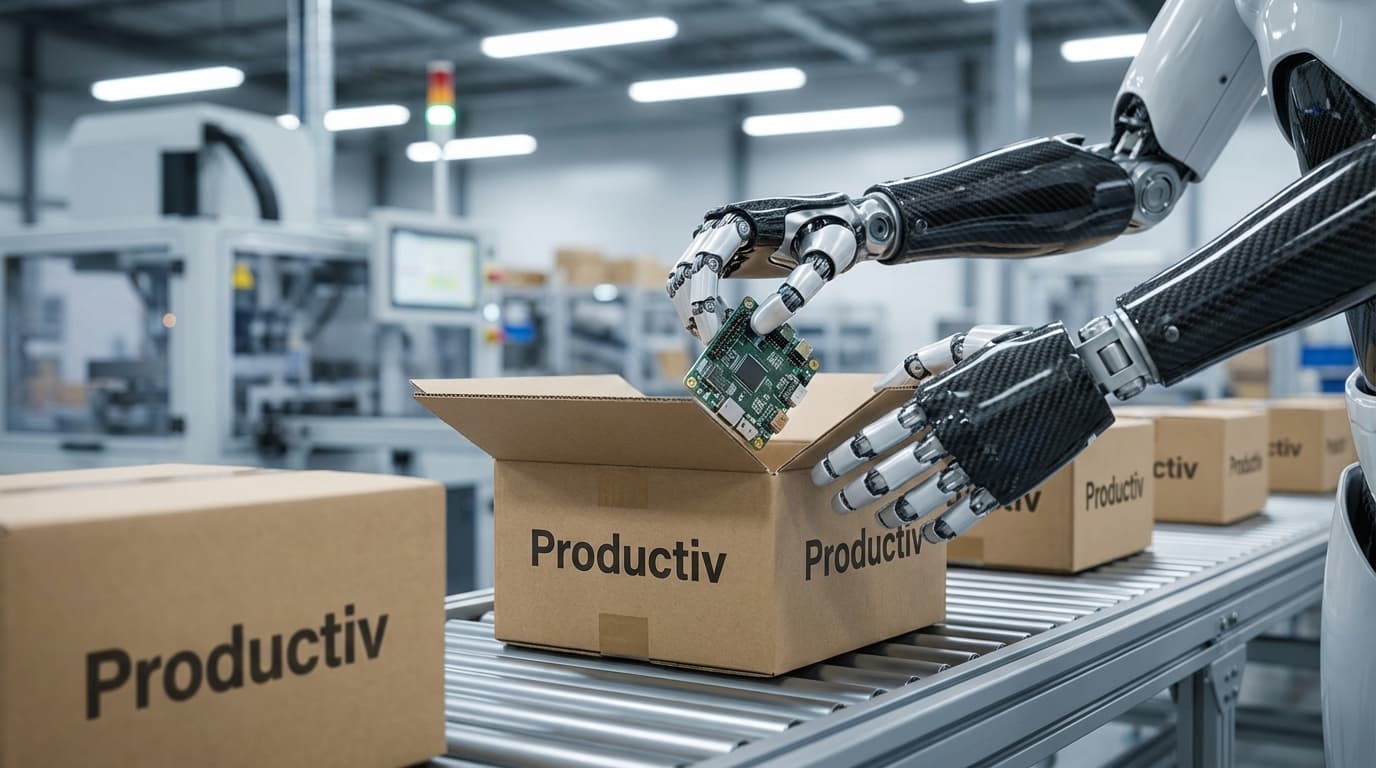
There's no shortage of humanoid robot content online. Backflips. Laundry folding. Carefully choreographed demo videos that, as one robotics professor noted, were recorded 50 times until one good take emerged.
At Productiv, we're past that.
Over the past 90 days, we've been running Avatar Robotics' humanoid systems in live kitting operations at our Dallas facility — not in a lab, not in a controlled test environment, but on active production lines shipping real product to real retail customers. One Avatar robot operating at 600 units per hour on an 8-hour shift. Multiple robots. Multiple SKUs. Real deadlines.
Here's what we've learned.
Why Traditional Automation Doesn't Solve the Kitting Problem
We started looking for robotics solutions for kitting lines back in 2019. It took six years to find something viable.
The reason is structural. Most of the manual labor in kitting, hand assembly, and hand packaging happens in confined areas that were designed for humans — conveyor belts, assembly lines, workstations sized for people working shoulder to shoulder. Fixed automation, whether it's palletizing robots, AMRs, or cobots attached to fixed structures, either requires redesigning the entire workflow or solves the wrong part of the problem.
AMRs reduce travel distance. That's valuable, but the savings come from transportation. The actual manipulation work — picking items, placing them into pouches and boxes, handling packaging configurations that change hourly — that's still a human job. A traditional robot arm can't drop into an existing line of 20 people and just work. You're either rebuilding the facility around the machine or you're not actually solving the problem.
Humanoid form factor changes this equation.
The In-Line Advantage
At our Dallas facility, we run a long conveyor belt with teams working on kitting programs for retail customers. The product changes. The packaging changes. The configuration changes — sometimes within the same shift. Absorbing that constant variety is a question of SKU coverage — how many distinct products a line can run without breaking flow.
With Avatar's humanoid robots, we didn't have to move a single workstation. We placed the robots directly in line with our human workers — same footprint, same setup, same conveyor. When the project changes, we reconfigure the line. The robots reconfigure with it. Tomorrow's setup doesn't require any special installation.
“Having that flexibility is what makes the humanoid form factor so much more valuable in our setup than even fixed automation.”
— Paul Baker, CFO, Productiv · The Manufacturing Executive Podcast
This is the key insight that six years of searching finally led us to: the constraint was never throughput — it was adaptability. A robot that can join a kitting line rather than requiring the line to be built around it is a fundamentally different category of solution.
What Live Production Actually Looks Like: The Numbers
This is where things get concrete.
On a single shift today, one Avatar robot operates at 600 to 1,000 units per hour on an 8-hour shift — 4,800 to 8,000 picks per day. Across multiple robots running simultaneously, each handling different SKUs and projects. That's not a controlled trial; that's a production line shipping to retailers.
Scale that across a single month: one robot accumulates 150,000 reps across multiple SKU types in 30 days.
That number matters because repetitions are the mechanism for improvement. Every cycle is real-world training data. Every packaging variant, every product weight, every bag that arrives twisted in a slightly different direction — the robot encounters it, handles it, and the system gets better. The rate of improvement inside a live production environment is not comparable to a demo or an innovation lab. The sim-to-real gap — the difference between how robots perform in simulation versus the real world — closes through reps, not research.
“What we accomplished in 90 days can never have been done in an innovation lab or a demo, unlike the number of projects that we worked on together and that we produce on a daily basis.”
— Paul Baker, CFO, Productiv · The Manufacturing Executive Podcast
The Cost Curve
When we evaluated kitting automation in 2019, the economics were impossible. The technology either didn't exist at viable accuracy or the deployment cost was prohibitive — machines were still approaching $1 million apiece for systems that couldn't reliably handle variable SKU configurations.
That has changed fast.
“It kind of resembles the solar power cost curve going back 10 or 15 years. It is just continuing to get better and better. Once Avatar showed up and we saw how fast they iterated, that gives us a lot of confidence that we're going to get to parity with humans in the near future.”
— Paul Baker, CFO, Productiv · The Manufacturing Executive Podcast
Avatar Robotics structured their commercial model around this reality. Rather than selling robots as capital equipment, they operate on an hourly labor rate — competitive with what many facilities pay for human labor today. They finance and deploy the hardware; customers pay per hour worked. That means the economics are accessible at almost any scale, and as the technology improves, the rate stays competitive.
The target we're building toward: parity with human labor cost at equivalent throughput and quality, with the additional benefit of continuous multi-shift operation without fatigue, turnover, or seasonal staffing risk.
Change Management: How You Introduce This to Your Workforce
One topic that gets less coverage than it deserves: how you actually introduce humanoid robots to the people working on the floor.
Before we rolled out the first Avatar robots, we brought the whole team together. The message was direct: the future of this industry is robotic and AI-enabled, we're moving in that direction, and doing so is going to allow us to win more clients, improve service levels for existing clients, and create opportunities for people on our floor to move into higher-value roles.
Most of our workers have been with Productiv for five to ten years. There's trust built up. When they see the Avatar team on-site working alongside us — engineers who are clearly invested in making the system work — it reads differently than a corporate announcement.
What's happened in practice: roles have shifted, not disappeared. We have more material handling work now and less manual kitting. Workers who were spending their day on repetitive pick-and-place tasks are now managing robot lines and equipment. That is, by most measures, a better job.
The longer view is honest: in 20 to 30 years, this industry looks very different. Our goal between now and then is to move people up the value chain as the technology scales — not simply replace them.
What Manufacturing Leaders Should Pay Attention To
The early scale for humanoid robots has been in 3PL and logistics, for a clear reason: manipulating packaged goods — moving products from one configuration to another — is solvable today. The dexterity requirements are achievable with current hardware.
Manufacturing has a structurally similar last-mile problem: the final manual processes that change too often or involve too much nuance for fixed automation. Assembly steps that shift when the product changes. Inspection tasks that require judgment. Any operation in a confined area that was originally built for people.
The capabilities that unlock these manufacturing applications are in active development. Better dexterous manipulation — handling smaller parts in more constrained spaces — is on a clear roadmap. The question for manufacturing leaders isn't whether this technology is coming. It's whether you're going to be an early adopter who builds expertise now or a late adopter who plays catch-up later.
Key Takeaways
- →Humanoid form factor solves the adaptability problem that fixed automation never could in confined kitting and assembly environments
- →Live production is the only environment that generates real improvement — 150,000 reps per month per robot vs. weeks of lab-equivalent learning
- →Current throughput: 600–1,000 units/hr per robot, 4,800–8,000 picks/day on an 8-hour shift
- →The cost curve is accelerating — comparable to solar power adoption, with hourly labor rate models making deployment accessible without capital outlay
- →Change management matters — direct communication, visible role transitions, and the robotics team on the floor alongside your workers
- →Manufacturing is the next frontier — manipulation capabilities developed in logistics transfer directly to assembly, inspection, and confined production environments
As Heard On
The Manufacturing Executive
“How Humanoid Robots Are Already Transforming Production Lines” — hosted by Joe Sullivan, Gorilla76. Paul Baker (Productiv) and Colin Webb (Avatar Robotics) discuss live deployment, economics, and what's coming in manufacturing.
Listen on Apple PodcastsHumanoid Robotics · Live Operations
Want to see what live humanoid deployment looks like?
Productiv's Dallas facility is open for robotics partnerships — 500+ workers, 8+ task categories, 15M+ kits per year. Talk to Paul directly.