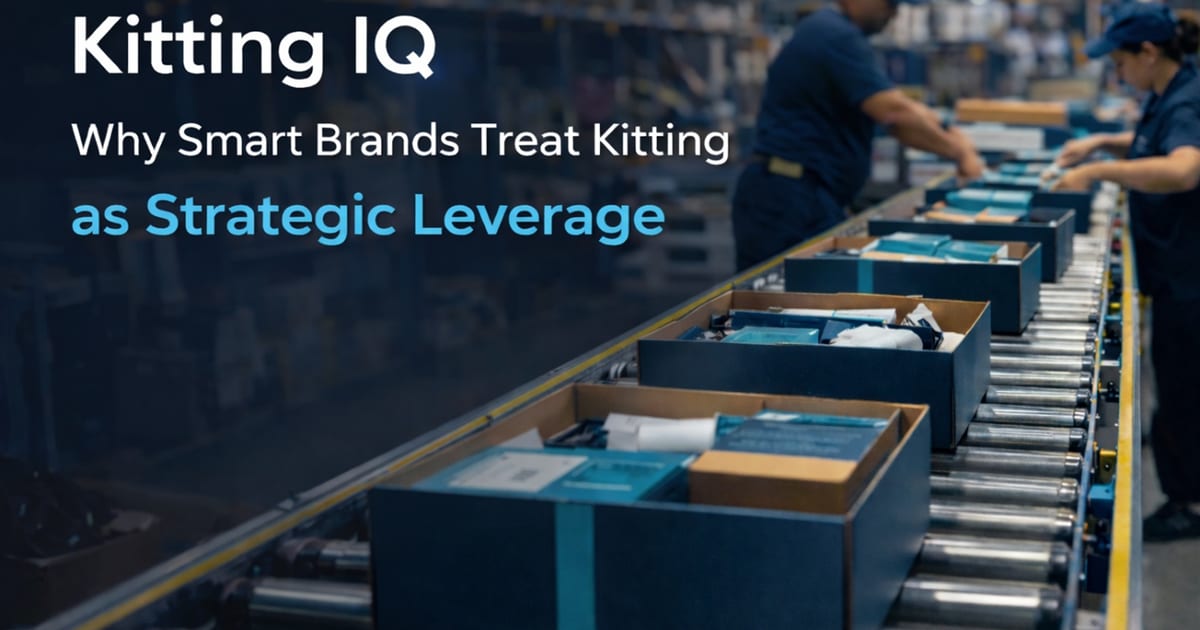
Here's a pattern we see constantly: a brand invests millions in product development, marketing, and channel strategy — then hands off kitting and assembly to whoever has floor space and a temp staffing contract.
The result? Kitting becomes a cost center that operates on inertia. Quality issues recur. Cost per unit creeps upward with volume instead of downward. And the operation never improves because nobody owns the outcome — they only own the hours.
This is the kitting blind spot. It affects companies of every size across consumer goods, health and beauty, subscription commerce, retail, and manufacturing. Kitting gets treated as an afterthought — a commodity task outsourced to the lowest bidder or absorbed into an overstretched warehouse team.
But what if kitting isn't the afterthought? What if it's actually one of the most powerful levers you have for controlling cost, speed, quality, and customer experience across your entire supply chain?
That's the premise behind what we call Kitting IQ — the organizational intelligence to recognize kitting as a strategic control point and treat it accordingly.
The Status Quo Is Costing You More Than You Think
For most companies, kitting operations fall into one of two buckets: handled internally by a warehouse team that treats it as secondary to fulfillment, or farmed out to a contract packager or staffing agency that bills by the hour and has no stake in your outcomes.
Both models share the same structural flaw: nobody is accountable for making the operation better. The staffing agency gets paid whether throughput improves or not. The internal warehouse team is optimized for shipping, not assembly. And when things go wrong — mispicks, quality escapes, missed retailer delivery windows — the same problems repeat quarter after quarter.
"Short-term cost goals are prioritized over long-term business value, and a narrow, function-specific focus limits the ability to pursue big change and meet full performance potential."
— Gartner, "5 Levers for Optimizing Supply Chain Costs"
This captures the kitting dilemma precisely. When kitting is treated as a transactional line item — hours billed, bodies deployed — there's no structural incentive to optimize it. The operation stagnates, and the real cost isn't what you're paying per hour. It's the efficiency you're leaving on the table.
The kitting and assembly services market is projected to reach $15.2 billion by 2033, growing at a 7.8% CAGR (Manufacturing Journal). That growth isn't driven by companies doing more of the same. It's driven by companies recognizing that kitting deserves the same strategic attention as procurement, logistics, and fulfillment.
Kitting as Control: Owning the Outcome, Not Just the Task
The shift from "kitting as task" to "kitting as control" starts with a fundamental question: who owns the outcome of your kitting operation?
If the answer is "a staffing agency," you don't have control. You have a vendor. If the answer is "our warehouse team, when they have time," you don't have control. You have a secondary priority.
Control means someone is accountable for measurable results — cost per unit, throughput rates, quality metrics, on-time performance — and is structurally incentivized to improve them. It means the operation has engineered workflows, not ad hoc processes. It means problems get solved permanently, not patched temporarily.
What Control Looks Like in Practice
Process Engineering Over Headcount. When kitting is treated as a control point, the first question isn't "how many people do we need?" It's "how do we design this workflow so it requires fewer interventions and produces fewer errors?" A single-piece flow conveyor configuration can be 30% to 200% faster than a table build — and quality can be monitored at each station rather than inspected at the end of the line.
Measurement and Refinement Cycles. Control requires data. Every kitting operation should have clear metrics — units per labor hour, defect rates, cost per unit at varying volumes — and a structured cadence for reviewing and improving against those metrics. If your operation doesn't get measurably better every month, your provider is selling you inputs, not outcomes.
Permanent Problem Resolution. In a task-based model, problems get patched. In a control-based model, they get root-caused and eliminated. The same issue shouldn't resurface quarter after quarter. This is the core philosophy of lean manufacturing applied to kitting — and it's what separates engineered operations from staffed operations.
Kitting as Strategic Leverage: The Competitive Advantage Hiding in Plain Sight
Once kitting moves from afterthought to control point, the next evolution is recognizing it as leverage — a capability that actively creates competitive advantage, not just prevents problems.
1. Speed to Market
Kitting happens before orders come in. That's the fundamental advantage. When products are pre-bundled and shelf-ready, fulfillment collapses from a multi-step assembly process into a single pick-and-ship operation. For brands competing on delivery speed — which in 2026 is essentially every brand — this isn't a nice-to-have. It's table stakes.
Just-in-time kitting takes this further by delaying final assembly until demand confirms. This gives you the flexibility to adjust configurations, swap promotional inserts, or respond to regional variations without carrying pre-built inventory for every scenario.
2. Cost Per Unit Economics
In a well-engineered kitting operation, cost per unit decreases as volume increases. That's the natural curve of lean manufacturing: standardized processes, optimized material flow, and continuous improvement compound over time.
But in most kitting operations, the opposite happens. Volume increases, complexity rises, temporary labor gets added, and cost per unit stays flat or actually goes up. The difference is engineering versus staffing. When you engineer a process, you build in the mechanisms for scale. When you staff a process, you just add more bodies.
"65% of executives are prioritizing supply chain and manufacturing costs as the biggest levers for organizations to pull for cost savings."
— Boston Consulting Group, "The CEO's Guide to Costs and Growth" (2024)
With executives overwhelmingly focused on supply chain cost optimization, kitting is one of the most accessible high-impact levers available. Unlike freight negotiations or warehouse automation — which require major capital expenditure or long lead times — kitting process engineering can deliver measurable cost reductions within weeks.
3. Quality as a Brand Differentiator
Every kit that reaches a customer is a brand touchpoint. A poorly assembled subscription box, a promotional display with missing components, a medical kit with an incorrect lot code — these aren't just operational failures. They're brand failures.
Strategic kitting operations build quality control into the workflow itself. In a single-piece flow configuration, each station serves as both an assembly point and a quality checkpoint. If station three is responsible for placing an item in a specific position and a kit arrives without it, the line stops. The error is corrected before it propagates — not discovered in a chargeback two weeks later.
4. Inventory Intelligence
Kitting provides a powerful lens into component consumption patterns. When components are grouped into kits under unified SKUs, you gain better visibility into which items are moving fast, which are stagnating, and where procurement timing needs adjustment. This enables more accurate demand forecasting and supports just-in-time inventory strategies that reduce carrying costs.
5. Supply Chain Resilience
Kitting operations that are engineered — rather than assembled ad hoc — are inherently more resilient. Standardized workflows can be replicated across facilities. Process documentation enables faster recovery from disruptions. And a dedicated operating partner can flex capacity during demand spikes without the lag time of recruiting and training temporary labor.
When a national cosmetics brand suddenly shifted volume to a secondary supplier, Productiv got the call on a Friday afternoon. By Monday, two conveyor lines were installed and running. Within six months, the operation had scaled to 25,000 units per shift across 27 lines. That kind of response is only possible when the operating model is built for variability — not designed around steady-state assumptions.
The Productiv Approach: Engineered Operations That Improve Over Time
At Productiv, we've spent nearly two decades building an operating model specifically designed to deliver on the promise of kitting as strategic leverage. Our approach is fundamentally different from traditional 3PLs, staffing agencies, and labor-only providers — and the difference shows up in results.
We Own Execution and Improvement Together. Traditional 3PLs and labor providers sell inputs — space, hours, transactions — and avoid accountability for outcomes. Productiv owns the operation. We run it, measure it, and improve it. Our contracts tie to outcomes, not headcount. That alignment is what makes continuous improvement structural, not aspirational.
Process Engineering, Not Headcount Deployment. We don't just staff your kitting line — we engineer it. Every workflow is designed using lean principles, measured against clear SLAs, and refined through structured improvement cycles. The result: lower cost per unit, fewer errors, and operations that get better as they scale.
Flexible Deployment: Our Network or Your Site. Every capability is available through two models: operations at Productiv facilities across our national network, or embedded operations where we deploy a dedicated team inside your facility and run it as our own — with our systems, our management, and our accountability.
Results Across Industries
- Consumer goods company achieved 99%+ SLAs across on-time fulfillment, order accuracy, and inventory accuracy within 30 days of transitioning to Productiv.
- Paper goods client saved 35% in labor costs processing over 3 million cases annually with 300 unique SKUs through lean-engineered workflows and fixed unit pricing.
- WMS implementation completed in 2 weeks for a fast-growing brand, reducing total materials by 25% and excess materials by 90%.
- 150,000 grocery boxes assembled in 33 days for hurricane disaster relief, delivering 2.7 million meals to Puerto Rico.
How to Assess Your Kitting IQ: Five Questions Every Brand Should Ask
Whether you currently manage kitting in-house or through a third-party provider, these five questions reveal how much strategic value you're capturing — or leaving on the table:
1. Does your cost per unit go down as volume goes up? If not, your process isn't engineered — it's staffed. True kitting operations should exhibit economies of scale, not linear cost growth.
2. Can you name three specific process improvements made in the last quarter? If your kitting operation looks the same as it did six months ago, improvement isn't built into the system. It's accidental at best.
3. Do you have real-time visibility into quality, throughput, and inventory? Data-driven decision-making isn't possible without real-time dashboards. If you're relying on end-of-week reports or anecdotal updates, you're operating blind.
4. Who is accountable when something goes wrong? If the answer involves finger-pointing between your team, a staffing agency, and a warehouse manager, you have a vendor problem, not an operating partner.
5. Is your kitting partner invested in your growth? A labor provider profits from your headcount. An operating partner profits from your success. The incentive structures are fundamentally different — and they produce fundamentally different results.
The Industry Is Moving — Don't Get Left Behind
Cost management is the number one priority for a third of corporate leaders globally, up eight percentage points from the prior year. 86% of supply chain executives are planning investments in AI and analytics for cost reduction. Over half of total logistics spending is now managed through outsourcing partnerships.
The brands gaining ground aren't the ones cutting corners on kitting. They're the ones investing in it as a strategic capability — treating it with the same rigor they apply to product development, marketing, and customer experience.
This isn't about spending more on kitting. It's about spending smarter — partnering with operators who have the engineering capability, the process discipline, and the accountability to turn your kitting operation into a competitive advantage.
If you're evaluating kitting partners or thinking through whether your current setup is actually engineered or just staffed, talk to our team. No pitch decks. Just a direct conversation about whether Productiv makes sense for your operation.
Learn more: Kitting and Assembly Services | 3PL Kitting and Assembly: Process and Benefits | Kitting in the Modern Supply Chain
Key Takeaways
- →When kitting is treated as a commodity task, nobody owns the outcome — the staffing agency gets paid whether throughput improves or not, and the same problems repeat quarter after quarter.
- →Control-based kitting requires measurable accountability: cost per unit, throughput rates, quality metrics, on-time performance — with structural incentives to improve all four.
- →In a well-engineered kitting operation, cost per unit decreases as volume increases. In a staffed operation, the opposite usually happens.
- →Strategic kitting creates leverage across five dimensions: speed to market, cost per unit economics, quality as a brand differentiator, inventory intelligence, and supply chain resilience.
- →If your cost per unit doesn't go down as volume goes up, your operation isn't engineered — it's staffed.
Frequently Asked Questions
What is Kitting IQ?
Kitting IQ is the organizational intelligence to recognize kitting and assembly as a strategic control point in your supply chain — not a commodity task. High Kitting IQ means someone is accountable for measurable outcomes (cost per unit, throughput, quality, on-time performance) and the operation has engineered workflows that improve over time. Low Kitting IQ means kitting is staffed reactively, measured rarely, and optimized never.
What's the difference between treating kitting as a task vs. a control point?
A task-based kitting model measures inputs: hours billed, bodies deployed, orders processed. A control-based model measures outputs: cost per unit, defect rates, throughput per labor hour, on-time percentage. The difference in incentive structure is significant. In a task-based model, the provider earns more when work takes longer. In a control-based model, the provider earns more by working more efficiently — which aligns their financial interest with yours.
How does strategic kitting lower cost per unit?
Engineered kitting operations exhibit economies of scale: standardized workflows, optimized material flow, and continuous improvement compound over time so cost per unit decreases as volume increases. Staffed operations do the opposite — as volume grows, complexity rises, temporary labor gets added, and cost per unit stays flat or increases. The difference is process engineering versus headcount deployment.
How do I know if my kitting operation is engineered or staffed?
Ask five questions: (1) Does your cost per unit go down as volume goes up? (2) Can you name three specific process improvements made in the last quarter? (3) Do you have real-time visibility into quality, throughput, and inventory? (4) Who is accountable when something goes wrong? (5) Is your kitting partner invested in your growth, or just your headcount? If any answer is unclear or uncomfortable, your operation is staffed, not engineered.
What does outsourcing kitting to a 3PL save vs. handling it in-house?
The visible savings are labor overhead, warehouse space, and equipment costs. The hidden savings are larger: eliminating constant recruiting and retraining costs from temp turnover (which runs 100–400% annually in warehouse environments), removing quality failures from undertrained workers, and freeing your operations team from managing a labor problem instead of growing the business. Productiv clients have achieved 35% labor cost reductions on comparable kitting volumes through fixed unit pricing and lean-engineered workflows.
20 Years of Kitting Excellence
Ready to Streamline Your Supply Chain?
Join industry leaders achieving 99%+ SLA performance with flexible kitting, fulfillment, and 3PL solutions.
Get in Touch