
KITTING INSIGHTS | CASE STUDY | SPRING 2026
TL;DR — Key Facts
- Productiv is a U.S.-based kitting and fulfillment company with 20 years of experience serving consumer brands in seasonal retail.
- This case study covers how Productiv produces multi-component grow kits for a national gardening brand — from inbound receiving through retail-compliant outbound.
- Productiv achieves 99.9%+ kitting accuracy through a multi-layer QC system: component-level scan, assembled kit scan, visual inspection, and weight validation.
- Kitting volume for this program more than doubles during the spring gardening window, requiring coordinated inbound planning, pre-season line qualification, and flexible labor deployment.
- The client's production planner describes the program as running "pretty flawlessly" from production planning through transportation.
- Productiv operates multi-client warehouse facilities across the U.S., including the Charlotte facility where this program is managed by Regional Manager Alan McNamara.
Seasonal retail is an unforgiving environment. The window opens, demand spikes, and brands that aren't positioned correctly miss revenue they can't recover. For one of our longest-running kitting customers — a national grow kit brand distributed through major retail chains and direct-to-consumer channels — spring is everything.
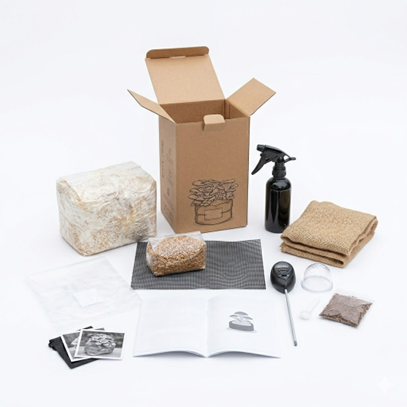
Their product is a carefully designed, all-in-one grow kit: seeds, growing medium, a container, and instructions, packaged into a single retail-ready unit. The customer experience depends on that kit being complete, correct, and consistent every time it's opened. Productiv's job is to make sure it is — at scale, season after season.
| 99.9%+ Kitting Accuracy scan-verified, every unit |
2×+ Spring Volume Ramp vs. off-season baseline |
20 yrs Productiv Experience kitting & fulfillment |
What Makes Kitting for Grow Kits Operationally Complex?
Grow kits look simple on the shelf. That simplicity is intentional — and it's exactly what makes producing them at scale operationally demanding.
Each unit is a multi-component assembly. Seeds, growing medium, a container, branded packaging, and instructions are sourced from separate vendors on separate inbound schedules. Each SKU has its own defined bill of materials. Packaging must meet the compliance specifications of multiple retail partners. And the entire program needs to double or more in volume during a narrow spring window.
A kitting error — a missing component, a mislabeled carton, a shipment that arrives outside a retailer's receiving window — is not just an operational failure. It is a brand failure, with direct consequences for the customer experience, retail relationships, and revenue.
The Core Operational Requirement
Every unit must be complete, correctly assembled, retail-compliant, and on time — across a production run that more than doubles during the spring gardening season.

How Does Productiv Manage the Bill of Materials for a Multi-Component Kit?
Every kitting program at Productiv begins with the bill of materials (BOM). Before a single component is received, the operations team builds the BOM for each kit SKU inside Productiv's warehouse management system (WMS): every component's part number, quantity, specification, and supplier.
The BOM is not a reference document. It is a live operational control. It governs what gets received and verified at the dock, what gets added at each production station, and what the WMS cross-checks during scan verification on the assembled unit. Every downstream step in the kitting process is anchored to it.
When components arrive from different vendors, the receiving team scans each shipment into the WMS against its BOM line item. Inventory is tracked in real time by component, giving production planners a continuous view of what is on hand, what is inbound, and whether any gap needs to be escalated before the next production run.
How Does Productiv Achieve 99.9%+ Kitting Accuracy?
Productiv's kitting accuracy comes from a multi-layer quality control system built directly into the production line — not applied at the end as a final check. For this grow kit program, QC occurs at four distinct points:
- Component-level scan: each component is scanned at the workstation against the BOM before being placed into the kit. An incorrect or missing component is caught at the station, before it becomes an assembled unit error.
- Assembled kit scan: once all components are in place, the completed kit is scanned as a whole. The WMS confirms that every BOM item is accounted for before the unit advances to packout.
- Visual inspection: a trained QC associate reviews each kit for packaging integrity, correct label placement, and presentation quality against the brand's standards.
- Weight validation: kit weight is checked within a defined tolerance as a final catch for missing or substituted components that may have passed visual review.
Any unit that fails at any checkpoint is pulled from the line, flagged, corrected, and re-verified before it can advance. Non-conforming units do not ship. This system is what sustains accuracy above 99.9% across high-volume seasonal production runs.
"Every kit that leaves our floor is the same as the last. That's not an accident — it's the result of the right systems, the right training, and a team that genuinely cares about what they're building. When you're handling a product that someone is going to open, plant, and watch grow, the stakes feel real. We take that seriously."
— Alan McNamara, Charlotte Regional Manager, Productiv
Running a seasonal kitting program? Talk to an operations expert about how Productiv manages volume ramps without sacrificing accuracy. →
How Does Productiv Handle Retail Compliance and DTC Fulfillment?
Retail Compliance
After QC clearance, kits destined for retail partners go through a channel-specific compliance process. Different retail accounts have different requirements for labeling, ticketing, case pack configuration, and pallet build standards. Productiv maintains retailer-specific compliance protocols for each account and applies them at packout: correct labels, correct case counts, correct routing documentation.
Retail compliance is treated with the same operational rigor as kitting accuracy. A non-compliant shipment generates chargebacks that directly erode the client's margin. For this program, Productiv manages compliance simultaneously across multiple retail accounts during peak spring production.
Direct-to-Consumer Fulfillment
For DTC orders, kits are packed into parcel-appropriate configurations, verified against the pick list at seal, and scanned out with carrier labels applied. Shipment tracking is initiated through the WMS as units leave the facility. Both channels — retail and DTC — run simultaneously during spring peak, and outbound staging is structured to prevent either from creating a bottleneck for the other.
How Does Productiv Scale Kitting Volume for Spring Without Losing Quality?
Spring gardening demand concentrates in a narrow window. Volume on this program more than doubles relative to the off-season baseline, and it does so quickly. Productiv's approach to scaling without sacrificing quality is built on three specific practices:
- Front-loaded inbound coordination: Productiv begins coordinating with the client's vendors well ahead of peak production. All components are received, verified, and staged before volume ramps begin. A component shortage at the line during peak season is a production stoppage; front-loading inbound eliminates that risk.
- Pre-season line qualification: before spring production begins, Productiv runs a full line qualification on each kit SKU — verifying that station setup, assembly sequence, and QC checkpoints are correctly configured for any updated kit designs entering the new season.
- Cross-trained flexible labor: as volume increases, Productiv scales the associate team on this program by drawing on its cross-trained workforce. New associates are verified against accuracy benchmarks before working independently on the line. Productiv's multi-client warehouse model allows labor to flex across programs based on real-time demand, without adding fixed overhead.
Spring 2026 Market Context
Gardening is one of the most broadly participated leisure activities in the U.S. The National Gardening Association's 2023 National Gardening Survey found that approximately 80% of U.S. households — around 104 million homes — engaged in lawn and garden activities, a five-year high. The category's participation rates have historically held up during economic uncertainty, though total retail sales can fluctuate: the NGA's own data from the 2008–2009 recession showed category sales declined before recovering as consumers redirected spending toward growing their own food. For brands with strong value positioning, spring demand forecasting carries both opportunity and real variability.
What Does the Client Relationship Look Like Day-to-Day?
Productiv's Charlotte team maintains a direct working relationship with the client's production planning and transportation teams throughout the season. Production status, inventory levels, inbound schedules, and outbound shipment confirmations are communicated on a regular cadence.
That visibility matters most when circumstances change mid-season — when an inbound shipment is delayed, a retailer updates a routing requirement, or volume comes in above forecast. Identifying issues early and communicating clearly is what separates a managed situation from a missed deadline.
"We have a very good team on our account, they've made it run very smooth, and they've done it pretty flawlessly. That's very big for me because I do production planning and transportation so for it to go smooth from beginning to end is really important for my job."
— Production Planner, National Grow Kit Brand
Key Takeaways
- What is kitting? Kitting is the process of assembling multiple individual components into a single, retail-ready unit. For grow kits, this includes seeds, growing medium, a container, and instructions, assembled to a defined bill of materials and packaged for retail or DTC distribution.
- What kitting accuracy does Productiv achieve? Productiv achieves 99.9%+ kitting accuracy on this program, sustained through a four-layer QC system: component-level scan, assembled kit scan, visual inspection, and weight validation.
- How does Productiv handle seasonal volume spikes? Through front-loaded inbound coordination, pre-season line qualification, and cross-trained flexible labor deployment within its multi-client warehouse model.
- Where does Productiv operate? Productiv operates multi-client warehouse and fulfillment facilities across the United States. This grow kit program runs out of its Charlotte, North Carolina facility.
- How long has Productiv been in business? Productiv was founded in 2006 and has 20 years of experience in kitting, assembly, and fulfillment for consumer brands.
If You're Evaluating Kitting Partners for Spring Production
Seasonal kitting programs have a hard deadline. Components need to be received and verified before the line runs. Retail ship windows don't move. If your current partner is struggling with accuracy, communication, or volume flexibility — or if you're setting up a seasonal program for the first time — talk to our operations team about how Productiv works and whether our model fits your program.
Talk to an Operations Expert →
About Productiv
Productiv operates multi-client warehouse and fulfillment facilities across the United States, executing complex kitting and assembly programs for consumer brands — from inbound component receipt through retail-compliant outbound distribution. Founded in 2006. Learn more or get in touch.
Key Takeaways
- →BOM-integrated WMS control is the foundation for kitting accuracy — every component is tracked from receiving through assembled kit scan
- →Multi-layer QC (component scan, kit scan, visual inspection, weight validation) sustains 99.9%+ accuracy across high-volume seasonal runs
- →Front-loaded inbound coordination eliminates the component shortage risk that shuts down seasonal kitting lines at peak
- →Retail compliance and DTC fulfillment can run simultaneously from the same facility without either creating a bottleneck for the other
Frequently Asked Questions
What is a kitting partner and what do they do?
A kitting partner is a third-party operations company that assembles multi-component products on behalf of a brand. They receive individual components from various suppliers, manage inventory through a warehouse management system (WMS), assemble units to a defined bill of materials, perform quality control verification, and prepare finished goods for retail distribution or direct-to-consumer fulfillment. Productiv is a kitting and fulfillment partner with 20 years of experience serving consumer brands in seasonal and year-round retail.
How does kitting accuracy work, and what does 99.9% mean in practice?
Kitting accuracy measures the percentage of assembled units that are complete and correct. 99.9% accuracy means fewer than 1 in 1,000 units has an error. Productiv achieves this through layered quality controls: each component is scanned at the workstation as it's added, the completed kit is scanned as a whole against the BOM, a visual inspection checks presentation and packaging, and weight validation provides a final check. Any unit that fails at any step is pulled and corrected before it can advance.
How do kitting operations scale for seasonal demand?
Scaling kitting for a seasonal spike requires three things working in advance: (1) all components received and staged before peak volume begins, so no shortage halts the line; (2) production lines pre-qualified on updated kit designs before the season starts; and (3) a cross-trained labor pool that can flex up quickly without introducing process variability. Productiv's multi-client warehouse model enables labor and capacity to flex across programs based on real-time demand.
What is the difference between retail compliance and DTC fulfillment in kitting?
Retail compliance involves preparing shipments to meet a specific retailer's requirements — correct labeling, ticketing, case pack sizes, pallet configurations, and routing documentation. Non-compliant shipments generate chargebacks. DTC fulfillment involves packing individual units into parcel-appropriate packaging for carrier routing, verifying order accuracy at seal, and initiating shipment tracking. Both channels can run simultaneously from the same facility, and each requires its own packout process and quality checks.
What should brands look for in a kitting partner for seasonal retail?
Key criteria include: WMS-integrated BOM management so inventory and production are tracked in real time; a documented, multi-layer QC process with verifiable accuracy metrics; the ability to scale labor and capacity without sacrificing process discipline; experience managing retail compliance for multiple accounts simultaneously; transparent communication and reporting throughout the production cycle; and a track record of executing seasonal programs on time and in full.
20 Years of Kitting Excellence
Ready to Streamline Your Supply Chain?
Join industry leaders achieving 99%+ SLA performance with flexible kitting, fulfillment, and 3PL solutions.
Get in Touch