7 Lean Warehousing Strategies for Improving Efficiency
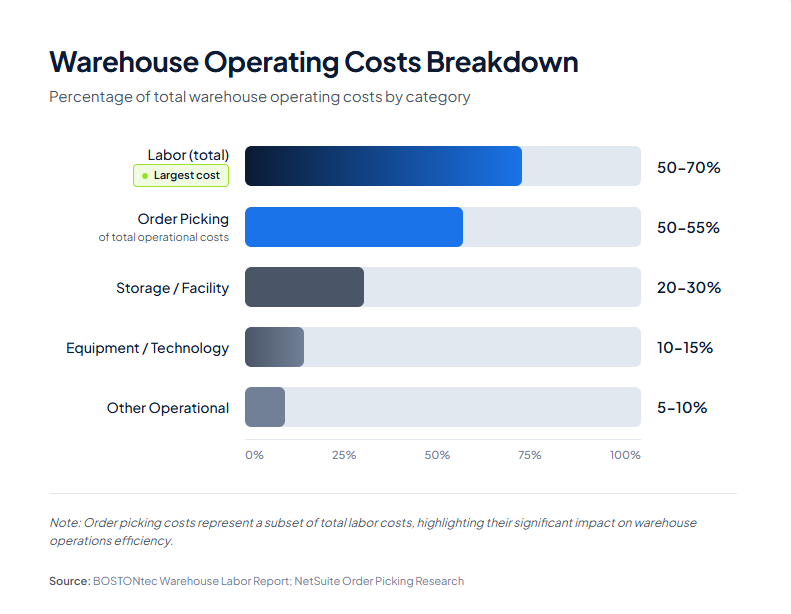
Warehouse labor costs account for 50% to 70% of total operating budgets, and order picking alone consumes 50% to 55% of those costs. For warehouse managers watching margins shrink, every wasted motion and unnecessary process translates directly to lost profit.
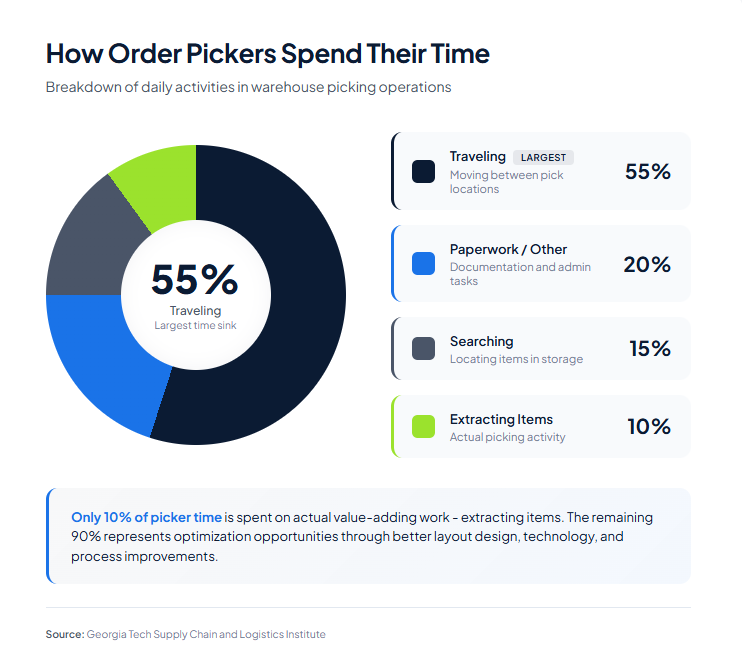
The problem compounds when you consider that pickers spend 55% of their time simply traveling between locations – not picking, not packing, just walking. Traditional warehouse setups weren't designed for today's speed demands, and inefficiencies are draining operations.
Lean warehousing offers a systematic fix. Rooted in the Toyota Production System, these principles eliminate waste while maintaining, and often improving, productivity.
This guide will walk you through the foundational 5S methodology and seven actionable strategies to transform your warehouse operation!
What Is Lean Warehousing?
Lean warehousing applies manufacturing efficiency principles to distribution and operation fulfillment. For companies seeking external support, professional warehousing solutions providers often build lean principles into their operations. The approach focuses on eliminating activities that consume time and resources without adding value to the end customer.
The methodology originated from the Toyota Production System (TPS), developed by Taiichi Ohno and Eiji Toyoda between 1948 and 1975, according to Wikipedia's overview of TPS. Toyota's engineers sought to remove what they called "muda", the Japanese word for waste, from every production step.
The term "lean production" itself was coined by IMVP researcher John Krafcik and popularized in the 1990 book The Machine That Changed the World by James P. Womack, Daniel T. Jones, and Daniel Roos.
In warehouse environments, lean principles target eight types of waste: overproduction, waiting, transportation, over-processing, excess inventory, unnecessary motion, defects, and underused talent. The original seven wastes were identified by Taiichi Ohno, with the eighth waste (underutilized talent) added in the 1990s when the Toyota Production System was adopted in the Western world. Each category represents an opportunity to reduce operational costs and accelerate throughput.
6 Benefits of Lean Warehousing
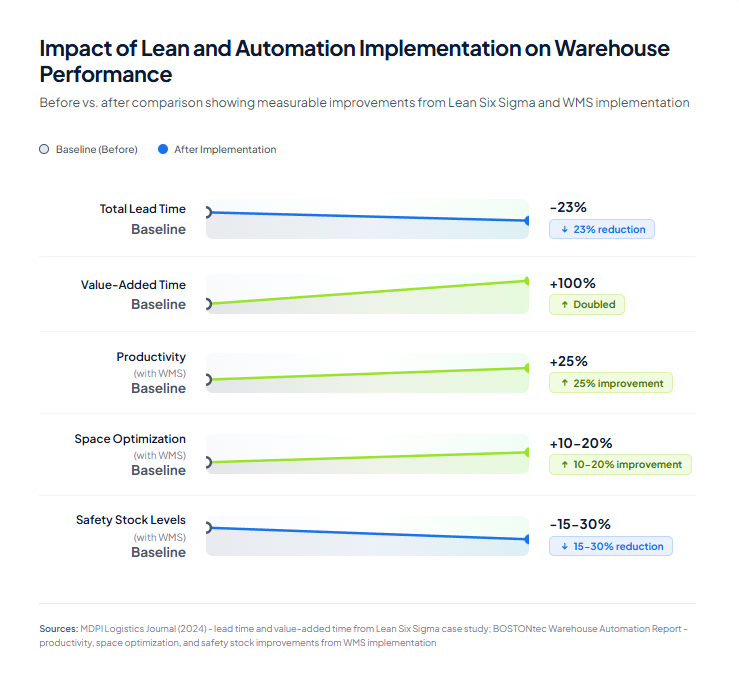
Implementing lean principles delivers measurable improvements across warehouse operations. A 2024 case study published in the journal Logistics found that an e-commerce warehouse applying Lean Six Sigma tools achieved a 23% reduction in total lead time and doubled its value-added time.
These results reflect broader patterns seen across facilities that commit to lean methodology. Organizations typically report gains in six key areas:
- Reduced operating costs. Eliminating wasted motion and streamlined processes directly cut labor expenses, the largest cost category for most warehouses.
- Faster order fulfillment. Organized workspaces and standardized processes reduce the time required to locate, pick, and pack items.
- Improved inventory accuracy. Systematic organization and regular audits minimize stock discrepancies and reduce shrinkage.
- Better space usage. Warehouse space optimization through removing unnecessary items and organizing the remaining inventory frees up floor space without requiring facility expansion.
- Higher employee retention. Workers in clean, organized environments with clear procedures report higher job satisfaction and lower burnout rates.
- Increased safety. Uncluttered aisles and designated storage areas reduce accident risks and injury rates.
5S Principles of Lean Warehousing
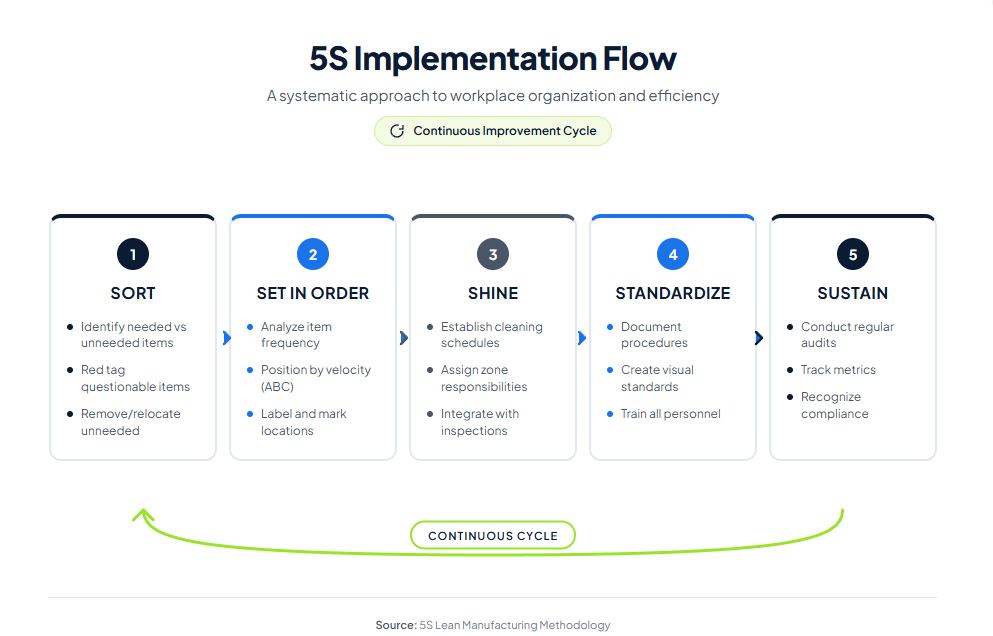
The 5S system forms the foundation of lean warehousing. Originally developed at Toyota, the framework uses five Japanese terms – Seiri, Seiton, Seiso, Seiketsu, and Shitsuke – to guide workplace organization. Each principle builds on the previous one to create a sustainable system for maintaining warehouse efficiency.
#1. Sort (Seiri)
Sorting requires examining every item in the warehouse to determine whether it still serves its current purpose. Tools, equipment, obsolete inventory, and accumulated materials all need evaluation.
The process starts with defining criteria for what stays and what goes. Items in active use remain in place. Items used infrequently are moved to secondary storage. Items with no foreseeable use get removed entirely: sold, donated, recycled, or discarded.
Red tagging is a common sorting technique. Workers attach red tags to questionable items, including the date and a brief description. If no one claims or uses the item within a set period (typically 30 days), it gets removed. This approach prevents hasty decisions while still clearing clutter.
Sorting often reveals surprising amounts of unused equipment. One manufacturing facility discovered a $100,000 nitrogen system that hadn't been used in years – the connecting pipes had been cut, and the machine was covered in dust. Sorting creates both space savings and potential asset recovery.
#2. Set in Order (Seiton)
Once unnecessary items are removed, the remaining materials need to be arranged logically. The goal is to place everything where it can be accessed with minimum motion and time.
Frequency of use drives placement decisions. High-velocity items belong in prime picking locations, typically at waist height near packing stations. Slow-moving stock moves to less accessible areas. Items frequently picked together should be stored adjacent to each other to improve kitting and assembly efficiency.
Visual management supports the system. Floor markings define zones for specific activities. Shadow boards outline where each tool belongs. Labels identify the contents of bins, shelves, and storage areas. The standard is that anyone should be able to find any item within 30 seconds.
ABC analysis provides the analytical framework. A-items (highest velocity, typically 20% of SKUs generating 80% of picks) get premium placement. B-items occupy middle-tier locations. C-items (slow movers) go to harder-to-reach storage. This arrangement minimizes travel time for most picks.
#3. Shine (Seiso)
Shine goes beyond basic cleaning to encompass regular maintenance and inspection. The principle recognizes that dirt and disorder mask problems while creating safety hazards.
Daily cleaning routines become part of standard work. Workers clean their areas at shift end, inspecting equipment for damage or wear. Spills get addressed immediately rather than worked around. Floors, racks, and equipment receive regular attention.
The deeper purpose is preventive. Cleaning forces close observation of equipment and work areas. A machine leaking fluid gets noticed during cleaning before it fails during operations. Damaged racking gets flagged before it collapses. Maintaining cleanliness creates early warning systems for larger problems.
Cleaning responsibilities should be clearly assigned. Maps showing who maintains which zones prevent coverage gaps. Schedules ensure all areas receive attention. Checklists document completion and identify recurring issues.
#4. Standardize (Seiketsu)
Standardizing converts the first three S's from one-time activities into consistent practice. Without standardization, organized areas gradually return to disorder as old habits resurface.
Standard Operating Procedures (SOPs) document how tasks should be performed. These include cleaning routines, organization methods, and maintenance schedules. Written procedures ensure consistency across shifts and provide new employees with training materials.
Visual standards reinforce written procedures. Photos showing the correct state of work areas serve as references. Color-coding systems identify storage zones, equipment types, or product categories. Floor markings delineate walkways, staging areas, and equipment positions.
Consistency matters more than perfection. The same procedures applied across all areas and shifts create predictability. Workers moving between zones know what to expect. Supervisors can quickly identify deviations from standards.
#5. Sustain (Shitsuke)
Sustaining keeps the system functioning long-term. This phase requires ongoing discipline and regular reinforcement of established practices.
Audits provide accountability. Regular inspections using standardized checklists measure adherence to 5S standards. Scores track progress over time and identify areas needing attention. Publishing results creates transparency and healthy competition between zones or shifts.
Management involvement signals importance. Leaders walking the floor, participating in audits, and recognizing improvements demonstrate organizational commitment. Conversely, managers who ignore 5S violations communicate that standards don't matter.
Continuous improvement keeps the system fresh. Each audit cycle should identify opportunities for refinement. Procedures evolve as operations change. The goal isn't maintaining a static state but continuously improving organization and efficiency.
7 Best Practices for Implementing Lean Warehousing
Beyond the foundational 5S framework, specific practices help warehouses capture lean benefits. These strategies address common inefficiencies while building sustainable improvement systems.
#1. Map Your Value Stream
Before changing processes, document current operations from receiving through shipping, including reverse logistics if applicable. Value stream mapping reveals where time and resources are consumed and where waste occurs.
The mapping process traces a single product's path through the warehouse. Each step gets documented with time required, resources used, and distance traveled. Activities are classified as value-adding (directly serving customer needs), necessary but non-value-adding (required by regulations or operations), or pure waste.
Mapping typically shows that value-adding activities account for only a small fraction of total process time. The visual representation makes waste visible and helps prioritize improvement efforts. Focus first on eliminating pure waste, then on streamlining necessary activities.
Update maps after implementing changes to verify improvements and identify the next opportunities. Mapping should become a regular practice, not a one-time exercise.
#2. Reduce Travel Time in Picking
Picker travel represents the largest time sink in most warehouse operations. According to research from the Georgia Tech Supply Chain and Logistics Institute, travel accounts for 55% of a picker's time, while actual picking accounts for just 10%.
Slotting decisions directly impact travel requirements. Position fast-moving items along the most efficient routes. Group items are frequently ordered together in adjacent locations. Place heavy or bulky items near the shipping area to minimize the distance you have to carry them.
Picking methods also affect travel efficiency—wave picking groups orders so pickers can retrieve items for multiple orders in a single pass. Zone picking assigns workers to specific areas, eliminating the need for full-warehouse traversal. Batch picking allows for the retrieval of the same item for multiple orders simultaneously.
Route optimization software calculates the most efficient paths through the warehouse. Without such tools, pickers often revert to intuitive but inefficient patterns. According to warehouse optimization research, AI-powered algorithms can cut travel by 20-50% compared to unoptimized routes. These fulfillment technology trends continue to reshape warehouse operations.
#3. Implement Pull-Based Inventory
Traditional warehouses push inventory based on forecasts, ordering stock in anticipation of demand. This approach often results in excess inventory tying up capital and space, making it harder to reduce inventory waste.
Pull-based systems replenish inventory based on actual consumption. When items leave the warehouse, replenishment orders are triggered. This approach simplifies planning warehouse capacity by keeping stock levels lean while maintaining availability.
Kanban signals provide the mechanism. Physical cards, bins, or electronic triggers indicate when inventory drops below reorder points. The visual nature of Kanban makes stock status immediately apparent; no reports are required to see that a picking location needs replenishment.
Pull systems require reliable suppliers and shorter lead times. Building relationships with vendors who can deliver quickly enables leaner inventory without the risk of stockouts. The trade-off between carrying and logistics costs needs to be evaluated for each product category. Additionally, knowing how to select a 3PL provider with a strong vendor network helps.
#4. Standardize Work Processes
Undefined processes produce variable results. When workers approach tasks differently, quality fluctuates, and efficiency suffers. Standardized work establishes the best current method and ensures everyone follows it. This is fundamental to streamlining fulfillment processes across any operation.
Document the specific steps, sequence, and timing for key processes. Include the tools required, quality checks, and safety precautions. Work instructions should be detailed enough for any trained worker to follow and achieve consistent results.
Time standards set expectations for task completion. These aren't pressure tools; they're baseline measurements used to identify abnormalities. A picker consistently exceeding standard times may indicate a process problem, equipment issue, or training need - not necessarily a performance failure.
Standards require periodic review. As operations evolve, documented procedures should evolve with them. Workers performing the tasks often identify better methods. Capturing these improvements updates standards and spreads best practices across the workforce.
#5. Deploy Visual Management Systems
Visual management makes the state of operations immediately apparent. Anyone walking through the warehouse should be able to identify what's normal, what's abnormal, and where attention is needed.
Floor markings establish clear zones. Different colors designate picking lanes, staging areas, forklift paths, and pedestrian walkways. Painted outlines show where the equipment belongs. Marked locations for inbound and outbound materials prevent confusion.
Status boards display real-time operational information. Order counts, throughput rates, and backlog levels let workers and supervisors see current performance. Problems become visible before they cascade. Daily targets create focus and enable course corrections.
Andon signals indicate when assistance is needed. Lights or electronic alerts let workers summon help without leaving their positions. Problems get addressed immediately rather than identified later during quality checks.
#6. Establish Continuous Improvement Practices
Lean warehousing isn't a project with an end date; it's an ongoing commitment to getting better. Continuous improvement, called Kaizen in Japanese, treats every process as improvable.
Regular improvement events focus teams on specific problems. A dedicated week focused on receiving processes or on addressing picking accuracy issues yields concentrated attention and rapid results. These events build improvement capabilities while solving immediate problems.
Daily problem-solving addresses issues as they arise. Workers who encounter obstacles should have channels to report them and see responses. Small, quick fixes often prevent larger problems later.
Metrics drive improvement priorities. Use supply chain data analytics to track key performance indicators, including throughput, accuracy, inventory turns, and labor productivity. Declining metrics signal areas needing attention. Improving metrics validates that changes are working.
#7. Invest in Workforce Development
Lean warehousing counts on engaged employees who understand and support improvement efforts. Training and involvement convert workers from passive participants to active problem-solvers.
Cross-training builds flexibility. Workers who can perform multiple functions can shift to where they're needed most. This flexibility reduces bottlenecks and supports seasonal demand management, even during absences or volume surges. Partnering with seasonal 3PL services provides additional surge capacity when needed.
Involvement in improvement activities builds ownership. Workers who help identify problems and design solutions become invested in making those solutions work. Their front-line perspective often reveals issues invisible to management.
Moreover, recognition reinforces desired behaviors. Acknowledging workers who identify problems, suggest improvements, or maintain excellent standards encourages continued engagement. Recognition doesn't require monetary rewards; public acknowledgment of contributions often proves more motivating.
Frequently Asked Questions
#1. How long does it take to implement lean warehousing?
Initial 5S implementation typically requires two to four weeks for a full facility audit, sorting, and reorganization. However, lean warehousing is an ongoing practice rather than a one-time project. Most organizations see measurable improvements within three months. Sustained benefits require continuous attention to standards and regular improvement activities.
#2. What is the difference between lean warehousing and traditional warehouse management?
Traditional warehouse management often prioritizes fixed processes and may not focus on continuous waste reduction. Lean warehousing emphasizes identifying and eliminating non-value-adding activities, involving employees in improvement efforts, and maintaining systematic organization through the 5S methodology. The approach treats efficiency as an ongoing pursuit rather than a static achievement.
#3. Can small warehouses benefit from lean principles?
Small warehouses often see proportionally larger benefits from lean implementation. Limited space makes organization more critical, and smaller teams can implement changes quickly. The 5S methodology requires no capital investment, just disciplined application of sorting, organizing, cleaning, standardizing, and sustaining practices. Small operations can often complete initial implementation in days rather than weeks.
#4. How do you measure lean warehousing success?
Key performance indicators include order-picking accuracy, throughput (orders or units per hour), inventory accuracy, and labor productivity. Travel distance per pick and order cycle time specifically measures lean improvements. Track these metrics before implementation to establish baselines, then monitor trends after changes. Declining metrics in any area signal the need for attention.
#5. What role does technology play in lean warehousing?
Technology supports lean principles but doesn't replace them. Warehouse Management Systems (WMS) provide visibility into operations and can direct efficient picking routes. Barcode scanning and RFID reduce errors in inventory tracking. However, applying technology to wasteful processes often just automates waste more quickly. Lean principles should guide process design, with technology enabling execution of well-designed workflows.
#6. How do you maintain lean standards during peak seasons?
Peak periods test lean systems but also demonstrate their value. Documented standard procedures enable rapid training of temporary workers. Visual management helps new staff navigate efficiently. Maintaining 5S discipline during busy periods requires extra attention; brief daily audits catch degradation before it spreads. Organizations that maintain lean standards during peaks typically outperform those that abandon discipline under pressure.
Key Takeaways
- Lean warehousing applies Toyota Production System principles to distribution operations to eliminate waste across receiving, storage, picking, packing, and shipping.
- Labor costs account for 50-70% of warehouse operating expenses, with order picking alone accounting for 50-55% of total operational costs, making efficiency improvements directly impact profitability.
- The 5S methodology, Sort, Set in Order, Shine, Standardize, Sustain, provides the foundation for organized, efficient warehouse operations.
- Picker travel time accounts for 55% of order picking, making slotting optimization and route planning high-value targets for improvement.
- Pull-based inventory systems and Kanban signals reduce carrying costs while maintaining stock availability.
- Visual management makes operational status immediately apparent, enabling faster problem identification and resolution.
- Continuous improvement practices treat lean warehousing as an ongoing discipline rather than a one-time project.
- Employee training and involvement convert workers into active participants in efficiency improvements.
20 Years of Kitting Excellence
Ready to Streamline Your Supply Chain?
Join industry leaders achieving 99%+ SLA performance with flexible kitting, fulfillment, and 3PL solutions.
Get in Touch