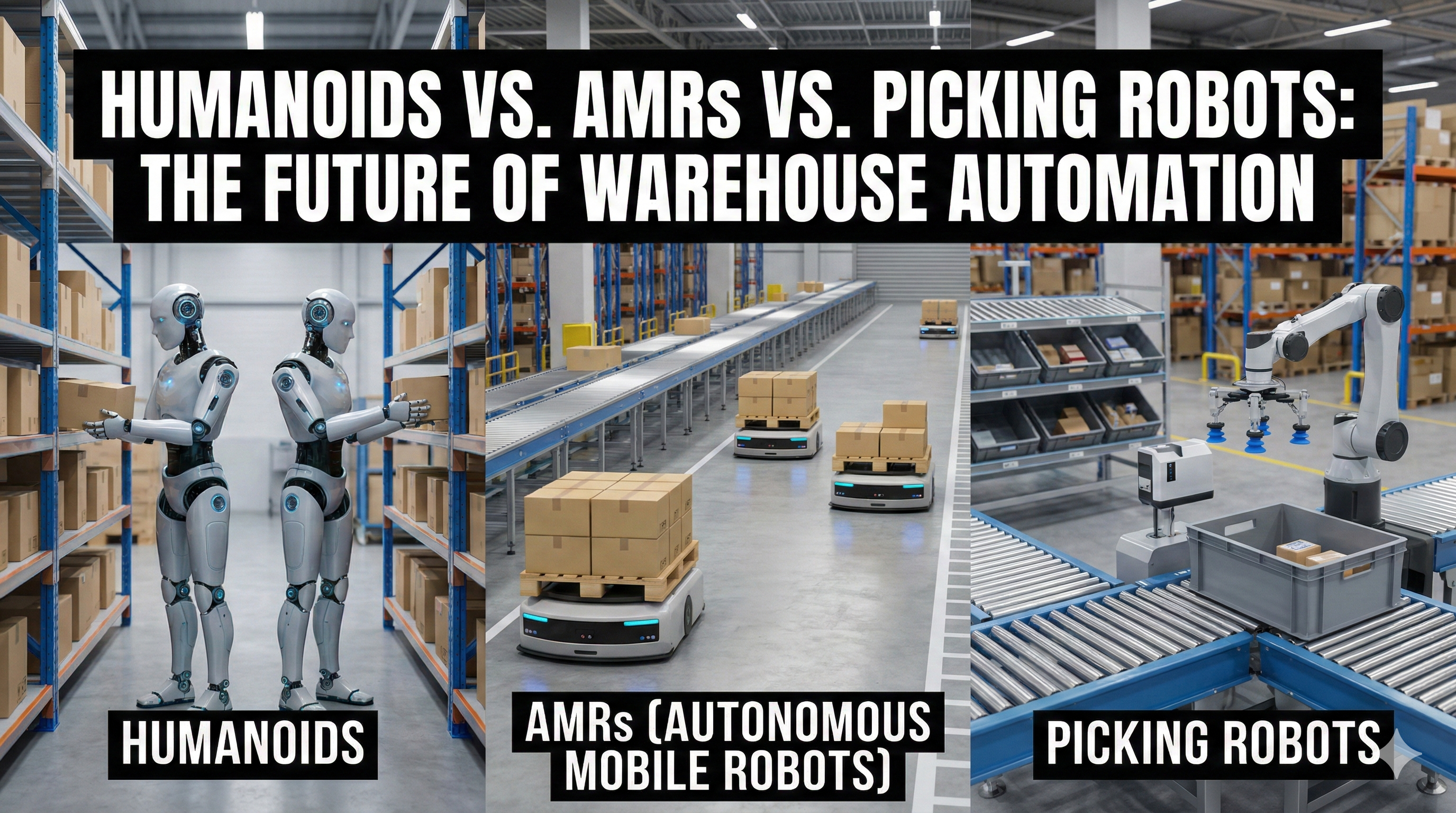
If you run a 3PL or manage fulfillment operations, you've been hearing about warehouse automation for years — conveyors, AS/RS systems, autonomous mobile robots (AMRs), robotic arms, goods-to-person systems. Now humanoid robots are entering the conversation. Naturally, the question becomes: how do they compare, and where does each type fit?
After two decades of operating warehouse environments and deploying automation across our facilities, here's how we think about it.
The Core Distinction: Fixed vs. Flexible
Traditional warehouse automation excels when the task is predictable and the environment is controlled.
A conveyor system moves packages along a fixed path. An AS/RS stores and retrieves standard containers in a defined grid. A robotic arm picks items of a known shape, weight, and location and places them in a known destination. These systems are fast, reliable, and efficient — for the specific task they were designed to handle.
The tradeoff is rigidity. Installing a conveyor system means committing to that workflow. Reconfiguring an AS/RS for a different product mix is a capital project. A robotic arm programmed for one pick sequence needs reprogramming for another.
Humanoid robots approach the problem differently. They're designed to operate in environments built for humans — walking through aisles, reaching shelves, manipulating objects with hands that approximate human dexterity. The promise is flexibility: one robot that can move totes today, pick orders tomorrow, and load a trailer next week.
That promise is partly real and partly aspirational, and the distinction matters.
Side-by-Side: Where Each Technology Wins
High-volume, low-variability tasks → Traditional automation wins. If you're processing thousands of identical orders per hour — same box, same product, same destination — a goods-to-person system or automated sortation line will outperform any humanoid robot by an order of magnitude. Speed and throughput density aren't close.
Heavy material movement → AMRs and AGVs win (for now). Autonomous mobile robots and automated guided vehicles can carry 1,000+ pounds at consistent speeds without fatigue. Current humanoid robots max out around 20-30 pounds of payload capacity. For pallet transport, bulk material movement, and heavy case handling, wheeled robots are the practical choice.
Structured picking in controlled environments → Robotic arms win. A six-axis robotic arm with machine vision can pick standard items from a bin faster and more accurately than a humanoid robot in a controlled station. If the items are known, the station is fixed, and the volume is high, dedicated picking arms are the right tool.
Variable tasks in human-designed spaces → Humanoid robots have the edge. This is the gap humanoid robots fill. When the work changes daily — different product configurations, different packaging, different destinations — and the environment is a standard warehouse with shelving, workstations, and aisles, humanoid robots offer something no fixed automation can: adaptability without infrastructure changes.
At our Dallas facility, we run eight distinct task categories on the same floor. Product configurations change hourly. Seasonal programs launch and wind down on short notice. A kitting line that runs subscription boxes in the morning might build retail displays in the afternoon. No amount of fixed automation handles that variability. Human workers do. And increasingly, humanoid robots from partners like Avatar Robotics will augment them.
Tasks requiring fine manipulation and judgment → Humans still win. Building retail displays from corrugate, inspecting cosmetic product quality, managing exception orders — these require a combination of dexterity, visual judgment, and contextual understanding that neither traditional automation nor humanoid robots can match today.
The Real Comparison: Total Cost of Deployment
The cost conversation is more nuanced than "robot vs. human wage."
Traditional automation requires significant upfront capital — conveyor installations run six to seven figures, AS/RS systems can exceed $10 million — plus ongoing maintenance, the physical footprint they consume, and the opportunity cost of committing to a fixed workflow. If your business changes, the automation may not change with it.
Humanoid robots have lower infrastructure costs (no custom installations, no facility modifications) but higher per-unit costs ($50,000-$100,000 per robot at current pricing) and are still limited in capability. The economic case improves as the robots get more capable and the per-unit cost drops — which is happening fast.
Cobots (collaborative robots like the ones we run from Blue Sky Robotics) sit in a sweet spot: moderate capital cost, good flexibility for manipulation tasks, and designed from the ground up to work alongside humans safely. They're a strong bridge technology between traditional automation and full humanoid deployment.
AMRs handle transport: moderate capital cost, good flexibility for moving materials, limited manipulation capability. They're a strong complement to either approach.
For a 3PL like Productiv, the calculus is unique. We serve brands with complex, variable, high-mix fulfillment needs. Fixed automation works for portions of our operation — we use conveyor systems, automated packaging equipment, and scanning systems extensively. But the core value we deliver — kitting variable configurations, building displays, managing seasonal surges, adapting to hourly changes — requires human-level flexibility.
That's exactly the gap humanoid robots are targeting. Not replacing our conveyors or our AMRs, but augmenting our workforce on the tasks that require adaptability. We break down what that looks like on our own floor in our overview of humanoid robotics in 3PL warehouses.
How These Technologies Work Together
The future isn't humanoid robots OR traditional automation. It's both, orchestrated by software.
Picture a fulfillment center where: An AS/RS handles storage and retrieval of standard inventory. AMRs transport totes and cases between zones. Robotic arms handle high-speed, standardized picking stations. Cobots from Blue Sky Robotics assist with repetitive pick-and-place. Humanoid robots from Avatar Robotics work alongside humans on variable kitting, display building, and complex order assembly. And a software orchestration layer routes work to the right resource — human, humanoid, cobot, or machine — based on task complexity, urgency, and current capacity.
This is the architecture we're building toward with ProVantage, our agentic software platform. It already manages task assignment and performance monitoring across our human workforce. As we deploy more robotic systems, ProVantage becomes the layer that coordinates everything — treating humans, cobots, humanoid robots, and traditional automation as a unified resource pool.
The 3PLs that get this right won't be the ones that bet everything on one technology. They'll be the ones that build the orchestration capability to use each technology where it performs best.
What This Means for Your 3PL Decision
If you're evaluating 3PL partners, automation capability is increasingly a factor. Here's how to think about it:
Don't be impressed by a single technology. A 3PL with a flashy robot demo but no data infrastructure, no process engineering, and no orchestration software isn't ready for mixed automation. Ask about the system, not the shiny object.
Look for process engineering discipline. The 3PLs that will integrate automation most effectively are the ones already engineering their operations — documenting processes, measuring cycle times, capturing data, and continuously improving. That discipline doesn't appear when you buy a robot. It has to already be there.
Ask about flexibility. If your product mix changes seasonally, if your SKU count is growing, if you need kitting and value-added services alongside standard fulfillment — you need a partner that can handle variability. That means human workers augmented by flexible automation, not a fixed automation line that handles one workflow.
We've spent twenty years building operations that deliver exactly this: enterprise-scale capability with the agility to handle complexity, variability, and change. The automation we're deploying — cobots, humanoid systems, traditional equipment, all orchestrated by ProVantage — is an extension of that same principle. The technology changes. The operational discipline doesn't.
Key Takeaways
- →Traditional automation wins on high-volume, low-variability tasks. Humanoid robots win on flexible, variable-product tasks in human-designed spaces.
- →AMRs outperform humanoid robots for heavy material transport (1,000+ lb capacity vs. 20–30 lb for current humanoids). Use both.
- →Cobots are the practical bridge: moderate cost, good flexibility for manipulation tasks, designed to work alongside humans safely.
- →The future isn't humanoid robots OR traditional automation — it's all of the above, orchestrated by software that routes work to the right resource.
- →Fixed automation requires large upfront capital ($10M+ for AS/RS) and locks in a workflow. Humanoids require software investment but adapt to change.
Frequently Asked Questions
What is the difference between humanoid robots and traditional warehouse automation?
Traditional warehouse automation (conveyors, AS/RS, robotic arms, AMRs) excels at high-volume, predictable, controlled tasks — but requires custom infrastructure and locks in a specific workflow. Humanoid robots are bipedal systems designed to operate in existing human-built environments without infrastructure changes. They offer flexibility for variable tasks but at lower speed and higher per-unit cost than purpose-built automation. The key distinction: traditional automation optimizes a specific workflow; humanoid robots adapt to changing workflows.
Should I invest in humanoid robots or AMRs for my warehouse?
It depends on the task. AMRs are the right choice for material transport — moving totes, cases, and pallets between locations. They carry 1,000+ pounds at consistent speeds and are proven technology. Current humanoid robots max out at 20–30 pounds payload capacity and are slower at pure transport. Humanoid robots are the right choice for variable manipulation tasks — picking from diverse shelf locations, handling irregular items, performing kitting or assembly work that changes frequently. For most operations, the answer is both.
What can AMRs do that humanoid robots cannot?
AMRs significantly outperform humanoid robots on heavy-payload transport (1,000+ lb vs. 20–30 lb), sustained high-speed movement across large floor areas, and cost-per-mile for material movement. AMRs are also more mature technology with proven reliability at scale. Humanoid robots outperform AMRs on manipulation tasks — picking, placing, sorting, and handling items that require hands.
How much does traditional warehouse automation cost compared to humanoid robots?
Traditional automation costs vary widely: conveyor systems run six to seven figures, AS/RS systems can exceed $10 million, and robotic picking systems typically run $500,000–$5 million depending on scale. These costs include facility modifications and are largely fixed once installed. Humanoid robots currently cost $50,000–$100,000 per unit with no facility modification required — lower capital threshold but higher per-unit cost for scale. Traditional automation typically has faster ROI for high-volume standardized operations; humanoid robots have better economics for variable, high-mix operations.
What is a cobot and how does it compare to a humanoid robot?
Cobots (collaborative robots) are purpose-designed to work alongside humans safely at a fixed workstation — typically for manipulation tasks like pick-and-place, assembly assist, or inspection. They're lower cost ($30,000–$80,000 typically), highly reliable, and proven for structured repetitive tasks. Humanoid robots are general-purpose bipedal systems designed for multiple task types in flexible environments. Cobots are the right choice when the task is defined and the workstation is fixed. Humanoid robots are the right choice when the task variety or environment flexibility makes a fixed-station approach impractical.
Which warehouse tasks are best suited for humanoid robots vs. fixed automation?
Fixed automation wins for: high-volume standardized order picking, palletized storage/retrieval (AS/RS), sortation, and anything with predictable product dimensions and high throughput requirements. Humanoid robots win for: variable product handling in high-mix environments, tasks that change frequently (seasonal programs, custom kitting), work in spaces that weren't designed for automation, and roles that currently require human adaptability but not human judgment. The line shifts as humanoid capability improves.
Can humanoid robots replace conveyor systems in a warehouse?
No — and they're not designed to. Conveyor systems move thousands of packages per hour with near-perfect reliability at very low per-unit cost. No humanoid robot approaches that throughput for high-volume, linear transport tasks. The right model is orchestration: conveyors handle high-speed throughput; AMRs handle flexible transport; humanoid robots handle variable manipulation; cobots handle structured assembly. Software routes work to the appropriate resource.
What warehouse automation works best alongside humanoid robots?
Humanoid robots are most effective when paired with: WMS/orchestration software (to route tasks and monitor performance), AMRs (for material transport between zones), conveyor systems (for high-throughput linear movement), and cobots (for structured manipulation alongside humanoids on variable assembly lines). The integrated architecture — where each automation type handles what it's best at, coordinated by software — outperforms any single technology deployed in isolation.
How do I evaluate warehouse automation options for my operation?
Start with task analysis: what are your highest-volume, most consistent tasks (candidates for traditional automation) vs. your highest-variability, most complex tasks (candidates for humanoid/cobot augmentation)? Then evaluate: current labor cost and turnover in each role, capital budget and payback requirements, operational flexibility needs (do your product mix and workflow change frequently?), and data infrastructure maturity. Operations running on tribal knowledge and undocumented processes should fix the foundation before investing in any automation.
What is the fastest-growing type of warehouse automation?
Humanoid robotics is the fastest-growing segment by investment — over $5 billion deployed since 2024 — though it's starting from a small commercial base. AMRs remain the largest deployed category by unit count. AI-powered orchestration software (managing mixed human-machine teams) is growing fastest in software. IDTechEx projects warehousing and logistics will be the second-largest adopter of humanoid robots over the next decade, trailing only automotive.
20 Years of Kitting Excellence
Ready to Streamline Your Supply Chain?
Join industry leaders achieving 99%+ SLA performance with flexible kitting, fulfillment, and 3PL solutions.
Get in Touch