Personalization has moved from a premium add-on to a brand expectation. Brands offering embroidered merchandise, custom-printed packaging, handwritten notes, and gift wrapping are no longer doing something special — they're keeping pace with what enterprise buyers and consumers expect from a premium fulfillment experience.
The operational problem: most 3PLs treat personalization as a special project. They'll say yes, run it once under a separate SOW, and treat it as an exception to normal workflow. That works for a pilot. It breaks down at scale.
Enterprise brands running personalization programs — thousands of orders per week, variable customer data driving each note or label, embroidery integrated into the pack-out flow — need a 3PL that engineers personalization as a production capability, not a favor.
This guide covers what that actually looks like: the five capabilities, how they're operated at scale, and what to ask when evaluating whether your 3PL can handle it.
What "Personalized Fulfillment" Actually Means at Scale
There's a meaningful difference between a 3PL that can personalize an order and a 3PL that runs personalization as a program.
Ad-hoc personalization means the operations team sets up a special station when the request comes in, trains whoever's available, and figures out QC on the fly. The result is inconsistent — good enough for 50 units, not good enough for 5,000.
Production-grade personalization means:
- A dedicated work cell with defined operator roles and cycle times
- Variable data input — customer name, message, tier — flowing from your order management system to the pick list without manual transcription
- QC checkpoints at each personalization step, not just at pack-out
- Material inventory management: embroidery thread, printed card stock, wrap tissue, ribbon — all tracked and reordered automatically
- Throughput targets that match your standard SLA, not a separate "personalization window"
The threshold where this distinction matters is roughly 500+ personalized orders per month. Below that, most 3PLs can manage it reactively. Above it, you need an engineered program or throughput will drag and error rates will climb.
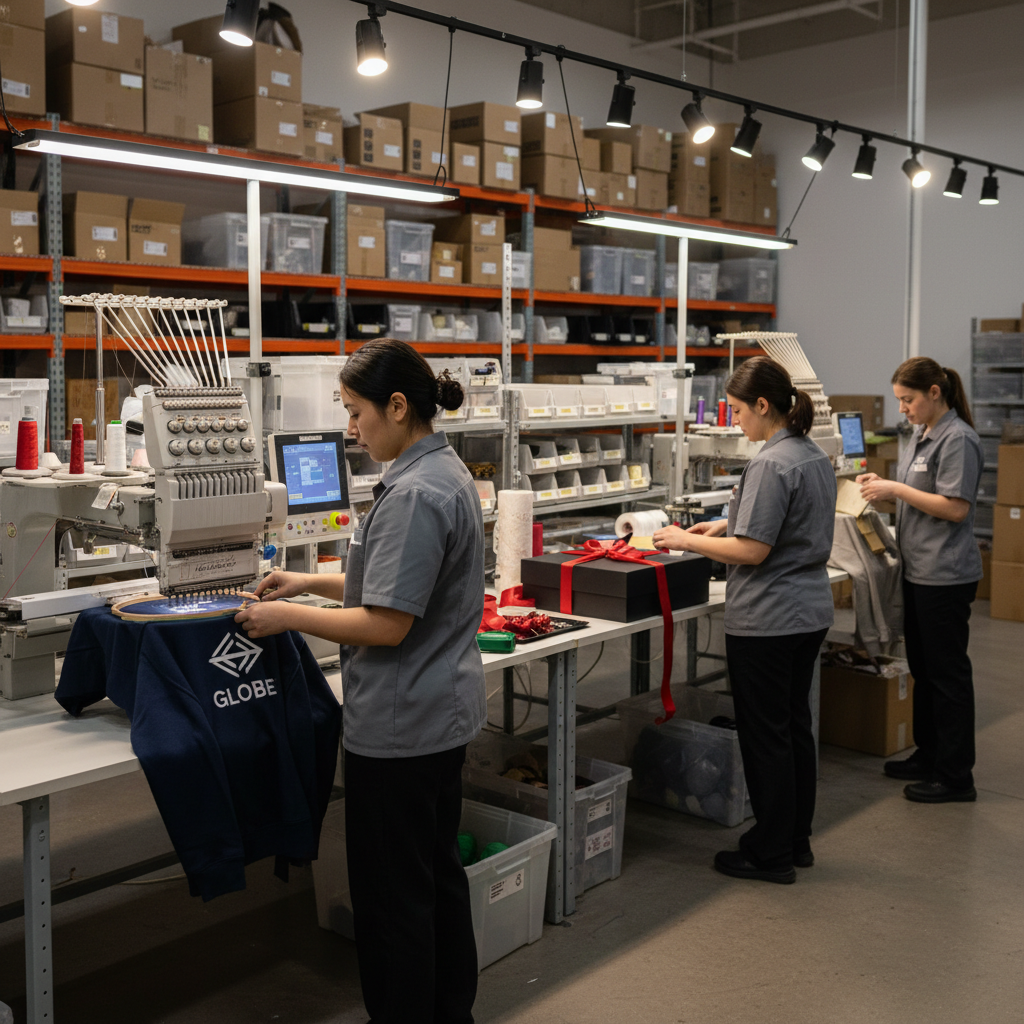
The Five Capabilities in a Production Personalization Program
1. Custom Embroidery
Embroidery at scale requires digitized design files, calibrated machines, and trained operators who can catch needle breaks and thread tension issues before they produce 200 mis-stitched units. At the production level, embroidery is integrated into the kitting flow — items arrive at the embroidery station pre-sorted by order, are completed in batches, and rejoin the pack-out line with scan verification confirming the right design landed on the right item.
Key production requirements: design file library with version control, machine setup sheets per SKU, per-item inspection before downstream steps, rejection rate tracking by design and operator.
2. Screen Printing and Direct Printing
Screen printing suits high-volume runs of a single design. Direct-to-garment or direct-to-surface printing suits shorter runs with variable designs — customer names, batch codes, personalized graphics. Both require color management protocols to ensure brand consistency across runs, especially when the same printed item ships alongside embroidered items in a single gift set.
Production requirement: print quality standards documentation with visual reference samples, spot-check frequency by run length, and dedicated staging area to avoid wet-print contamination of adjacent items.
3. Personalized Notes and Variable Inserts
Handwritten-style notes and personalized inserts are operationally straightforward but fail at scale when the data flow breaks. The common failure mode: order data lives in your ecommerce platform, but the 3PL's WMS doesn't receive the customer message field — so operators transcribe from a spreadsheet, introduce errors, and create a QC nightmare.
The right setup: variable data prints directly to card stock at the pack station from WMS-driven order detail, eliminating manual transcription entirely. Each card is scan-verified against the order before insertion. For true handwritten notes, the same data-driven approach applies — the note content, tone tier (formal vs. warm), and any personalization fields are defined in the order and executed against a documented writing guide.
4. Gift Wrapping
Gift wrapping sounds simple until you're doing 2,000 orders in a holiday week with three wrap configurations (standard, premium, luxury) driven by customer selection at checkout. The operational challenge is materials management and station layout: wrap paper, ribbon, tissue, and boxes in four sizes need to be within arm's reach of the wrap station with inventory counts that trigger reorder before a mid-shift stockout kills throughput.
Production-grade gift wrapping also includes QC on presentation — not just function. Enterprise brands running gift programs care whether the wrap looks consistent across 10,000 units. That requires a visual standard, a photo reference, and a supervisor sign-off cadence.
5. Full Branded Unboxing
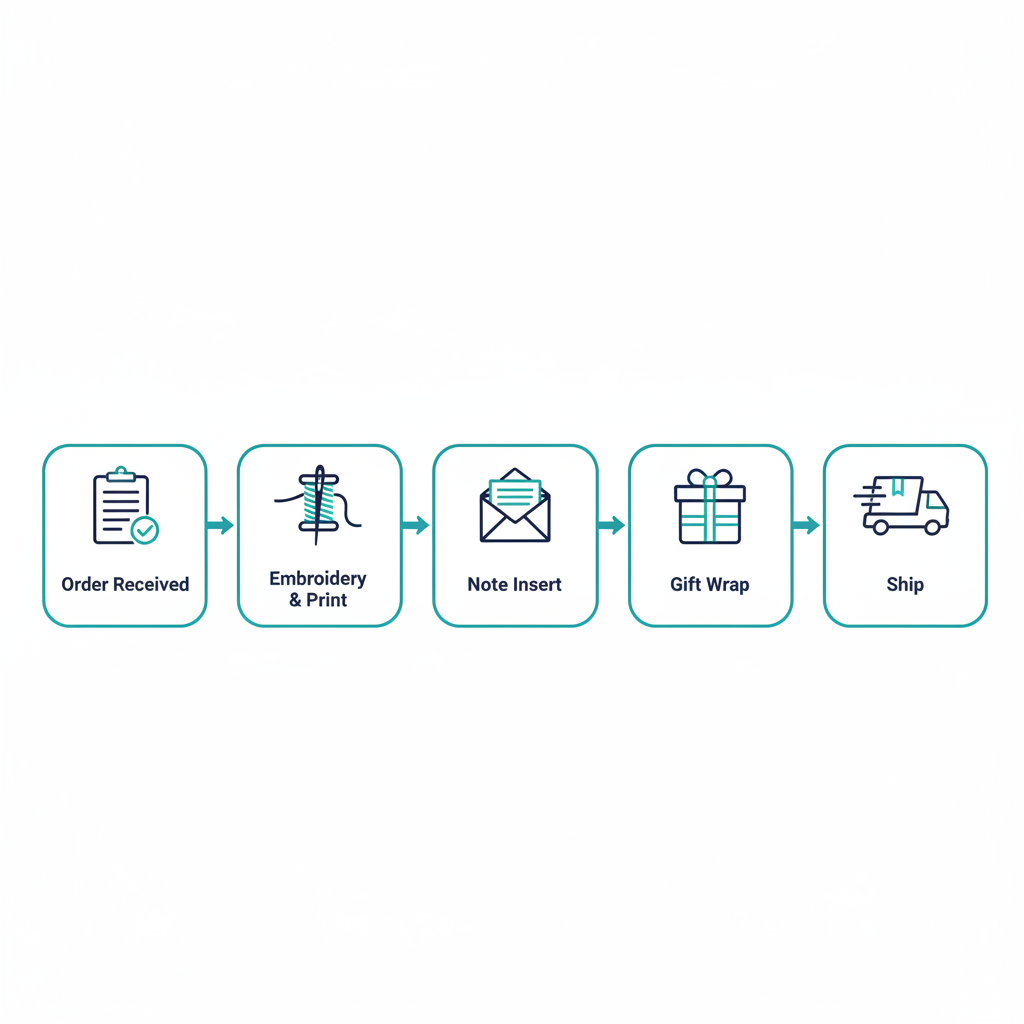
The highest-complexity personalization program combines all of the above: embroidered item, printed tissue, personalized note, gift wrap, and branded outer packaging — assembled in a defined sequence with scan verification at each step. A major coffee and retail brand running this program through Productiv executes this across high-volume gifting programs with consistent presentation standards across every unit shipped.
At this level, the program needs a dedicated work cell design, a documented assembly sequence (wrong order = rework), and throughput modeling to confirm the cell meets SLA before the program goes live.
How Throughput Works With Hand-Touch Steps
The instinct is to treat personalization steps as add-ons to standard fulfillment — finish the normal pick-pack, then add the personalization at the end. That's wrong. It creates a bottleneck at the personalization step that can't be cleared without staging large WIP piles, which introduces mix-up risk.
The right model is to integrate personalization into the fulfillment cell as a defined station with its own cycle time. If embroidery takes 4 minutes per item and your standard pack rate is 90 seconds, you need either parallel embroidery machines or a separate batch-and-rejoin flow where embroidery runs ahead of pack-out.
Cell design determines whether personalization programs are profitable. Productiv engineers these cells before launch — not after the first bad week — modeling the cycle time per personalization type against the expected order mix to set staffing and station count.
What Separates Enterprise Personalization From Ad-Hoc
Five things distinguish a production-grade personalization program from a 3PL that "can do" personalization:
- Documented SOPs per capability — embroidery, printing, wrapping, and note insertion each have their own procedure, not a general "personalization guide"
- Variable data integration — customer personalization data flows from your OMS to the 3PL's WMS without manual steps
- Material BOM management — every consumable (thread, card stock, ribbon, tissue) is tracked against orders and reordered on a defined trigger, not when someone notices the shelf is empty
- Per-step QC — quality checks happen at each personalization touchpoint, not only at final pack-out
- KPI tracking — personalization error rate, rework rate, and throughput per station are measured and reported separately from standard fulfillment metrics
Five Questions to Ask Your 3PL
Before committing a personalization program to a 3PL, ask these:
- Can your WMS receive and print variable customer data at the pack station? If not, your note and insert personalization will require manual transcription — and errors will follow.
- How do you model cycle time for personalization steps before a program launches? A 3PL that hasn't done this before will guess. You'll pay for the wrong guess in your first peak week.
- What's your material BOM process for consumables like embroidery thread, ribbon, and card stock? If the answer is "we'll figure it out," that's a stockout risk.
- Can you show me a QC checkpoint flow for an embroidery or gift wrap program? Ask for a real one from a live client, not a theoretical answer.
- How do you handle rework when personalization errors are caught downstream? The rework process reveals how mature the program is.
Frequently Asked Questions
What is personalized fulfillment?
Personalized fulfillment is a 3PL service where individual orders receive custom treatment based on customer data — embroidered names or logos, custom-printed packaging or inserts, handwritten-style personalized notes, gift wrapping, or a combination of all four. It goes beyond standard pick-and-pack by integrating variable data and hand-touch operations into the fulfillment workflow for each order.
Can a 3PL handle embroidery and screen printing?
Some 3PLs offer embroidery and screen printing as part of their value-added services. The key distinction is whether these are run as production operations with dedicated equipment, trained operators, and documented QC procedures — or as occasional special projects. Enterprise brands with recurring personalization volume need the former. At Productiv, embroidery and printing are integrated into kitting and fulfillment workflows, not handled as separate requests.
How do personalized notes get added to orders at scale?
In a production-grade personalization program, customer message data flows from the brand's order management system to the 3PL's WMS, which prints the note content directly at the pack station. This eliminates manual transcription. For true handwritten notes, the same data feeds an operator workstation where the note content, format, and personalization fields are pre-populated — the operator executes against a consistent writing guide rather than interpreting free-form data.
What is the minimum order volume for a personalized fulfillment program?
Most 3PLs can handle personalization requests below 500 orders per month on an ad-hoc basis. At 500+ monthly personalized orders, the economics and quality consistency favor building a dedicated production program with its own cell design, staffing, and QC flow. Enterprise brands running gift programs or subscription boxes with variable personalization typically exceed this threshold quickly.
How does gift wrapping work in a 3PL fulfillment environment?
Gift wrapping at a 3PL is run as a defined station in the fulfillment cell. Orders flagged for gift wrap route to the wrap station after picking, where operators execute a documented wrapping procedure (fold sequence, ribbon placement, tissue layering) against a visual quality standard. Material inventory — wrap paper, ribbon, tissue, boxes — is tracked against expected order volume and reordered before stockout. Wrap configuration (standard, premium, luxury) is driven by customer selection at checkout and flows through order data to the station.
What's the difference between personalized fulfillment and standard kitting?
Standard kitting combines fixed components into a defined unit — the same kit for every order. Personalized fulfillment uses variable data to make each order different: a different name on the embroidery, a different message on the insert, a different wrap tier based on customer selection. This variable data dependency is what makes personalization operationally more complex than kitting, and why the WMS integration and data flow matter as much as the physical execution.
Which types of brands need personalized fulfillment?
Enterprise brands most commonly running personalized fulfillment programs include: retail and hospitality brands with gifting programs (branded merchandise, seasonal gift sets), subscription box brands offering customization by subscriber tier, direct-to-consumer brands using personalization as a retention driver, and corporate gifting programs where branded, embroidered, or printed items ship to employee or client lists. The common thread is a recurring program with defined personalization rules — not one-off custom orders.
20 Years of Kitting Excellence
Ready to Streamline Your Supply Chain?
Join industry leaders achieving 99%+ SLA performance with flexible kitting, fulfillment, and 3PL solutions.
Get in Touch