
9 Essential Tips for Reducing Warehouse Operational Costs
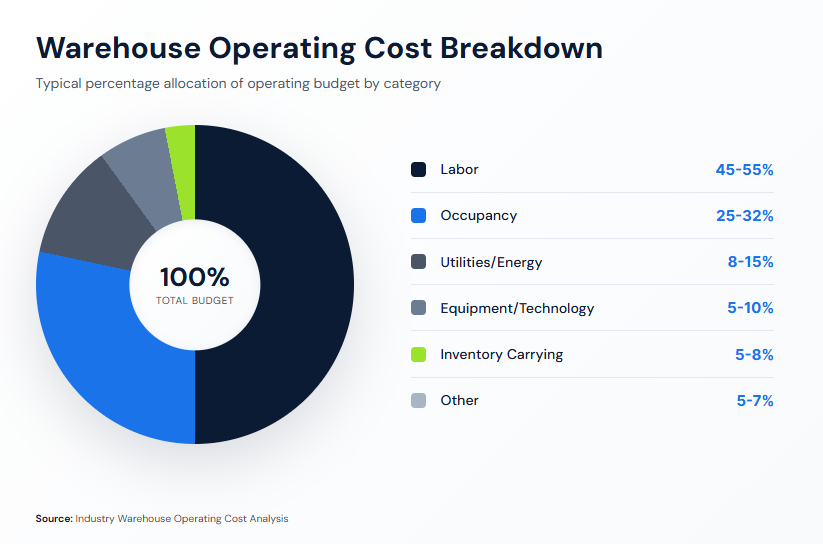
Warehouse costs are eating into your margins. Labor expenses alone account for 45-55% of your operating budget, and with hourly wages rising 7.4% year-over-year, the pressure keeps building.
The difference between profitable operations and struggling facilities often comes down to cost management.
This article provides nine practical strategies for reducing warehouse operational costs without sacrificing performance.
6 Most Common Warehouse Costs
Understanding where your money goes is the first step toward controlling expenses. These six cost categories make up the bulk of warehouse operating budgets:
- Labor costs. Wages, benefits, training, and overtime for warehouse staff. This category includes direct labor (picking, packing, shipping) and indirect labor (supervision, maintenance, administration). Optimizing your warehouse pick rate directly impacts this expense. According to the 2024 Warehousing and Fulfillment Costs Survey, personnel expenses accounted for approximately 28.59% of total warehouse revenue.
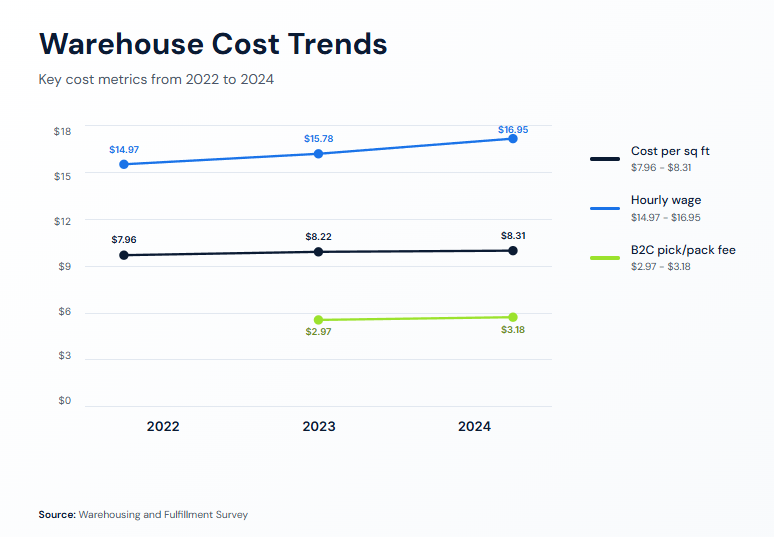
- Occupancy costs. Rent or mortgage payments, property taxes, insurance, and building maintenance. The cost per square foot of warehouse space increased to $8.31 in 2024, up from $7.96 in 2022, according to an MDM study; it’s an 8.3% increase over two years.
- Utilities and energy. Electricity, natural gas, water, and waste management. Lighting and space heating account for approximately 76% of total energy use in non-refrigerated warehouses.
- Inventory carrying costs. Storage, insurance, obsolescence, shrinkage, and opportunity cost of capital tied up in stock. The National Retail Federation reported an average retail shrink rate of 1.6% in 2022, resulting in $112.1 billion in industry-wide losses.
- Equipment and technology. Forklifts, conveyors, barcode scanners, warehouse management systems, and maintenance costs. Equipment maintenance and repair represent ongoing expenses that can become steep when machinery breaks down.
- Shipping and transportation. Outbound freight, packaging materials, and carrier fees. Professional transportation management can reduce these costs. B2C pick and pack fees increased from $2.97 in 2023 to $3.18 in 2024, while B2B rates rose from $4.31 to $4.79.
 Why Is Warehouse Cost Reduction Necessary?
Profit margins in the warehousing sector have tightened, dropping from 10.49% in 2023 to 9.37% in 2024. This compression means that every dollar saved in operations flows directly to the bottom line.
Rising costs across multiple categories, labor, real estate, and energy, create compounding pressure on warehouse operators. Companies that fail to actively manage these expenses risk falling behind competitors who have implemented streamlined fulfillment processes.
Successful cost reduction also creates flexibility to invest in growth initiatives, technology upgrades, and employee retention programs that further strengthen competitive positioning.
9 Tips for Reducing Warehouse Operational Costs
#1. Audit and Improve Labor Productivity
Labor represents the largest controllable expense in most warehouse operations. Start by measuring current productivity metrics: picks per hour, orders per labor hour, and cost per order. Improving your warehouse pick rate directly reduces labor expenses. These baseline measurements reveal where improvements are possible.
Track individual and team performance to identify top performers and those who need additional training. According to the Opensend study, the warehousing industry experiences an average annual turnover rate of 49%, making retention programs a direct cost-saving measure: every retained employee avoids recruitment and training expenses.
Implement labor management systems that track productivity in real time. Create incentive programs tied to measurable performance goals and cross-train employees to handle multiple roles and reduce downtime. Additionally, schedule shifts based on order volume patterns to avoid overstaffing.
#2. Adopt a Warehouse Management System (WMS)
A WMS provides visibility into inventory levels, employee activity, and order status through supply chain data analytics. According to industry data, 93% of warehouses now rely on warehouse management systems for operations.
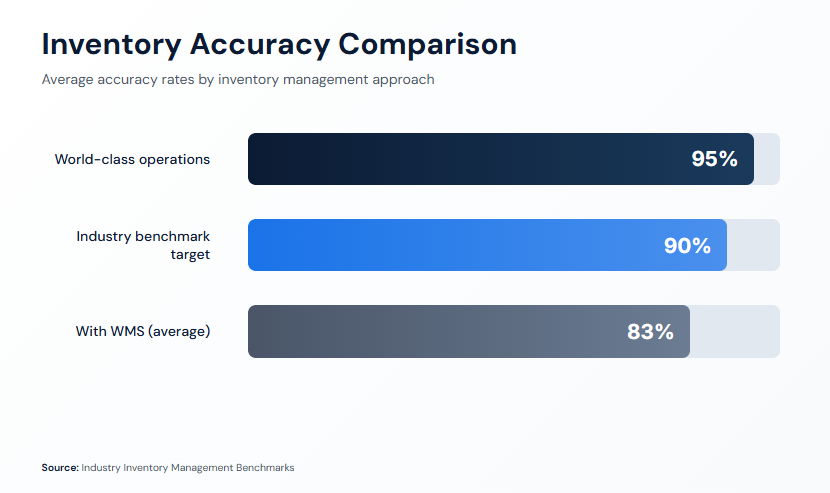
WMS platforms reduce picking errors, improve inventory accuracy, and enable better demand planning. The average inventory accuracy rate for businesses is 83%, with world-class operations achieving 95% or higher, according to the CAPS Research via NetSuite.
Evaluate WMS options based on your facility size and order complexity. You should always prioritize systems that integrate with existing ERP and shipping software. Plan for implementation costs; initial setup typically ranges from $50,000 to $200,000, depending on complexity. Finally, train staff thoroughly to ensure adoption and maximize ROI.
 #3. Redesign Warehouse Layout and Slotting
Product placement directly affects picking efficiency. Items that move frequently should be located closest to the packing and shipping areas, which is one of the best practices for order fulfillment. Slotting refers to the strategic placement of products within the warehouse to minimize travel time.
Poor slotting forces workers to walk farther and reach higher, increasing both labor time and injury risk. A layout redesign can reduce picking time by 20-30% without adding staff or equipment.
Analyze SKU velocity data to identify fast, medium, and slow movers. Place high-velocity items in "golden zones" at waist height in prime locations. The group frequently ordered items together to enable batch picking.
Review and adjust slotting quarterly based on seasonal demand changes. Seasonal 3PL services can provide additional flexibility during peak periods and support seasonal demand management.
#4. Reduce Energy Consumption
Energy costs account for approximately 15% of a non-refrigerated warehouse's operating budget. For refrigerated warehouses, this percentage increases substantially since refrigeration accounts for 60% of the electricity used in those facilities.
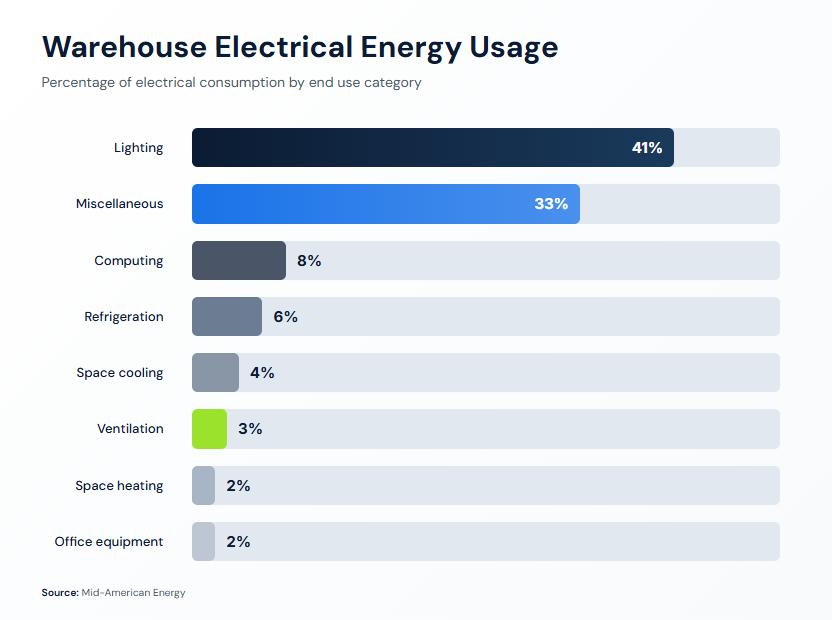
Lighting accounts for the largest share of electrical consumption in warehouses, at 41%, according to a study by Mid American Energy. Upgrading to LED fixtures can reduce lighting costs by 50% or more compared to metal halide and high-pressure sodium fixtures.
Replace HID and fluorescent lighting with LED fixtures. Install motion sensors and automatic lighting controls in low-traffic areas. Maintain HVAC equipment annually to ensure peak warehouse efficiency. Keep dock doors closed when not actively loading or unloading. Consider solar panels or renewable energy where feasible.
#5. Improve Inventory Accuracy and Reduce Shrinkage
Inventory inaccuracy leads to stockouts, overstocking, and write-offs. According to Shopify, stockouts are responsible for approximately $1 trillion in missed sales annually across global retail. Meanwhile, storage costs increase by 20-30% when businesses carry excess inventory, a common order fulfillment challenge.
Implement cycle-counting programs to verify inventory accuracy on an ongoing basis, rather than relying solely on annual physical counts. Use barcode scanning or RFID technology to reduce human error during receiving, picking, and shipping.
Establish daily or weekly cycle counts for high-value and high-velocity items. Investigate and resolve discrepancies immediately. Implement barcode or RFID scanning at all inventory touchpoints. Set inventory accuracy targets and track progress monthly.
#6. Negotiate Carrier Rates and Consolidate Shipments
Shipping costs represent a substantial portion of fulfillment expenses. One of the key benefits of 3PL partnerships is that third-party logistics providers can negotiate rates 10-30% below what individual shippers can obtain due to their volume.
Consolidating shipments reduces per-package costs and decreases the number of pickups needed. Zone skipping, shipping consolidated loads to regional distribution points before final delivery, can provide additional savings on long-distance shipments.
Request annual rate reviews from current carriers. Compare rates across multiple carriers for each shipping lane. Consolidate orders going to the same region. Consider partnering with a 3PL for access to better carrier rates. And if you already outsource but suspect you're overpaying, our breakdown of the true cost of switching — and staying with — a 3PL shows how to run that math.
#7. Implement Automation Where ROI Justifies It
Automation can reduce labor costs, improve accuracy, and increase throughput. However, automation requires significant capital investment and should be evaluated on the basis of return on investment rather than trend-following.
The warehouse automation market is projected to reach $42.25 billion by 2029, indicating broad industry adoption, according to a Research & Markets study.
Start with low-cost automation, such as conveyor systems and automated contract packaging equipment. Evaluate automated storage and retrieval systems (AS/RS) for high-density storage needs. Consider collaborative robots (cobots) for repetitive picking tasks. Calculate payback period before committing to major automation investments.
#8. Reduce Returns Processing Costs
According to NRF, consumer returns totaled $890 billion in 2024, resulting in substantial reverse logistics costs to identify production costs. Return processing typically costs $3.95 per return, covering inspection, restocking, and administrative work.
Efficient returns handling minimizes the time products spend out of sellable inventory. Dedicating space and staff specifically to returns processing - rather than handling returns as an afterthought - reduces overall costs.
Create a dedicated warehouse returns processing area. Establish clear grading criteria for returned items. Process returns within 24-48 hours of receipt. Analyze return reasons to identify product or fulfillment issues.
#9. Monitor KPIs and Conduct Regular Cost Audits
What gets measured gets managed. Establish key performance indicators for each major cost category and review them monthly.
In 2024, 85% of warehouses tracked their performance metrics, down from 89% in 2023, according to an MDM study. This decline in monitoring correlates with tightening profit margins: companies that stop tracking costs often see costs rise, creating complex supply chain challenges.
Track cost per order, cost per line, and cost per unit shipped. Monitor labor cost as a percentage of revenue monthly. Review utility bills for unexpected increases. Conduct quarterly cost audits comparing actual expenses to budgets. Benchmark performance against industry standards and stay current with 3PL trends.
Frequently Asked Questions
#1. How long does it take to see results from warehouse cost reduction initiatives?
Quick wins, such as renegotiating carrier rates or adjusting staff schedules, can yield results within 30-60 days. Technology implementations, such as WMS rollouts, typically require 3-6 months to deliver measurable savings. Layout redesigns and automation projects may take 6-12 months to complete and demonstrate full ROI.
#2. What is a good inventory accuracy rate to target?
Industry benchmarks suggest 90% accuracy as a solid target, with world-class operations achieving 95% or higher. The current average across businesses is approximately 83%. Each percentage point improvement reduces stockouts, overstocking, and associated carrying costs.
#3. Should small warehouses invest in automation?
Small warehouses benefit most from low-cost automation like barcode scanning, conveyor systems, and basic pick-to-light systems. Major automation investments typically require high order volumes to justify the capital expenditure. Evaluate each automation opportunity based on payback period rather than facility size alone.
#4. How can warehouses reduce labor costs without layoffs?
Improving productivity through better training, incentive programs, and workflow optimization allows warehouses to handle more volume with existing staff. Cross-training employees reduces downtime and overtime costs. Flexible scheduling that aligns with demand patterns prevents both overstaffing and understaffing.
#5. What percentage of revenue should warehousing costs represent?
Warehousing costs vary by industry and business model, but typically range from 5% to 10% of revenue for companies that manage their own facilities. Labor should represent less than 30% of warehouse revenue for efficient operations. Occupancy costs trending above 32% of revenue may indicate a need to evaluate facility utilization.
#6. How often should warehouse layout be reviewed?
Review warehouse slotting and layout quarterly to account for seasonal demand shifts and SKU velocity changes. Conduct a full layout analysis annually or whenever order volume increases by more than 20%. Product mix changes, new product introductions, and discontinued items should trigger immediate slotting reviews.
Key Takeaways
- Labor costs represent 45-55% of warehouse operating expenses, making workforce productivity the highest-impact area for cost reduction.
- Warehouse management systems improve inventory accuracy to an average of 83%, reducing stockouts and carrying costs.
- LED lighting upgrades can cut lighting expenses by 50% or more - and lighting accounts for 41% of warehouse electrical use.
- Warehouse space costs have increased 8.3% since 2022, reaching $8.31 per square foot in 2024.
- Third-party logistics providers often secure shipping rates 10-30% below those negotiated by individual shippers.
- Corporate profit margins in warehousing fell from 10.49% to 9.37% between 2023 and 2024, underscoring the need for cost control.
- Tracking performance metrics correlates with better financial outcomes - 85% of warehouses monitor KPIs, though this percentage has declined recently.
20 Years of Kitting Excellence
Ready to Streamline Your Supply Chain?
Join industry leaders achieving 99%+ SLA performance with flexible kitting, fulfillment, and 3PL solutions.
Get in Touch