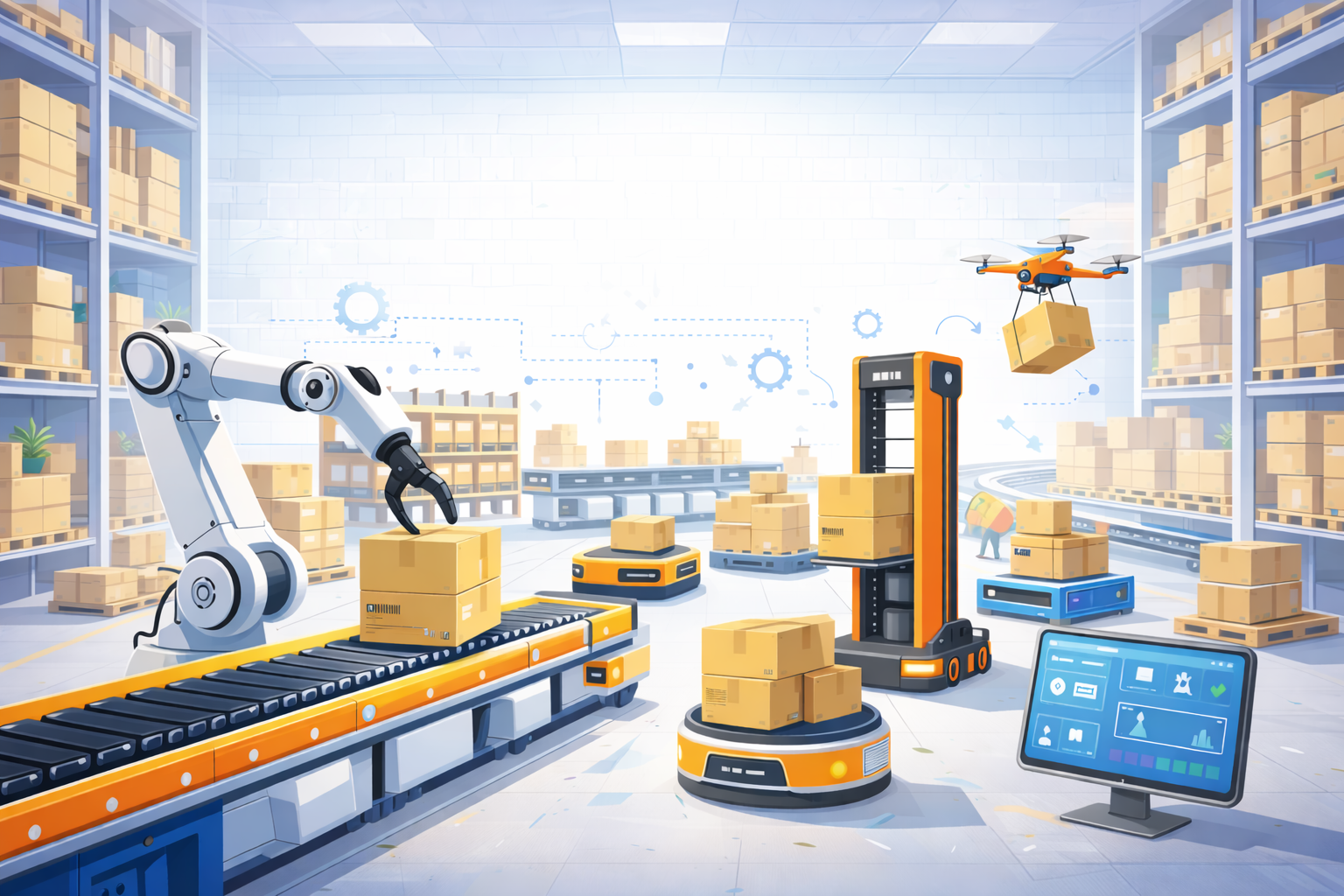
If you walk the floor of a modern trade show like MODEX or ProMat, you might be forgiven for thinking the future of warehousing is fully "Lights Out"—a silent, sterile box where humanoids and robotic arms do everything, and humans are obsolete.
The demos are impressive. You see bipedal robots walking over uneven floors and vision-guided arms tossing boxes with sub-millimeter precision. You see a vision of the future that looks like science fiction.
But if you talk to the Operations Directors who actually deployed early automation systems three years ago, you hear a different story. You hear about "automation islands" that don't talk to the WMS. You hear about expensive robotic arms that jam whenever a label is wrinkled. You hear about the nightmare of "hard automation" in a flexible world.
At the cutting edge of logistics, the goal isn't to chase the "Lights Out" fantasy. It’s to avoid the mistake many manufacturers made in the 2010s: over-automating until the system became too rigid to function. As the industry learned the hard way, "Humans are underrated."
To build a truly smarter warehouse, you need to strip away the hype. You need to know exactly where AI-powered robotics win, where they fail, and why the Hybrid Line—orchestrated by intelligent software—is the actual future of fulfillment.
Part 1: Where AI Robotics Win (The Intelligent Muscle)
We aren't talking about "dumb" automation like conveyor belts or shrink wrappers anymore. We are talking about AI-enabled robotics—machines that perceive, decide, and act. When applied to specific tasks, they change the physics of the P&L.
1. The "Long Haul" (Autonomous Mobile Robots) The single biggest waste in a traditional warehouse is walking. In a 500,000 sq. ft. facility, a human picker can walk up to 12 miles a day. That is 12 miles of paying someone to commute, not to work.
- The AI Win: Modern facilities deploy AMRs (Autonomous Mobile Robots). Unlike old AGVs that followed magnetic tape, these bots use LiDAR and SLAM (Simultaneous Localization and Mapping) to navigate dynamic environments. They dodge forklifts, re-route around spills, and meet the human associate at the pick face. Companies like MD Logistics use these systems to set the pace for material handlers and eliminate unproductive walking time.
- The Result: Pick rates double not by making the human work faster, but by eliminating the commute.
2. The "Vision Pick" (Cobots & Arms) For years, robotic arms were blind. They simply moved from Point A to Point B. If the box wasn't at Point A, the robot grabbed air.
- The AI Win: Today’s Vision-Guided Cobots (Collaborative Robots) utilize machine learning to "see" items in a bin. They can identify a specific SKU, determine the best grip point, and execute a pick even if the items are jumbled—similar to how DCL Logistics utilized cobots to achieve a 500% productivity increase.
- The Result: This allows for high-speed induction and sorting of mixed goods—tasks that previously required a human eye.
3. The "Stack" (Smart Palletizing) Stacking boxes onto a pallet is a geometric puzzle. It requires planning ("Tetris-ing" the load) and endurance.
- The AI Win: Advanced Palletizing Cells now use software to scan incoming case dimensions in real-time and dynamically generate the optimal stacking pattern. The robot arm executes the heavy lifting, ensuring a stable, density-optimized pallet without the back injury risk associated with manual stacking.
Part 2: Where Robots Fail (The Rigidity Trap)
Here is the part most robotics vendors won’t tell you. Even AI robots struggle with extreme variability.
While AI has improved perception, robotics still lag behind human dexterity and adaptability in meaningful ways. Many experts argue that current humanoid models face hard limits due to high energy consumption and immature perception in high-mix environments.
1. The "New Shampoo Bottle" Problem Imagine you invest millions in a high-speed robotic picking cell designed for rigid boxes. Six months later, your client rebrands and launches a round, slippery, or deformable shampoo bottle.
- The Failure: The robot’s gripper may not be able to handle the new surface friction or shape. While AI helps, the physical end-effector often hits a hard limit. You face downtime for re-tooling and re-training models.
- The Reality: In a high-mix 3PL environment, product profiles change constantly. Humans adapt instantly; robots often require engineering intervention. Studies on work redesign show that involving employees in these transitions is more effective than relying on "hard" automation alone.
2. The "Edge Case" Stoppage Robots are binary. They operate within confidence intervals.
- The Failure: If a box arrives with a torn label, a crushed corner, or an unexpected piece of tape, a vision system might return a "low confidence" score and stop the line. In a fully automated facility, a single piece of trash can create a bottleneck that halts the building.
- The Reality: A human sees a crushed corner and makes a split-second judgment: "It's fine" or "Reject it." A robot often freezes, requiring a human to intervene anyway.
Part 3: The Humanoid Frontier (Figure vs. Optimus)
This leads us to the hottest topic in logistics: Humanoid Robots. The promise here is the "Universal Worker"—a robot that fits into the human world rather than forcing us to rebuild the warehouse for machines.
The Contenders:
- Tesla Optimus: Leveraging the vision stack from autonomous vehicles, Optimus aims to be a general-purpose laborer trained on massive datasets of real-world physics.
- Figure (01/02): Backed by major AI players and piloted at auto manufacturers like BMW, Figure is focusing on high-dexterity tasks—learning to manipulate complex objects that traditional grippers can't handle.
The Pragmatic Take: Forward-thinking operators view humanoids as the ultimate "Brownfield" solution.
- The Brownfield Advantage: Traditional automation requires a "Greenfield" (brand new) building designed around the machine. Humanoids can walk into an existing ("Brownfield") warehouse, climb stairs, and reach shelves designed for humans.
- The Strategy: The winning strategy is hardware agnostic. Whether it’s Figure, Optimus, or Agility Robotics, they are plug-and-play labor. But they are not ready to run the facility alone. They are best deployed as "Task Agents" for dangerous or highly repetitive movements (like unloading a hot trailer in July), while humans handle the complexity.
Part 4: The Solution: The "Hybrid Line"
Because of the limitations of rigidity and the immaturity of humanoids, we don’t replace humans—we augment them. We build Hybrid Lines.
In a modern, intelligent facility, you won't see a line of just robots or just humans. You will see a "Sandwich Model" orchestrated for maximum flow:
- The Start (Machine): An Automated Case Erector builds the box. (High repetition, zero judgment).
- The Middle (Human + Cobot):
- Humans handle the complex picking, kitting, and judgment calls (e.g., inspecting a luxury item for defects).
- Cobots work alongside them, handing parts to the human or performing vision checks to verify the count.
- The End (Machine): A Vision-Guided Robot seals and stacks the pallet. (Heavy lifting, high consistency).
Why This Wins: This approach gives the speed of automation with the flexibility of a human workforce. If the product changes, you don't rebuild the factory. You just brief the human team, swap the end-effector on the cobot, and you are running again in 30 minutes.
Part 5: The Missing Piece: The "Brain" (Software)
The biggest mistake companies make is buying the "Muscle" (Robots) without building the "Brain" (Software).
A robot is only as good as the instructions it receives. If you deploy advanced humanoids but run your staffing on a whiteboard, you have a Ferrari with no GPS. The industry standard is shifting from basic WMS (Warehouse Management Systems) to WES (Warehouse Execution Systems) and intelligent orchestration layers.
1. Dynamic Workforce Orchestration Static schedules don't work in a dynamic warehouse. Leading operations now use AI-driven orchestration tools to balance labor in real-time.
- The Function: These systems analyze the live order pool and the specific skills of the workforce (both human and robotic).
- The AI: If a backlog builds up in packing, the system automatically re-allocates AMRs and human packers to that zone. It treats the robot and the human as interchangeable resources, assigning tasks based on who (or what) is best position to execute them.
2. Computer Vision QA (Quality Assurance) You can’t just trust a robot to do it right. You need verification.
- The Function: Moving QC from manual clipboards to "Visual QA."
- The AI: Cameras mounted above the line use computer vision to "watch" every kit. They verify that the correct instruction manual is included, the label is straight, and the dunnage is sufficient. This creates a digital audit trail for every single package, eliminating the "he-said-she-said" of shipping disputes.
3. Agentic Yard & Dock Management Automation on the floor is useless if the trucks are jammed at the dock.
- The Function: Advanced Yard Management Systems (YMS) now utilize AI Agents to negotiate appointment times.
- The AI: Instead of a dispatcher manually calling carriers, an AI agent schedules inbound trucks based on the "Must Arrive By" date of the inventory. It syncs the dock door availability with the robotic induction capacity, ensuring a smooth, continuous flow from the trailer to the AMR.
The Bottom Line
Smarter warehousing isn't about buying the most expensive robot. It's about knowing what to automate and what to empower.
The future isn't Figure vs. Optimus. The future isn't Human vs. Machine. The future is Human + Machine, orchestrated by Intelligent Software.
By combining the AI-powered muscle of modern robotics with the flexibility of human talent—and driving it all with an orchestration layer—companies aren't just cutting costs. They are creating capacity, consistency, and a supply chain that is actually resilient enough to survive the real world.
Resources & Further Reading
For more in-depth data and continuous insights into the evolving landscape of warehouse automation, explore the following reputable sources:
Industry Market Reports & Trends
- 2026 Warehouse Automation Trends: An analysis of how AI, software orchestration, and robotics are converging to redefine the modern warehouse ecosystem.
- Global Robotics Trends of 2026: Insights from the International Federation of Robotics (IFR) on the rise of humanoid reliability and AI-driven autonomy.
Scholarly & Professional Analysis
- Research: Human-Partnered Automation: A Harvard Business Review digital article exploring why warehouse and logistics automation performs significantly better when paired with human partners.
- Warehouse Automation & Order Fulfillment Study: A specialized research brief from Supply Chain Management Review on real-world automation performance.
20 Years of Kitting Excellence
Ready to Streamline Your Supply Chain?
Join industry leaders achieving 99%+ SLA performance with flexible kitting, fulfillment, and 3PL solutions.
Get in Touch