Most subscription box founders hit the same wall. The idea is solid, the first few cycles ship without incident, and then the cracks appear: margins that don't add up at volume, a fulfillment operation that can't absorb the next growth push, and a churn rate that quietly cancels out every new subscriber gained.
Left unaddressed, each problem compounds the others. Thin margins make it harder to invest in retention. Poor fulfillment accelerates churn. Churn forces more acquisition spend, which further compresses margins. The business grows and gets less profitable at the same time.
Knowing how to start and scale a subscription box business means anticipating constraints before they become the ceiling. This guide works through them in the order that matters.
Why the Model Is Worth Building Around
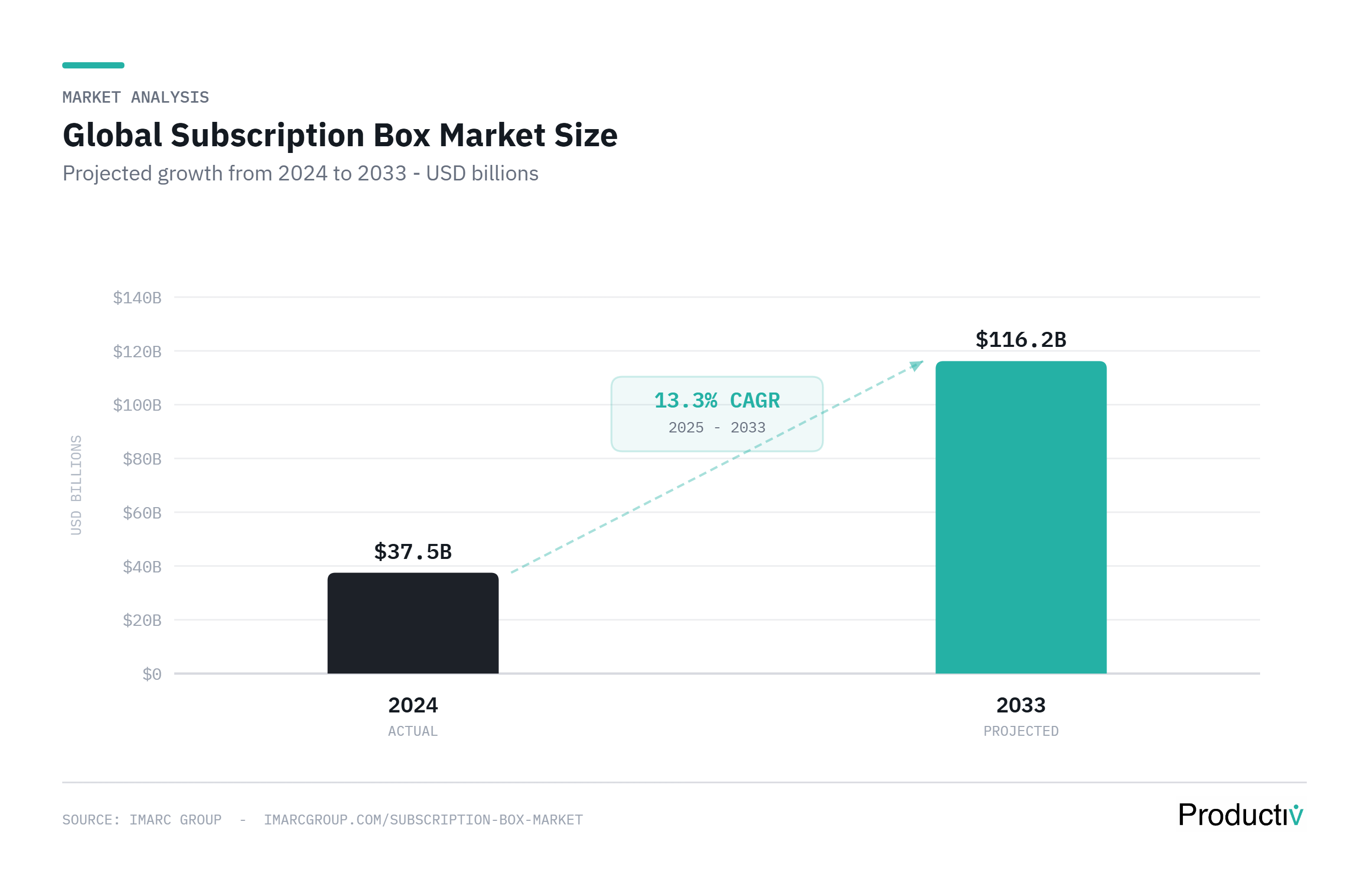
The subscription box market reached USD 37.5 billion in 2024 and is projected to grow to USD 116.2 billion by 2033, according to IMARC Group, with a compound annual growth rate of 13.3%. The underlying demand drivers are durable: consumers want convenience, personalization, and the discovery experience that a well-curated box delivers.
On the operator side, the model solves problems that plague traditional retail. Recurring monthly revenue makes cash flow planning far more predictable. You know roughly how many boxes you'll ship next month, which means you can negotiate better unit economics, reduce waste, and plan production runs with a real number in hand.
The model also produces higher customer lifetime value (CLV) than one-time purchases. A subscriber paying $45 per month who stays for 18 months generates more than $800 in revenue from a single acquisition event. That math changes how you should think about your marketing budget and pricing from the very beginning.
8 Steps to Start and Scale Your Subscription Box Business
Each step below builds on the last. Skipping ahead – launching before validating demand, or scaling fulfillment before nailing margins – is where most subscription box businesses lose time and money they can't recover.
#1. Define a Niche Specific Enough to Win
"Beauty box" is a category. "Indie skincare for people switching off synthetics" is a niche. The distinction matters more than most founders realize at the start.
A specific niche makes product curation easier because you're not trying to satisfy a broad audience. It also generates word-of-mouth that fuels early subscriber growth. People are far more likely to tell others about a box that feels made for them specifically than one that could have been made for anyone.
When evaluating a niche, check three things:
- Does an existing community organize around this interest? Reddit, Facebook groups, YouTube channels, and dedicated forums are all signals that an audience exists and spends time talking about this topic.
- Can you source products consistently? A niche dependent on rare or seasonally unavailable items turns into a sourcing crisis at scale.
- Is there demonstrated willingness to pay? Look at what the community spends on related products, events, or experiences elsewhere.
The niche you choose also shapes which subscription box business model makes the most sense, and each has different implications for sourcing, pricing, and retention.
#2. Validate Before You Commit to Inventory
The fastest way to test whether your concept translates to actual demand is a pre-sale: accepting subscriber sign-ups or deposits before a single box is assembled. Many successful subscription box brands shipped their first cycle on pre-sale revenue alone.
Set a minimum subscriber threshold before ordering the product. If your cost model requires 150 subscribers to be profitable, don't place your first purchase order until you reach that threshold. Pre-sale campaigns also create urgency and generate early content; the unboxing videos and subscriber reactions from your first cohort become your most effective marketing assets.
Use this phase to run direct conversations with potential subscribers. Ask what they'd want inside the box, what they'd pay for it, and what would make them cancel. The answers will shape your product mix, price point, and onboarding sequence before you've spent anything on inventory.
#3. Price for Profitability, Not for Conversion
Underpricing is the most reliable way to destroy a subscription box business in the first year. Setting a price that fills your waitlist but doesn't cover costs just delays the problem, and by the time you realize it, you have hundreds of subscribers locked into rates you can't sustain.
A sustainable box requires, at a minimum, a 40% profit margin after all costs are accounted for. At scale, 50-60% is a more realistic target. Work backward from these numbers when setting your price.
Your per-box cost breakdown should include:
- Product cost (typically 40-50% of the subscription price)
- Branded packaging and any inserts or cards
- Shipping and carrier fees
- Fulfillment labor for kitting and assembly
- Platform and payment processing fees
- A proportional customer acquisition cost per subscriber
Each line item compounds as volume grows. An extra $2 per box in uncounted costs becomes $20,000 per month at 10,000 subscribers. For a detailed breakdown of how to structure pricing across different box types and billing intervals, see the subscription box pricing guide, which covers the full margin math.
#4. Build Your First Prototype Box
The prototype serves three purposes: it confirms your product curation works at the margin you've set, it lets you test the packaging before committing to large print runs, and it gives you something tangible to put in front of early adopters for feedback.
Product sourcing at this stage falls into three broad approaches:
- Curated. Selecting products made by third-party brands, sourced at wholesale. Fastest to launch, easier to vary month-to-month, but lower margins.
- Manufactured. Creating or co-creating your own products. Higher margins and stronger brand differentiation, but requires higher minimum order quantities and longer lead times.
- Hybrid. A core manufactured product supplemented by curated additions.
Most early-stage boxes start with curation and introduce manufactured elements as subscriber numbers justify the investment.
When building the prototype, treat the packaging experience as a product decision, not a cosmetic one. The unboxing moment is the primary driver of social sharing, and social sharing is the lowest-cost customer acquisition channel available to subscription boxes.
The materials, the tissue paper, the card copy, the way items are arranged inside, all subscription box packaging elements contribute to whether subscribers post about it or quietly move on. The subscription box packaging guide covers how to intentionally engineer that experience.
#5. Set Up the Right Tech Stack
Subscription box businesses require tools that standard e-commerce stores don't need by default. Before launch, you'll need:
- A subscription management platform (common options: Recharge for Shopify, or a dedicated platform like Subbly) to handle recurring billing, failed payment recovery, and subscriber self-service portals
- An e-commerce storefront for acquisition and checkout
- An email platform with automation for onboarding sequences, renewal reminders, and win-back campaigns
- An inventory tracking system to monitor component stock against projected box quantities
The most consequential technical decision is your approach to failed payments. Without proper dunning, including automated retry logic and subscriber communication when cards decline, you'll lose a meaningful share of subscribers to involuntary churn. These are people who intended to stay but were removed due to a failed payment. Platforms that handle this natively recover a significant portion of revenue that would otherwise be lost silently.
#6. Launch With a Pre-Sale Strategy
A staged launch, building from 50 to 100 to 500 subscribers over several weeks, produces better results than a single launch event for most subscription box businesses. The reason is simple: your first subscribers teach you things no research phase will.
Their feedback on the product mix, the packaging, and the experience will change what goes into your second box. You want that feedback before you're locked into large inventory orders.
Build your initial subscriber base through:
- A waitlist with a referral incentive (e.g., subscribers who refer two friends get their first box free)
- Seeding boxes to micro-influencers and creators in your niche for organic content
- Social content that builds anticipation around launch day without giving away exactly what's inside
The goal at launch is to demonstrate proof of concept and build a base of subscribers who are genuinely invested in the product.
#7. Build a Fulfillment Operation That Can Scale
Fulfillment is where subscription box businesses quietly accumulate problems that become visible only when volume makes them expensive. Packing 80 boxes at your kitchen table works. Packing 800 boxes per month while managing address changes, holds, damaged-item replacements, and carrier pickups is a different kind of operation.
Understanding how subscription box fulfillment works, from inventory management through final-mile delivery, helps you identify where your current process has gaps before you scale. The decisions you make at a few hundred boxes per month - which carriers you use, how you handle kitting, how you track outbound accuracy - are much harder to change at a few thousand.
A few specific areas worth getting right early:
- Kitting timing and quality control. Assembly errors are most expensive when you find them after boxes have shipped. Building quality checks into the assembly workflow, not just at pack-out, catches problems before they reach subscribers.
- Inventory buffer management. Subscription boxes require ordering products weeks before the ship date, based on subscriber counts that shift constantly. Subscription box inventory management covers how to structure your ordering cadence and safety stock approach to reduce the risk of short-shipping.
- Shipping cost structure. Carrier rates have an outsized effect on per-box economics. Strategies to reduce subscription box shipping costs through carrier diversification, zone optimization, and volume-based rate negotiations become increasingly relevant as monthly box counts grow.
Additionally, being aware of the most common subscription box fulfillment mistakes before your first major ship cycle is essential.
#8. Manage Churn, or It Will Manage You
Here's the math that catches most subscription box founders off guard: at 10% monthly churn, you lose approximately 70% of your subscriber base over 12 months. At a 5% monthly churn rate, you retain about 54%. At 3%, you retain about 69%.
Those differences compound dramatically as the subscriber base grows. Adding 200 new subscribers per month while losing 10% of your existing base is effectively running in place.
Churn has distinct root causes, and the fix depends on diagnosing which one applies:
- Value misalignment. The subscriber doesn't feel they're receiving enough for the price. Survey churned subscribers specifically; their answers are more honest than those of retained subscribers.
- Product fatigue. The box feels predictable or repetitive by month four or five. Introducing variation, limited-edition drops, or early-access subscriber options addresses this.
- Price sensitivity. Subscriptions are often among the first things cut when household budgets tighten. Offering a "pause" option rather than forcing a cancellation-or-continue choice recovers a meaningful share of would-be cancellations.
- Fulfillment failures. Late shipments, wrong items, and damaged products are the fastest path to permanent cancellations. A well-chosen subscription box fulfillment partner with quality control systems built into the process addresses this at the source.
Annual billing is among the most effective retention tools available. Annual subscribers generate significantly more lifetime revenue per acquisition event and churn at substantially lower rates than month-to-month subscribers.
According to Recurly's churn research, the median monthly churn rate for consumer goods and retail subscriptions sits around 4.1%, and annual plans are among the primary drivers that bring businesses below that threshold.
When to Outsource Fulfillment to a 3PL
The question of when to move from in-house to a third-party logistics provider (3PL) rarely comes down to a specific subscriber count. The real signal is operational bandwidth: if fulfillment is consuming time and attention that should go to product curation, subscriber growth, or marketing, that's the indicator.
For most subscription box businesses, the tipping point appears to be between 300 and 800 boxes per month. Above that threshold, the fully loaded cost of in-house fulfillment, including labor, packaging storage, carrier account management, and returns handling, typically exceeds what a specialized 3PL charges for the same output.
A 3PL such as Productiv that specializes in subscription boxes brings several advantages beyond cost:
- Better carrier rates through shipping volume across multiple clients
- Warehouse infrastructure sized for subscription fulfillment's unusual demand profile (a large single cycle per month, not continuous daily throughput)
- Systems for handling subscriber address changes, holds, and late-billing adjustments before the ship date
- Kitting infrastructure that can absorb custom inserts, product swaps, and late-arriving items without disrupting the ship cycle
Before transitioning to a 3PL partner, work through a subscription box fulfillment checklist to ensure you've documented your process, transferred supplier contacts, and set clear expectations before your first outsourced shipping cycle.
Frequently Asked Questions
#1. How do I scale a subscription box business?
Scaling requires addressing three constraints in order: unit economics (pricing and margin), retention (churn reduction), and fulfillment capacity. Subscriber growth without healthy margins accelerates losses. Growth without retention just replaces churned subscribers at a cost. Fulfillment operations that can't absorb volume become the ceiling. Address each layer before pushing harder on acquisition.
#2. What causes subscription box churn, and how does fulfillment affect it?
Churn stems from value misalignment, product fatigue, price sensitivity, and fulfillment failures. Fulfillment affects the last category most directly; late or incorrect shipments are among the top reasons subscribers cancel and don't return. A consistent, accurate ship cycle is the baseline on which all other retention efforts depend.
#3. When is the right time to outsource subscription box fulfillment?
The clearest signal is when fulfillment work consumes time that should go to growth, product development, or the subscriber experience. For most subscription box businesses, the operational tipping point appears between 300 and 800 boxes per month, when the fully loaded cost of in-house labor, storage, and carrier management starts to exceed what a specialized 3PL can deliver.
#4. Is it better to fulfill subscription boxes in-house or use a 3PL?
Early-stage businesses often fulfill in-house to preserve cash and stay close to the product. As volume grows, a 3PL typically offers better carrier rates, dedicated warehouse infrastructure, and the capacity to handle surge cycles without staffing problems. The right answer depends on your current volume, margin profile, and how much of your time fulfillment is consuming.
#5. How much does it cost to start a subscription box business?
Startup costs range from a few hundred to several thousand dollars, depending on niche and scale. The primary variable is your minimum viable product order. A small pre-sale batch with simple packaging can cost $1,500-$5,000 to produce and ship. Custom packaging, manufactured products, and larger initial orders push that number significantly higher. The more important figure is your per-box cost at target margin.
#6. How do I manage inventory for a monthly subscription box?
The core challenge is ordering products weeks in advance, based on subscriber numbers that shift between the order date and the ship date. Maintain safety stock for hard-to-source hero items, set SKU-level reorder points, and track monthly churn rates to sharpen your ordering forecasts. A warehouse management system that tracks component-level quantities against projected box needs reduces the risk of short-shipping.
Key Takeaways
- The subscription box market reached USD 37.5 billion in 2024 and is projected to grow at a 13.3% CAGR through 2033, according to IMARC Group. The fundamentals driving growth, such as convenience, personalization, and discovery, are durable.
- Niche specificity is a competitive advantage, not a constraint. The more precisely defined your audience, the easier curation becomes.
- Price for a minimum 40% profit margin from day one. Underpricing at launch is much harder to correct than losing early sign-ups to a higher price point.
- At 10% monthly churn, roughly 70% of your subscriber base is gone within 12 months. Retention work, including annual billing, pause options, and consistent fulfillment, has a higher ROI (Return on Investment) than acquisition at most stages of growth.
- Annual subscribers churn at approximately half the rate of monthly subscribers and generate 2.4x more lifetime revenue.
- The signal to move from in-house to 3PL fulfillment is operational bandwidth, not a specific subscriber count. When fulfillment consumes time that should go to growth, it's time to make the transition.
When you're ready to make that transition, Productiv's subscription box fulfillment and kitting services handle monthly assembly cycles, multi-SKU configurations, and dual-channel retail execution for brands at every stage of scale.
20 Years of Kitting Excellence
Ready to Streamline Your Supply Chain?
Join industry leaders achieving 99%+ SLA performance with flexible kitting, fulfillment, and 3PL solutions.
Get in Touch