
8 Streamlining Assembly Processes Strategies
Assembly bottlenecks drain manufacturers of time, money, and competitive edge.
When production lines stall, workers wait, orders pile up, and margins shrink. Left unaddressed, these inefficiencies compound, eating into profits while competitors pull ahead.
In this article, we’ll cover eight strategies to streamline assembly processes, reduce waste, accelerate throughput, and build assembly operations that deliver consistent results.
Why Is Streamlining Assembly Processes Important?
Manufacturers who fail to address assembly inefficiencies face compounding problems, from missed delivery windows to inflated labor costs. Improving assembly operations delivers measurable benefits across multiple business dimensions:
- Reduced operating costs. According to the Lean Enterprise Research Centre, 60% of production activities in a typical manufacturing operation are waste that adds no value for the customer. Eliminating these non-value activities directly improves profit margins.
- Increased throughput capacity. Deloitte's 2025 Smart Manufacturing Survey found that manufacturers implementing smart manufacturing technologies unlocked 10-15% additional capacity from existing equipment, without capital expansion.
- Improved product quality. Standardized assembly processes reduce variation and defects. World-class manufacturers achieve Overall Equipment Effectiveness (OEE) scores of 85% or higher, compared to the industry average of 60-75% for discrete manufacturing operations.
- Better workforce utilization. Manufacturers lose an average of 800 hours annually to unplanned machine maintenance and downtime, roughly 15 hours per week of paid non-productive time. Addressing root causes frees workers to engage in value-adding activities.
- Faster response to customer demand. Manufacturers that adopt lean principles report lead-time improvements of 70-90%, enabling faster order fulfillment and better customer satisfaction.
 8 Strategies for Streamlining Assembly Processes
#1. Implement Value Stream Mapping to Identify Waste
Value stream mapping (VSM) creates a visual representation of every step in your hand assembly process, from raw materials to finished goods. This technique reveals where time and resources disappear without adding customer value.
Start by documenting your current state. Walk the production floor and record cycle times, wait times, inventory levels, and material movement between stations. Map information flows alongside physical flows to expose disconnects between planning and execution.
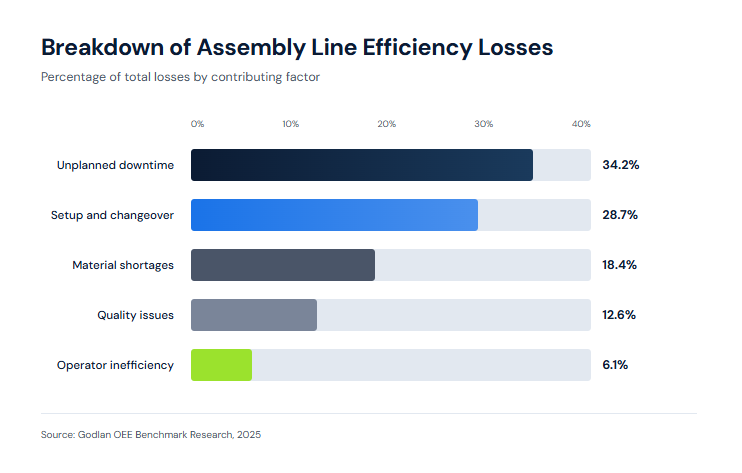
Focus on the eight wastes of lean manufacturing: defects, overproduction, waiting, non-utilized talent, transportation, inventory, motion, and extra processing. Research indicates that quality issues contribute to roughly 12.6% of efficiency losses in discrete manufacturing, while setup and changeover activities account for nearly 29%.
Create a future-state map that eliminates non-value-added steps and reduces wait times between operations. Prioritize changes that deliver the greatest impact with the least disruption. Many organizations discover that simple rearrangements of workstations or changes to material delivery schedules produce substantial improvements.
#2. Standardize Workstations and Procedures
Variation kills efficiency. When operators perform tasks differently, quality fluctuates, training becomes difficult, and continuous improvement stalls.
Develop standardized work instructions that document the one best method for each assembly task. Include specific steps, sequence, timing, and quality checkpoints. Use visual aids, such as photos, diagrams, and videos, to communicate procedures clearly, regardless of operator experience level.
Apply the lean warehousing 5S methodology (Sort, Set in order, Shine, Standardize, Sustain) to organize workstations. Position tools and materials within easy reach, eliminate clutter, and create designated locations for everything. This reduces motion waste and ensures operators can find what they need instantly.
Review and update standards regularly. The best processes evolve based on operator feedback and performance data. Build mechanisms for workers to suggest improvements and test modifications in controlled conditions before full implementation.
 #3. Deploy Targeted Automation for Repetitive Tasks
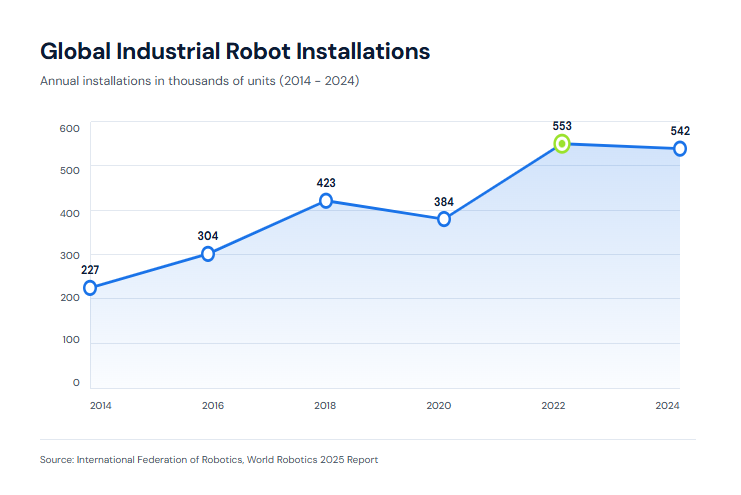
According to research by the International Federation of Robotics, industrial robot installations reached 542,000 units globally in 2024, more than double the number from ten years ago. This growth reflects manufacturers recognizing that automation in kitting and assembly delivers consistent quality on repetitive tasks while freeing human workers to focus on complex problem-solving.
Focus automation investments on those that generate the greatest returns. Tasks with high repetition, consistent specifications, and ergonomic risks make ideal candidates. Welding, painting, material handling, and pick-and-place operations often yield strong ROI.
Collaborative robots (cobots) offer entry points for smaller operations. These systems work alongside human operators without extensive safety caging, reducing implementation costs and space requirements. The cobot segment continues growing as manufacturers seek flexible automation that adapts to changing product mixes.
Deloitte's 2025 survey found that 46% of manufacturing executives ranked process automation as their first or second investment priority for the next two years. Physical automation followed at 37%. These manufacturing trends address both skilled labor shortages and productivity targets.
#4. Adopt Just-in-Time Material Delivery
Excess inventory ties up capital, consumes floor space, and hides production problems. Just-in-Time (JIT) delivery systems bring materials to assembly stations precisely when needed; not earlier, not later.
Implement pull systems that signal material requirements based on actual consumption rather than forecasts. Kanban cards or electronic signals trigger replenishment when inventory reaches predetermined levels. This prevents both stockouts and overaccumulation.
Work with suppliers to establish reliable delivery schedules that support JIT operations. Some manufacturers implement vendor-managed inventory arrangements in which suppliers monitor stock levels and replenish automatically. Others establish local staging areas for critical components.
Material shortages account for approximately 18.4% of efficiency losses in make-to-order manufacturing environments. Addressing supply chain reliability directly improves assembly line uptime and reduces the scrambling that disrupts planned production sequences.
#5. Reduce Changeover Times with SMED
The Single-Minute Exchange of Die (SMED) methodology separates setup activities into external tasks (performed while the equipment runs) and internal tasks (performed only when the equipment stops). Converting internal tasks to external tasks dramatically reduces changeover duration.
Document current changeover procedures in detail. Video recording captures steps that written procedures miss. Analyze each task to determine whether it requires the machine to be stopped or could be completed during the prior production run.
Prepare materials, tools, and fixtures in advance. Stage everything needed for the next job before the current run ends. Use quick-release mechanisms, standardized connections, and preset adjustments to minimize internal changeover time.
Setup and changeover activities account for nearly 28.7% of efficiency losses in discrete manufacturing – the second-largest category after unplanned downtime. Companies that implement SMED often reduce changeover times by 50% or more, enabling smaller batch sizes and greater production flexibility.
 #6. Implement Real-Time Production Monitoring
Production monitoring systems collect data from machines and operators to provide visibility into actual performance. This information enables rapid response to problems and evidence-based improvement decisions.
Overall Equipment Effectiveness (OEE) serves as the standard metric for assembly line performance. OEE combines availability (uptime), performance (speed), and quality (good parts) into a single percentage. A world-class OEE score of 85% indicates the equipment produces high-quality parts at full speed with minimal downtime.
Most discrete manufacturing operations achieve OEE scores between 60% and 75%. This gap between typical and world-class performance represents a significant opportunity to improve assembly-line efficiency. Each percentage-point improvement directly translates into increased output from existing assets.
Deploy dashboards that display real-time performance at the point of production. When operators and supervisors see the current status relative to targets, they respond more quickly to deviations. Historical data enables pattern analysis to identify recurring issues and guide preventive action.
#7. Invest in Preventive and Predictive Maintenance
Unplanned downtime accounts for over 34.2% of efficiency losses in manufacturing operations. Equipment failures disrupt production schedules, cause quality issues, and generate costly emergency repairs.
Preventive maintenance schedules routine service based on time intervals or usage counts. This approach catches wear items before failure and extends equipment life. Develop maintenance calendars that minimize production impact by scheduling services during planned downtime.
Predictive maintenance uses sensor data and analytics to forecast failures before they occur. Vibration analysis, thermal imaging, and oil analysis detect developing problems while the equipment continues to operate normally. According to McKinsey & Company research, predictive tools have reduced downtime by up to 50% for some manufacturers.
Deloitte's 2025 survey found that 68% of manufacturing executives performed cybersecurity risk or maturity assessments of their smart manufacturing technology stack in the last year. As production systems become increasingly connected, protecting them from disruption becomes essential to maintaining uptime.
#8. Build a Continuous Improvement Culture
Sustainable assembly performance requires ongoing attention from everyone in the organization. One-time improvement projects deliver temporary gains that fade without systematic follow-through.
Establish regular review meetings in which production teams examine performance data and identify opportunities for improvement. Daily huddles keep small issues from becoming large problems. Weekly reviews track progress on active initiatives. Monthly sessions evaluate whether improvement investments deliver expected returns.
Train workers in problem-solving methodologies. Root cause analysis techniques help teams move beyond symptoms to address underlying issues. Plan-Do-Check-Act cycles provide a structured approach to testing changes before full implementation.
Deloitte found that more than a third of manufacturing executives cite equipping workers with skills for smart manufacturing as their top workforce concern. Technical capabilities matter, but so does creating an environment where workers actively seek and implement improvements.
Frequently Asked Questions
#1. What is the difference between OEE and production efficiency?
Production efficiency measures actual output against the maximum possible output. OEE provides a more comprehensive view by combining three factors: availability (the percentage of scheduled time the equipment runs), performance (actual speed relative to designed speed), and quality (good parts relative to total parts produced). A machine running at full speed but producing defects would show high efficiency but lower OEE.
#2. How long does it take to see results from implementing lean manufacturing?
Most organizations observe measurable improvements within 3-6 months of starting lean initiatives. Quick wins from 5S organization and standardized work often appear within weeks. More substantial gains from value stream redesign and automation projects typically require 9-15 months. Research indicates that defect rates can drop up to 80% within this timeframe when lean principles are systematically implemented.
#3. Which assembly tasks should be automated first?
Prioritize tasks that combine high repetition, consistent specifications, and ergonomic risk. Good candidates include repetitive pick-and-place operations, quality inspection using machine vision, material handling between stations, and processes requiring precision beyond human capability. Avoid automating tasks that change frequently or require judgment and adaptation.
#4. How do manufacturers calculate the cost of downtime?
Calculate downtime costs by combining direct and indirect factors. Direct costs include lost production revenue, idle labor, and emergency repair expenses. Indirect costs include expedited shipping for late orders, quality issues from rushed restarts, and damage to customer relationships. In automotive assembly, Siemens research found that downtime costs reach $2.3 million per hour - or roughly $600 per second.
#5. What percentage of the manufacturing budget should go toward automation?
Deloitte's 2025 survey found that 78% of manufacturing executives plan to invest 20% or more of their improvement budgets in smart manufacturing initiatives, including automation. The appropriate level depends on the current state, competitive pressure, and available talent. Start with projects delivering clear ROI within 18-24 months, then reinvest gains into additional capabilities.
#6. How does standardized work differ from documented procedures?
Documented procedures describe the tasks that need to be completed. Standardized work specifies the one best method - including sequence, timing, motion patterns, and quality checkpoints. It represents the current best practice that all operators follow consistently. Unlike static procedures, standardized work evolves based on continuous improvement insights and operator feedback.
#7. What role does workforce training play in assembly optimization?
Training ensures workers execute standardized methods correctly and contribute to continuous improvement. Deloitte found that only 48% of manufacturers have smart manufacturing training standards in place, and 35% cite workforce upskilling as a top concern. Effective training combines classroom instruction with hands-on practice and ongoing coaching, with processes evolving over time.
Key Takeaways
- Unplanned downtime accounts for the largest share of manufacturing efficiency losses, representing over 34.2% of total losses. Preventive and predictive maintenance programs directly address this drain.
- Value stream mapping reveals waste hiding in assembly operations; research shows 60% of production activities add no customer value.
- Standardized work and 5S organization eliminate variation that causes quality problems and slows production.
- Industrial robot installations have doubled over the past 10 years, reaching 542,000 units globally in 2024, as manufacturers automate repetitive tasks.
- OEE scores of 85% are world-class, while most discrete manufacturers operate between 60% and 75%, creating a significant improvement opportunity.
- SMED techniques can reduce changeover times by 50% or more, enabling smaller batches and greater flexibility.
- Real-time production monitoring provides visibility that enables rapid response to problems and data-driven improvement decisions.
- Building a continuous improvement culture requires regular reviews, worker training in problem-solving methods, and leadership commitment to sustained attention.
20 Years of Kitting Excellence
Ready to Streamline Your Supply Chain?
Join industry leaders achieving 99%+ SLA performance with flexible kitting, fulfillment, and 3PL solutions.
Get in Touch