The global subscription box market reached $37.5 billion in 2024 and is projected to hit $116.2 billion by 2033.
That kind of growth attracts many entrepreneurs, which means the real question isn't whether the market is big enough. It's whether your specific niche is one subscribers will stay loyal to, and whether the product actually fits the operational realities of recurring fulfillment.
These subscription box business ideas are organized by category. Each one includes a note on what drives demand, where churn risk tends to sit, and what to expect operationally once orders start coming in.
What Separates a Viable Idea from a Struggling One?
Before getting into the list, two variables determine whether a subscription box idea has legs.
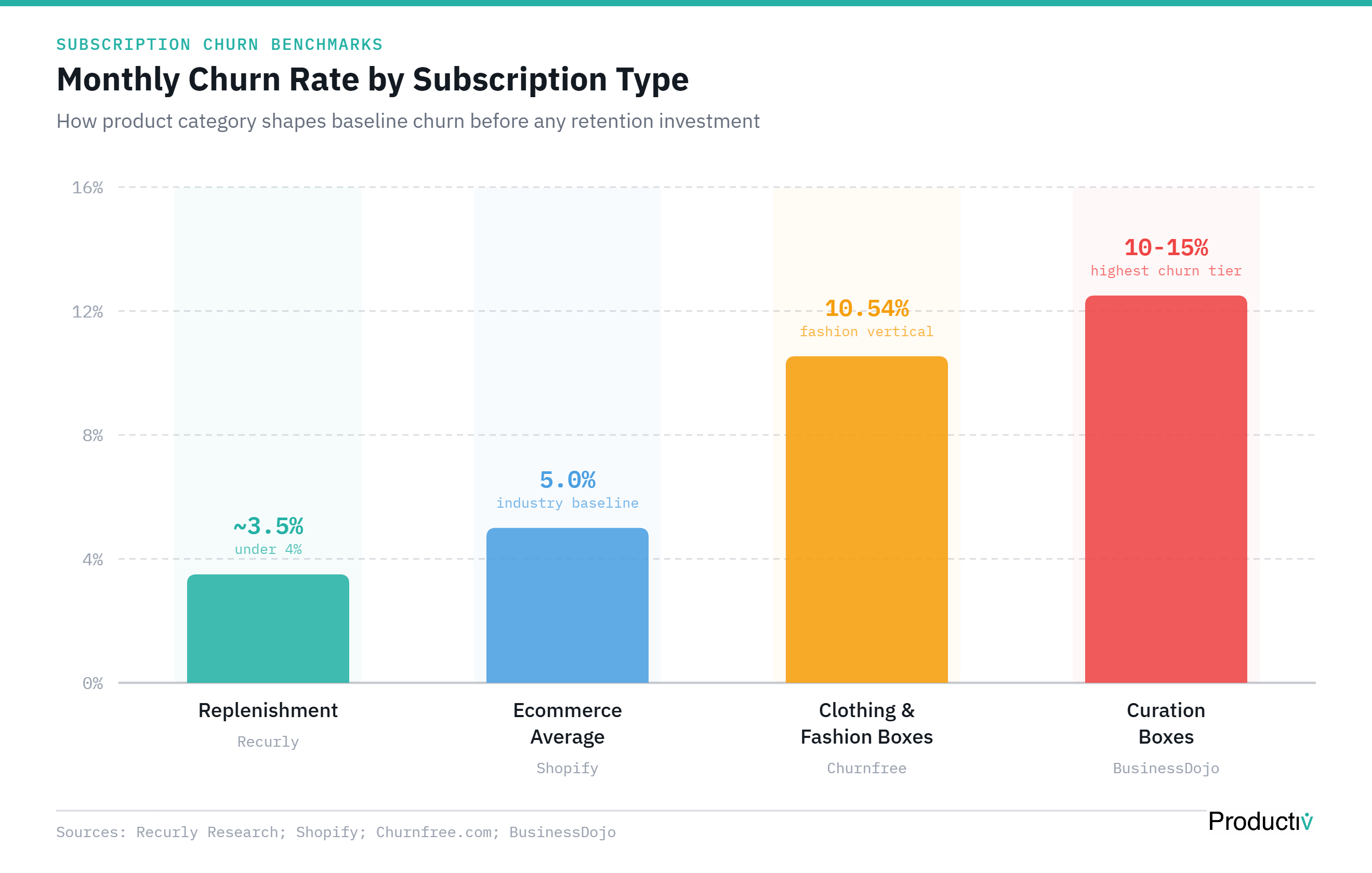
The first is whether you're selling replenishment or curation. Replenishment boxes, including products subscribers consume and need restocked, like vitamins, coffee, or pet food, benefit from structural demand that keeps churn low. Curation boxes, which deliver discovery and surprise, are emotionally compelling but carry a higher risk of cancellation. Recurly's benchmark data shows that replenishment subscriptions average below 4% monthly churn, while general ecommerce subscription boxes run closer to 10-15%.
The second variable is fulfillment complexity. Products that require kitting and assembly, such as curated sets with multiple SKUs (Stock Keeping Units), custom inserts, or mixed product types, take more labor to prepare and more coordination to manage at scale. That complexity isn't a dealbreaker, but it needs to factor into your pricing and your choice of whether to fulfill in-house or outsource.
Beauty and Personal Care
Skincare Subscription
Skincare is one of the most established categories in subscription commerce, and the retention numbers support that. Subscribers tend to reorder products they trust, especially in the anti-aging, acne, and sensitive-skin niches. The curation angle works here because discovering new products is a genuine part of the skincare hobby, not just a marketing hook.
The operational side requires attention to the temperature sensitivity of certain actives and to fragile packaging for glass components. Subscription box packaging needs to protect delicate products without adding unnecessary dimensional weight.
Churn risk: Medium. Retention improves significantly with personalization (e.g., quizzes, skin-type matching).
Men's Grooming
This niche benefits from genuine replenishment demand; razors, shaving cream, and skincare products run out. The audience is also underserved compared to women's beauty, which keeps competition lower and customer acquisition more affordable.
Fulfillment is relatively uncomplicated: most products ship as non-hazardous liquids in small quantities, and the kit composition tends to be consistent month to month.
Churn risk: Low to medium. Replenishment products anchor retention.
Food and Beverage
Specialty Coffee or Tea
Coffee and tea subscriptions have some of the best churn profiles in the industry because the product is genuinely consumable. Subscribers run out. They reorder. The discovery element, including new origins, roasters, and blends, creates a hook without sacrificing the replenishment baseline.
Shipping coffee at scale requires attention to bag sizing, protective packaging, and freshness dating. Sourcing relationships with roasters or importers matter more here than in most categories.
Churn risk: Low. Few categories match the natural replenishment cycle of a daily habit.
Artisan Snacks and Regional Foods
This is a large and crowded category, but niching down to, for example, regional American foods, international imports, allergen-specific diets, or small-batch producers, creates a difference. The challenge is that taste is subjective, which drives higher churn than most founders expect.
Products vary significantly in weight, fragility, and shelf life, which complicates inventory management and increases the importance of reliable supplier relationships.
Churn risk: Medium to high. Taste preferences and novelty fatigue are ongoing challenges.
Functional Foods and Health Bars
Protein bars, energy gels, nootropic supplements in food form, and similar products serve a fitness-conscious demographic that values replenishment over discovery. The price sensitivity in this category is lower than in the general snacks category, supporting better margins.
Because products often carry specific nutritional claims, quality control at the kitting stage matters more than it does for general snack boxes.
Churn risk: Low to medium, especially with subscribers on specific dietary plans.
Health and Wellness
Vitamins and Supplements
This is arguably the purest replenishment play in the subscription box space. Subscribers who commit to a daily supplement routine need a consistent supply, and the inconvenience of canceling and resourcing keeps retention high.
The regulatory side requires attention; supplement labeling, ingredient sourcing, and shipping certain products across state lines or internationally involve compliance considerations. But operationally, the products are lightweight and easy to kit.
Churn risk: Low. Monthly subscriptions in this category closely mirror the consumable subscription profile.
Fitness Accessories and Gear
Resistance bands, gym chalk, lifting straps, and training aids serve an active audience with genuine ongoing needs. The challenge is that equipment purchases are more episodic than consumable purchases; subscribers may feel they've accumulated enough gear.
Monthly themes or training-program pairings help extend perceived value. Bundling equipment with educational content (programming guides, training cards) increases the experiential element.
Churn risk: Medium to high unless educational content sustains engagement.
Pets
Dog Treats and Toys
Pet subscriptions consistently rank among the stickiest categories in the industry. Owners form emotional attachments to brands that their pets enjoy, and treats replenish naturally. The combination of consumables (treats) and non-consumables (toys) gives you flexibility to refresh the curation element monthly while anchoring retention with the edible component.
The subscription box fulfillment side involves managing food-grade packaging standards for treats alongside toy components, which typically ship as a multi-SKU kit each month.
Churn risk: Low. Pets build subscriber loyalty that human-facing categories rarely match.
Cat Accessories
Cat owners are a distinct and underserved audience compared to dog owners in subscription commerce. Toys, treats, catnip products, and enrichment accessories translate well to monthly curation, and the fanbase tends to be vocal on social media.
Churn risk: Low to medium. Similar to dog subscriptions but with a smaller total addressable market.
Kids and Family
STEM and Educational Craft Kits
This category has one of the cleanest retention profiles among curation boxes because the subscriber's motivation is tied to their child's development rather than their own entertainment. Parents are more likely to maintain a subscription if they believe it's genuinely educational.
The kitting requirements are involved; STEM (science, technology, engineering, and mathematics) kits typically include multiple small components, printed instructions, and age-specific packaging. Getting kitting and assembly right is critical for delivering a consistent experience month to month.
Churn risk: Medium. Retention is strong until children age out of the target range.
Children's Books
Book subscriptions for kids benefit from the gifting dynamic: parents, grandparents, and relatives subscribe to give rather than to receive. That gifting layer improves retention because the emotional motivation differs from self-directed spending.
The operational requirements are straightforward: books ship flat, pack predictably, and require little assembly. This is one of the easier categories from a fulfillment standpoint.
Churn risk: Medium. Age-appropriateness becomes a challenge as children grow.
Hobbies and Crafts
Art Supplies and Painting
The art supply category serves a passionate community with genuine ongoing material needs. Subscription boxes can target beginners (learning-focused) or experienced artists (premium materials, specific mediums). Niche further – watercolor only, or oil painting supplies – to build a more dedicated audience.
Materials vary in fragility, chemical composition, and shipping requirements. Some pigments and solvents carry shipping restrictions, so reviewing carrier guidelines before selecting your product range is essential.
Churn risk: Medium. Hobbyists accumulate materials over time, so ongoing value requires fresh project ideas alongside products.
Fiber Arts: Knitting and Crochet
Yarn subscription boxes serve a community that actively seeks variety in texture, color, and fiber content. The market is well-defined, passionate, and online-native; social platforms like Ravelry, Instagram, and TikTok have built-in communities that drive organic discovery.
Churn risk: Medium. Yarn accumulation can lead to subscriber "stash overwhelm," a real driver of cancellations in this niche. Monthly themes or project challenges help offset this.
Home and Living
Candles and Home Fragrance
Home fragrance is a consistently popular subscription category with strong demand for gifting and self-purchase. Products are visually appealing (high unboxing appeal), aromatic (a sensory experience), and consumable.
The shipping side requires attention: candles are fragile, wax can melt in heat, and glass containers add weight. Packaging strategy matters more in this category than in most others, since protective inserts reduce damage rates and enhance the unboxing experience.
Churn risk: Medium. Scent fatigue can occur, but rotating themes and aligning with the season help maintain novelty.
Eco-Friendly Household Products
Sustainability is a growth segment with committed subscriber demographics. Reusable cleaning supplies, bamboo products, compostable alternatives, and refillable personal care items serve subscribers who've made a values-based purchasing decision, which is a strong retention signal.
The replenishment element (cleaning supplies run out) combines naturally with curation (new sustainable brands to discover). That combination is structurally favorable for retention.
Churn risk: Low to medium. Values-driven subscribers churn less than trend-driven ones.
30M+ Kits Per Year
Whatever the Niche, the Box Still Has to Ship
Every idea on this list lives or dies on kitting, packaging, and on-time monthly delivery. Here's how we run that side of the business.
See Our Subscription Box OperationLifestyle and Niche
Specialty Coffee and Tea (Regional or Single-Origin Focus)
Covered above in Food and Beverage, but worth noting here as a standalone lifestyle brand play. Coffee subscription boxes positioned around origin stories, independent roasters, or brewing education serve a premium audience willing to pay higher per-box prices, thereby improving margins without a proportional increase in fulfillment costs.
Vinyl Records and Music
Vinyl saw a resurgence that has proven durable rather than cyclical. A subscription built around curated records by genre, era, or mood serves a collector community with strong emotional investment in physical media.
Shipping records require custom protective packaging, as vinyl warps and scratches easily. Weight also adds to shipping costs, which affects how you should approach reducing shipping costs as you scale.
Churn risk: Medium. Collectors can accumulate faster than they can enjoy new additions.
Cultural Food Discovery
International snack boxes, such as those that sample foods from a different country each month, combine the moment of discovery with an accessible price point. The audience tends to be curious and educated, with strong social sharing behavior that supports organic growth.
Sourcing requires building import relationships or working with established specialty importers. Customs documentation for international products adds a layer of operational complexity that pure domestic sourcing avoids.
Churn risk: Medium. Novelty is the core value proposition, so maintaining genuine discovery quality month after month is the main retention challenge.
Book Club for Adults
Adult book subscriptions go beyond delivering a title; the best ones build community through reading guides, author Q&As, and member discussions. That community layer is what separates retained subscribers from churned ones.
Genre specificity (mystery, romance, science fiction, literary fiction) builds a more loyal niche audience than general fiction boxes do, because subscribers feel the curation is tailored to their tastes rather than a broad editorial guess.
Churn risk: Medium. Reading pace variability causes accumulation; community engagement is the retention lever.
Working with a 3PL
In-house fulfillment makes sense early. You control the unboxing experience, catch quality issues before they ship, and the economics work when you're under 200 subscribers. That window closes faster than most founders expect.
At 300-500 subscribers, the labor cost of kitting multi-SKU boxes in-house often exceeds what it costs to outsource subscription box fulfillment per unit, especially once you count the time spent packing instead of running the business. The categories where these tips are most relevant are the ones with higher complexity: fragile products, custom inserts, or anything requiring assembly across multiple SKUs.
A few things to evaluate when choosing a subscription box fulfillment partner:
- Ship-date reliability. Subscription subscribers expect their box on a predictable schedule. A 3PL that misses cycle deadlines produces immediate churn, regardless of product quality. Ask specifically how they handle subscription batch fulfillment, not just standard ecommerce orders.
- Kitting capability. Not every warehouse does this well. Look for documented experience with multi-component assembly, quality checkpoints, and SKU-level accuracy tracking.
- Inventory visibility. You need real-time stock data to manage purchasing cycles accurately. A 3PL without a transparent WMS creates blind spots that compound as your subscriber base grows.
- Scalability. A partner sized for your current volume may not be positioned to handle a 3x growth event. Understanding their capacity ceiling before you sign protects you from having to switch providers mid-growth.
What Happens When You Start Shipping at Volume
The business model is easy to describe. Executing at 500 or 5,000 subscribers per month is when most early-stage operators discover gaps in their original plan.
Consistent kitting at volume requires dedicated processes, not improvised packing sessions the week before ship date. Products that seem easy to assemble at 50 units take on a different character at 2,000. Subscription box inventory management also becomes harder as SKU counts grow and supplier lead times add variability.
The point at which in-house fulfillment no longer makes economic sense varies by business, but most operators reach it sooner than expected. Understanding the in-house and outsourced fulfillment trade-off before you hit that wall puts you in a more comfortable position than figuring it out mid-crunch.
If you're still in early planning, reviewing a subscription box fulfillment checklist gives you a practical framework for what the operational side actually involves before your first shipment goes out.
Frequently Asked Questions
Which subscription box niches have the lowest churn rates?
Replenishment categories, such as vitamins, coffee, pet food, and cleaning supplies, consistently show the lowest churn because subscribers need the product and run out on a predictable schedule. Recurly benchmarks place replenishment subscriptions below 4% monthly churn, compared to 10-15% for general curation boxes.
When is the right time to outsource subscription box fulfillment?
For most operators, the signal is when fulfillment starts to pull focus away from customer acquisition and product curation. If your team is spending more time packing boxes than building the business, that's the inflection point. Volume thresholds vary, but the choice between in-house and outsourced fulfillment depends as much on operational capacity as on subscriber count.
How does fulfillment quality affect subscription box churn?
Directly. Late shipments, damaged products, and incorrect items in the box are controllable drivers of churn, unlike price sensitivity or taste preferences. A box that arrives on time, intact, and correctly assembled costs no more to ship than one that doesn't, yet yields materially different retention outcomes. Fulfillment accuracy and ship-date consistency are two of the clearest levers operators have for reducing avoidable cancellations.
How much does it cost to start a subscription box business?
Startup costs vary widely based on product sourcing, packaging design, and initial inventory investment. Customer acquisition costs for subscription boxes typically range from $70 to $135 per subscriber, and most businesses aim for 30-60% per-box profit margins. Reaching profitability takes 6-12 months on average, with premium and curated boxes getting there faster due to higher per-subscriber contribution.
How do I scale a subscription box business once it's working?
Scaling requires systematizing what's currently manual. That means documented kitting procedures, reliable supplier agreements with defined lead times, and an inventory system that accounts for projected subscriber growth rather than just current volume. Operators who scale successfully also tend to shift to annual billing options earlier rather than later - annual subscribers are 2.4x more profitable than monthly subscribers and churn at far lower rates.
Can I start a subscription box with no prior fulfillment experience?
Yes, and many successful operators have. The practical starting point is to understand the operational requirements of your specific product category before deciding how to handle fulfillment. Starting with a 3PL partner from early on removes the operational learning curve from your plate. Still, it requires finding a partner with subscription-specific experience rather than a general-purpose warehouse.
Key Takeaways
- The global subscription box market is projected to grow from $37.5 billion in 2024 to $116.2 billion by 2033 at a 13.3% CAGR, according to IMARC Group.
- Replenishment subscriptions (vitamins, coffee, pet food, cleaning supplies) have a structurally lower churn rate than curation boxes, at below 4% monthly vs. 10-15% for general curation boxes.
- Reducing monthly churn from 10% to 5% doubles average customer lifetime from 10 to 20 months, compounding the effect on profitability.
- Product category determines fulfillment complexity; categories with multi-SKU kits, fragile items, or temperature-sensitive products require more operational investment than simple, lightweight consumables.
- Annual billing reduces churn by 51% compared to monthly plans, and annual subscribers are 2.4x more profitable. Offering annual pricing from launch is one of the highest-ROI structural decisions you can make.
- Validation before inventory commitment separates operators who reach profitability in 6-12 months from those who spend that period working through unsold stock.
- Fulfillment accuracy and on-time delivery are controllable drivers of churn; outsourcing to a subscription-specialized 3PL becomes economically justified earlier than most founders expect.
20 Years of Kitting Excellence
Ready to Streamline Your Supply Chain?
Join industry leaders achieving 99%+ SLA performance with flexible kitting, fulfillment, and 3PL solutions.
Get in Touch