Miss one step in your fulfillment process, and subscribers notice. Send the wrong item in month two, run out of a component mid-cycle, or delay shipments by a few days, and you're fighting churn instead of growing.
Subscription box churn averages 12.71% per month, and it’s one of the highest rates across all subscription categories. Most operators assume that's a product or pricing problem. Frequently, it's a fulfillment problem.
The subscription box fulfillment checklist below covers every stage of the process, from supplier lead times to post-shipment monitoring, so nothing falls through the gap between cycles.
Pre-Cycle Preparation
Getting fulfillment right doesn't start when boxes hit the packing station. It starts 4-6 weeks before your ship date.
#1. Confirm Your Box Contents and Bill of Materials
Before accepting orders for any inventory, finalize the exact contents of the cycle's box. Document a complete bill of materials (BOM) that lists every SKU (Stock Keeping Unit), quantity, insert, and packaging component. Any ambiguity at this stage compounds into errors at pick-and-pack.
If your box varies by tier or subscriber preference, for example, a "standard" vs. "premium" curation, create a separate BOM for each variant. This is the reference document your warehouse uses during kitting, and it needs to be accurate down to the last sticker or tissue sheet.
#2. Communicate Lead Times to Suppliers Early
Subscription box businesses live and die by their ship dates. Those dates don't change, so supplier deliveries can't either. Work backward from your cutoff date to set hard deadlines for every vendor, then add a buffer of at least five to seven business days to absorb delays.
If your box features rotating products – new items every cycle rather than replenishment goods – lead times become even more critical. Managing inventory for a subscription box business requires tighter supplier coordination than standard e-commerce, because a single late delivery can hold up an entire batch.
#3. Set Your Subscriber Cutoff Date
New subscribers who join after your cutoff won't receive the current cycle's box; they'll begin with the next one. Confirm this date is set correctly in your subscription management platform and that it syncs with your fulfillment system. A cutoff that's misaligned between billing and warehouse operations results in orders being picked too late or skipped entirely.
Inventory Receiving and Storage
#1. Receive and Inspect All Inbound Inventory
When inventory arrives at your warehouse, every unit should be counted, inspected, and scanned into your warehouse management system (WMS) before it touches the fulfillment floor. Receiving errors that go undetected – short shipments, damaged units, wrong SKUs – surface during kitting, at the worst possible time.
Check quantities against the purchase order and flag discrepancies immediately. Units with cosmetic damage that could affect the unboxing experience should be set aside rather than included in boxes. A subscriber who receives a dented product blames you, not your supplier.
#2. Allocate Component Inventory to the Current Cycle
Once inventory is received, reserve the exact quantities needed for the cycle's projected order volume. If the same SKUs are available for individual sale on your storefront, this allocation step prevents the same item from being committed twice—once to a subscription box and once to a regular order.
Subscription box inventory management that doesn't separate reserved and available stock is a direct path to mid-cycle shortages.
Kitting and Assembly
#1. Build or Pre-Kit Boxes Before the Ship Window
Whether you pre-kit boxes well in advance or assemble them closer to the ship date depends on your product type and volume. Perishable or temperature-sensitive items can't be pre-kitted far in advance; stable, non-perishable products benefit from earlier assembly that spreads labor across slower periods.
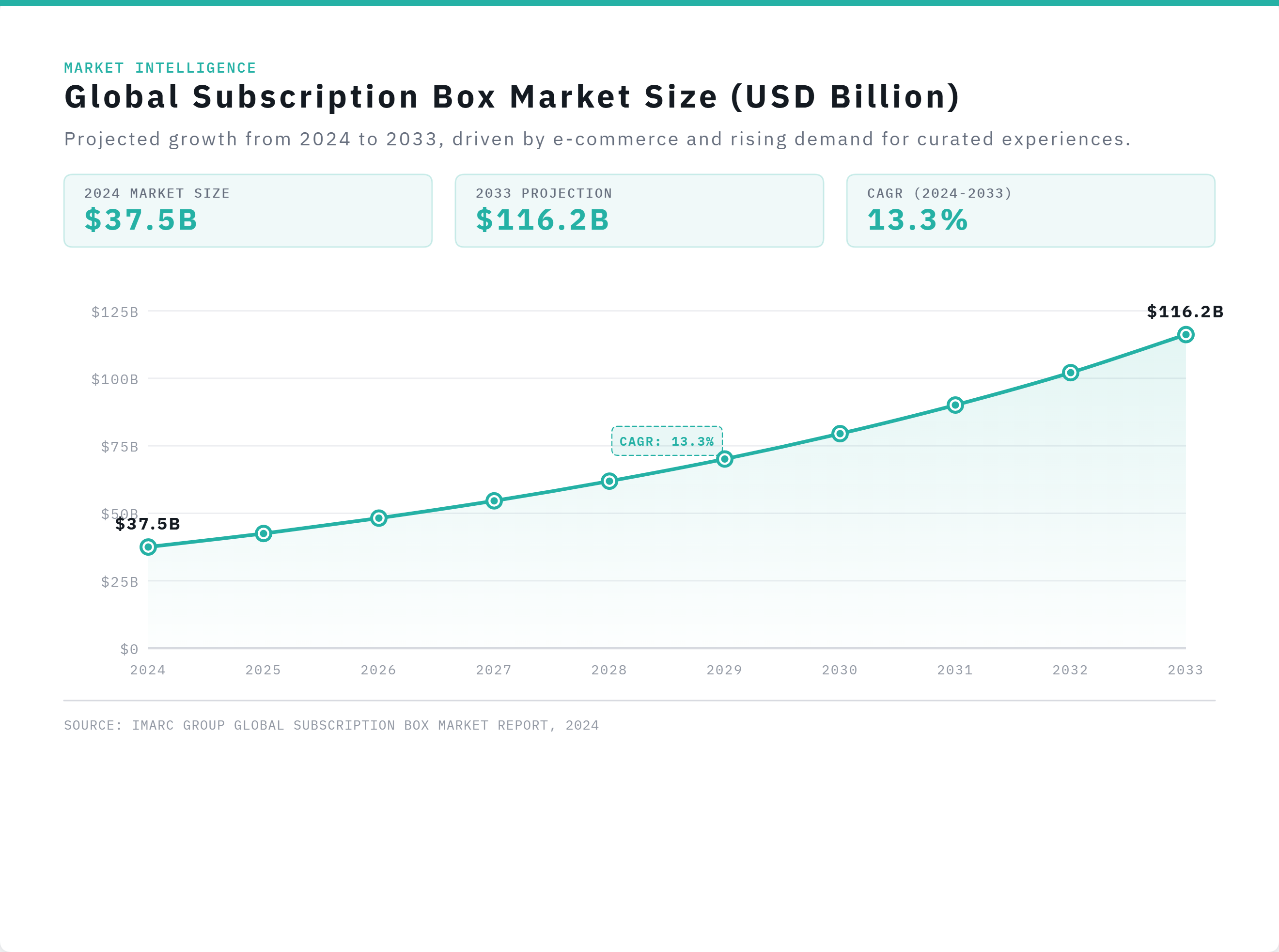
For most subscription box businesses, kitting and assembly are the most labor-intensive stages of the operation. Pre-kitting during off-peak periods reduces bottlenecks during the ship window and gives your team more time to catch quality issues before boxes are sealed. The global subscription box market reached $37.5 billion in 2024 and is projected to grow at 13.3% annually through 2033 – meaning the operators who build reliable fulfillment systems now are building them into a much larger market.
#2. Verify Every Kit Against the BOM
Every assembled box should be checked against the BOM before it's sealed. The verification doesn't have to be slow – a weight check is one of the fastest QC methods. A completed kit, weighed against its expected weight, reveals missing components in seconds.
For higher-volume operations, barcode scanning at the pack station confirms that each component was included before the box closes. Errors caught at this stage cost almost nothing to fix; errors that ship cost customer trust.
#3. Check Packaging and Presentation Consistency
Subscription box packaging isn't just a container; it's a brand touchpoint. Every box in the cycle should look the same: inserts in the correct position, tissue paper folded to standard, branded tape applied consistently. Documenting this with a photo reference guide at kitting stations removes ambiguity for staff and keeps the unboxing experience consistent across the full run.
Order Processing and Shipping
#1. Sync Orders with Your Fulfillment System
Your subscription platform (Shopify with a subscription app, Cratejoy, Subbly, or a custom system) needs to push orders directly to your WMS or 3PL portal without manual re-entry. Every manual touchpoint in this process is a place where an order can get lost, duplicated, or misrouted.
Test this integration before the ship window opens, particularly after any platform updates. Integrations break quietly – an API change in your billing system can silently stop orders from flowing to fulfillment, and you won't find out until subscribers start emailing.
#2. Segment Orders by Variant and Address Type
If you offer multiple box tiers or regional variants, segment order batches before pick-and-pack begins. Mixing standard- and premium-tier orders on the same pick list is one of the most common mistakes operators make in subscription box fulfillment.
Separate domestic from international shipments at this stage as well – they require different labels, potentially different packaging, and different carrier handoffs.
#3. Rate-Shop Carriers and Apply Labels
Once orders are batched, run them through carrier rate shopping to confirm you're using the lowest-cost option for each shipment's weight, dimensions, and destination zone. Carrier rates change, and the configuration you set six months ago may not reflect current pricing. Labor alone accounts for 45-65% of total fulfillment costs, according to F. Curtis Barry & Company, making every minute saved during pick-and-pack meaningful at scale.
Print and apply labels in the correct batch order. A mislabeled box that ships to the wrong address is one of the most expensive errors in subscription fulfillment – it requires a replacement shipment, a customer service interaction, and frequently, a refund.
The most consistent way to reduce subscription box shipping costs is to address this at the rate configuration and label generation stage, not after shipments go out.
#4. Confirm Ship Date and Notify Subscribers
Subscribers who know their box is on the way are less likely to contact support asking about it. Send a dispatch confirmation email with tracking information as soon as the label is generated or the carrier picks up the shipment. This one step significantly reduces the number of "where's my box?" tickets during the ship window.
If your ship window spans multiple days – some 3PLs process subscription batches over two or three days – be clear in your communications about when each cohort will ship.
Post-Shipment Monitoring
#1. Track Delivery Performance in Real Time
Pull a delivery report three to five days after your ship date. Flag any orders that haven't updated in transit – stuck shipments, failed delivery attempts, or returns-to-sender should be identified and resolved before subscribers contact you. Recurly's benchmarks put subscription box churn at 12.71% per month, the highest of any physical subscription category – and delivery failures are a direct contributor to that number.
Pay attention to zone-based delivery times. A carrier that consistently underperforms on Zone 6-8 shipments is costing you subscriber satisfaction in those regions, and it's worth addressing during your next carrier review.
#2. Capture and Act on Post-Delivery Feedback
Set up a short post-delivery survey – sent 24-48 hours after the estimated delivery date – asking subscribers what they thought of the box. Questions about product satisfaction matter, but so do logistics questions: did it arrive on time, was the packaging intact, was anything missing?
This data tells you where your fulfillment process is breaking down. A spike in "item was missing" responses points to a kitting accuracy problem. Recurring "packaging was damaged" responses indicate a void-fill or carrier-handling issue. Neither of those will show up in your WMS data.
When to Reassess Your Fulfillment Setup
The checklist above assumes that your current fulfillment setup – whether in-house or outsourced – can execute each step. As order volume grows, some of those assumptions no longer hold.
The point at which in-house vs. outsourced subscription box fulfillment becomes a real question is usually when the ship window starts to stretch beyond what your team can reliably execute, or when kitting errors begin to creep up during peak volume. A 3PL that specializes in subscription fulfillment brings dedicated kitting infrastructure, WMS integration, and carrier relationships that reduce cost per shipment as volume scales.
If you're evaluating that decision now, Productiv's subscription box fulfillment services are designed specifically for brands that need reliable, cycle-based execution with full visibility into kitting and shipping.
Frequently Asked Questions
#1. How does subscription box fulfillment work from start to finish?
The cycle begins four to six weeks before your ship date with BOM finalization and supplier coordination. Inventory is received, inspected, and allocated to the cycle. Kitting assembles boxes against the BOM, followed by QC checks. Orders are then processed, labeled, and shipped, with post-dispatch delivery performance monitored. The full cycle repeats each billing period.
#2. What are the most common subscription box fulfillment mistakes?
The most common errors are running out of a component mid-cycle due to poor inventory allocation, kitting inaccuracies that result in wrong or missing items, and label errors that send boxes to the wrong addresses. Order segmentation failures – mixing tier variants on the same pick list – are also frequent. Most of these trace back to inadequate pre-cycle planning rather than execution-stage breakdowns.
#3. How do I manage inventory for a monthly subscription box?
Reserve component inventory for each cycle immediately after the order cutoff. Keep subscription-allocated stock separate from inventory available for standard orders in your WMS. Set reorder points based on projected subscriber volume plus a safety buffer, and coordinate supplier delivery deadlines with a 5- to 7-day cushion built in before your ship window opens.
#4. What causes subscription box churn, and how does fulfillment affect it?
Voluntary churn is driven by perceived value – subscribers canceling because the box no longer feels worth it. Fulfillment directly affects that perception: late shipments, missing items, damaged packaging, and inconsistent box quality all signal that the operator doesn't have control of their process. According to Recurly, subscription boxes have a monthly churn rate of 12.71%, the highest among physical subscription categories.
#5. When is the right time to outsource subscription box fulfillment?
Consider outsourcing when your ship window takes more than two to three days to complete, when kitting error rates are rising, or when your team is spending more time on logistics than on product curation and subscriber growth. Volume alone isn't always the trigger – complexity is. If your box has multiple tiers, frequent product changes, or custom packaging requirements, a 3PL with subscription box experience will execute more reliably than an in-house team stretched thin.
#6. What's the difference between subscription box fulfillment and regular ecommerce fulfillment?
Regular ecommerce fulfillment processes individual orders as they arrive, with flexible timing. Subscription fulfillment is batch-based – a defined volume of identical or tiered boxes ships within a narrow window, usually monthly. This creates concentrated kitting labor, stricter inventory requirements, and tighter coordination between billing cutoffs and warehouse operations. Errors in subscription fulfillment affect many orders simultaneously rather than one at a time.
#7. How do I reduce shipping costs for my subscription box?
The primary levers are dimensional weight optimization (packaging sized as tightly as possible to the product), carrier rate shopping across multiple carriers, and zone skipping for high-volume batches. Consolidating shipments and maintaining a clean, validated address list also reduces costs by eliminating reshipments. A 3PL with negotiated carrier rates typically achieves shipping costs 10-30% below standard retail rates for subscription-volume batches.
Key Takeaways
- Fulfillment errors – not just pricing or product – are a primary driver of subscription box churn, which averages 12.71% per month for the category.
- Pre-cycle preparation (BOM sign-off, supplier lead times, subscriber cutoff dates) determines whether the rest of the process works.
- Inventory allocation must separate reserved subscription stock from general available stock to prevent mid-cycle shortages.
- Kitting accuracy should be verified against the BOM at the assembly stage, not discovered post-shipment through subscriber complaints.
- Post-shipment tracking and subscriber feedback are not optional monitoring steps – they're the data source for fixing the next cycle.
- If your ship window is stretching or kitting error rates are rising, the checklist isn't the problem – the fulfillment infrastructure is.
20 Years of Kitting Excellence
Ready to Streamline Your Supply Chain?
Join industry leaders achieving 99%+ SLA performance with flexible kitting, fulfillment, and 3PL solutions.
Get in Touch