Every subscription box brand eventually hits the same wall. Orders start climbing, the product mix changes month to month, and packing day turns into a multi-day scramble. Items go missing. Boxes ship with the wrong contents. Subscribers notice.
The fix is not more staff or faster packing. It is a proper kitting and assembly process - one built around the recurring, batch-based nature of subscription fulfillment rather than borrowed from standard ecommerce workflows.
Here is what a process that actually holds up at scale looks like, and which gaps most brands do not catch until they are already paying for them.
What Is Subscription Box Kitting?
Kitting is the process of pre-assembling individual products into a single, ready-to-ship unit before orders go out. For subscription boxes, this means combining every item in that month's box: the products, such as inserts, tissue paper, and promotional cards, into a finished, verified package that sits in staging until ship day.
Each completed kit receives its own SKU (Stock Keeping Unit) in the warehouse management system. Instead of picking five separate products for each subscriber at the time of order, warehouse staff picks one pre-built unit – the picking work shifts to before orders drop, not after.
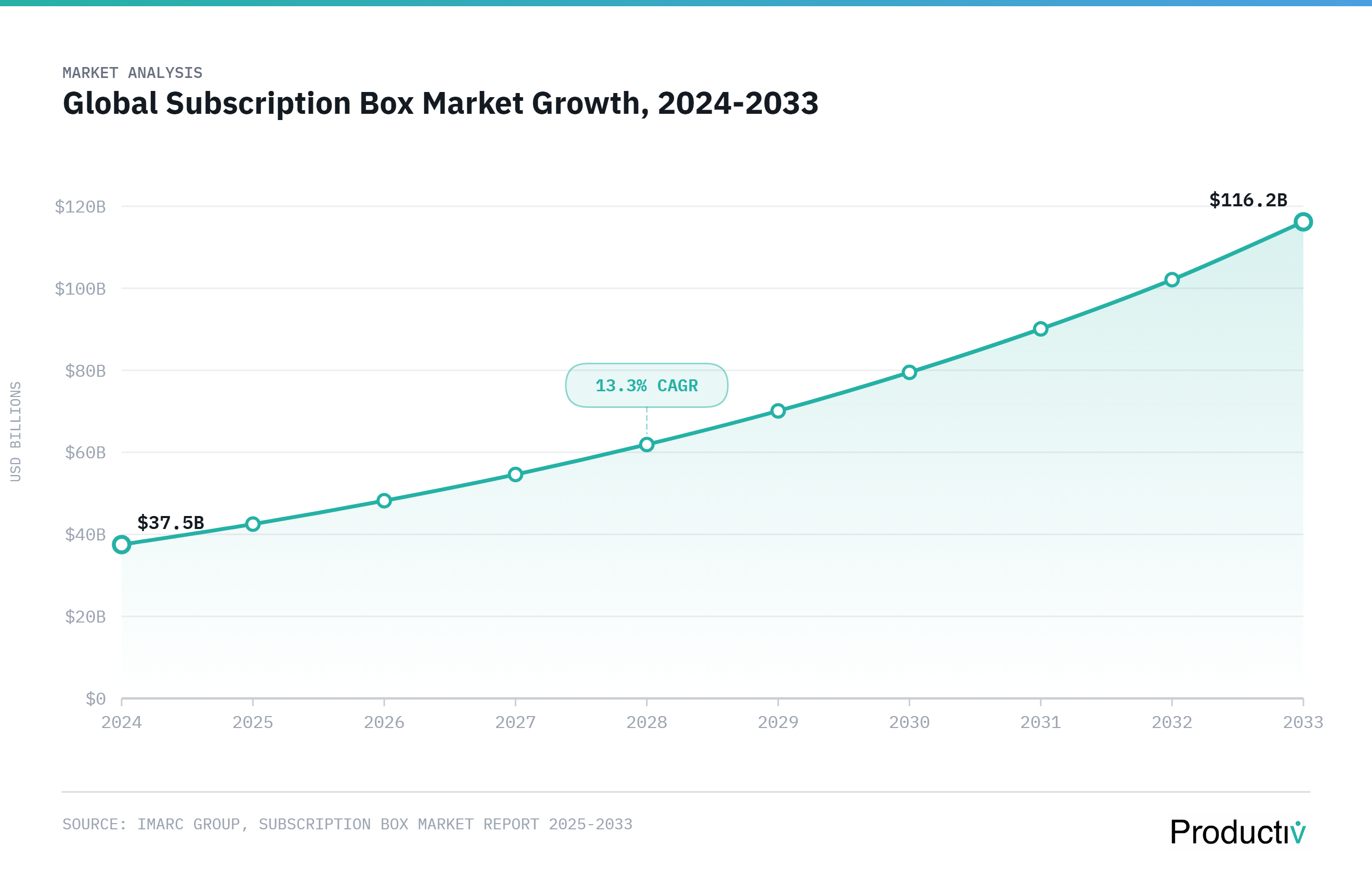
This distinction matters more for subscription brands than for any other fulfillment model. According to IMARC Group, the global subscription box market reached USD 37.5 billion in 2024 and is projected to grow at a 13.3% CAGR through 2033. At that scale and growth rate, the brands that can execute assembly accurately and on time have a structural advantage over those that still treat each box as a one-off ecommerce order.
Your subscription box fulfillment process as a whole depends on kitting being done right. It is not one optional step in the chain, but rather the operational core.
What Is Subscription Box Assembly?
Assembly is the product-preparation work that occurs before kitting begins. Where kitting groups finished items into a single package, assembly physically prepares individual products so they are ready to be kitted. It involves applying labels, bundling paired items, sealing containers that arrive open from a vendor, folding tissue liners, attaching hang tags, or inserting segmented inserts by subscriber tier.
Kitting and assembly are often conflated because they occur in the same space with the same staff. But assembly operates at the product level (how do I prep this item?) while kitting operates at the box level (what goes in, in what order?). Mixing the two into one undocumented process makes errors in either layer harder to catch and harder to train around.
This distinction matters more in subscription boxes than in standard e-commerce because the product mix changes every cycle. Assembly requirements that applied last month may not apply this month, which is why subscription box kitting and assembly capability at the 3PL (third-party logistics) level is evaluated separately from general fulfillment. The ability to absorb new prep instructions quickly each cycle is not something every provider can do reliably.
Batch Kitting vs. Customized Kitting
Subscription box assembly falls into two distinct models, and the one you choose shapes every part of your kitting operation.
Batch kitting means building identical boxes in bulk. Every subscriber in a given tier receives the same products in the same configuration. Assembly teams work through the month's run like a production line: one box version, repeated thousands of times. This approach is operationally straightforward, easy to check and ensure quality standards are met, and cost-effective to outsource. It works well for replenishment-style boxes and any brand where the curated selection is the same for all subscribers.
Customized kitting is more complex. Boxes vary by subscriber tier, preferences, or profile data - different products for different segments, with inserts, samples, or configurations that change order by order. The assembly process must handle dynamic BOMs, subscriber-level data flowing into the warehouse, and quality checks across variable configurations. The loyalty payoff can be significant: personalized boxes tend to have lower churn, but the operational requirements are proportionally higher.
Most brands start with batch kitting and introduce customization gradually as subscriber data matures and fulfillment capacity scales. Understanding this distinction is important when you evaluate subscription box fulfillment partners; not every 3PL can handle both models with equal depth.
7 Steps of Subscription Box Kitting and Assembly Process
#1. Create a Bill of Materials That Covers Both Products and Assembly Instructions
Before anything gets assembled, every item in the box needs to be documented in a bill of materials. For subscription boxes, a complete BOM covers more than just SKUs and quantities; it also documents assembly instructions for each product that requires prep. If a vendor's candle arrives unlabeled, the BOM should specify the label to apply and where. If two items are meant to be bundled together in tissue before kitting, the BOM also captures that.
This is where most brands underinvest. They maintain a product list but treat assembly steps as verbal instructions passed along on packing day. That approach works at 200 boxes. It breaks down at 2,000, and it breaks down badly when a key team member is absent.
Review and finalize the BOM, including all assembly instructions, at least two weeks before your planned ship window. That lead time gives procurement enough room to flag component shortages and gives the kitting team time to review prep requirements before inventory arrives.
#2. Plan and Stage Inventory
Before anything gets assembled, every item in the box needs to be documented in a bill of materials. The BOM specifies exact product SKUs and quantities, insert configurations, packaging materials, any special handling instructions, and the order in which items are placed in the box.
The BOM is what assembly staff work from. It is also what your warehouse management system uses to track component consumption and trigger restocking. A poorly maintained BOM is one of the fastest ways to ship incorrect boxes - if a product substitution or insert change does not make it into the BOM before kitting begins, those changes will not reach the warehouse floor.
Review and finalize the BOM at least two weeks before your planned ship window. That lead time gives procurement enough room to flag any component shortages before the kitting team is set up and waiting.
#3. Plan and Stage Inventory
Once the BOM is locked, confirm that every component is on hand in the required quantities. This means your actual physical count, not your system record. Inventory discrepancies between WMS data and physical stock are common. CAPS Research, cited by NetSuite, found that average inventory accuracy across businesses is roughly 83%. Running a physical count before kitting starts prevents the mid-assembly discovery that a key item is 300 units short.
Stage components in or near the kitting area before assembly begins. Requiring staff to retrieve items from distant storage locations mid-build slows throughput and introduces opportunities for picking errors. Good subscription box inventory management depends on inventory being positioned for kitting, not just stored somewhere in the warehouse.
#4. Complete Pre-Kitting Assembly
This step happens before you build the boxes. Products that need prep, including labels applied, items bundled, and tissue liners positioned, should be processed in a dedicated assembly pass rather than alongside kitting. Mixing the two forces staff to context-switch between different instruction sets at the same station, which is where errors start.
Running the assembly first also creates a clean QC checkpoint. When it is complete, the kitting team receives products that are ready to place, not products still needing work. Catching an assembly error before kitting begins costs seconds; catching it in a finished box costs a reship.
#5. Build Out Kitting Stations
Kitting stations should be purpose-built for the task, not a corner of the receiving area converted under time pressure. Each station needs a flat work surface large enough to stage a full box's worth of components, visual guides showing the current month's BOM configuration, barcode scanners for component verification, and packaging materials within arm's reach.
Ergonomics affects both accuracy and throughput. Anti-fatigue mats, proper table heights, and logical component placement reduce fatigue during long assembly runs, which directly affects error rates in the second half of a shift.
For brands doing batch kitting, an assembly-line layout works well, with one person per component, boxes moving down the line, and accumulating items. For customized kitting, individual stations, where each assembler builds a complete box from start to finish, provide better control over per-order accuracy.
#6. Assemble and Verify Each Kit
Assembly without verification is just packing. Every item placed in a box should be scanned against the BOM (Bill of Materials), not eyeballed. Barcode scanning confirms that the correct SKU is present before the box moves to the next stage. Weight verification adds a second layer: a completed box that weighs outside its expected range by more than a set tolerance indicates a missing or incorrect item.
These checks should happen at the station, not only at a final QC point before shipping. Catching errors early keeps them from compounding - a wrong item found at the station is a 30-second correction; the same error found after shipping is a re-ship, a customer service ticket, and a potential cancellation.
Build regular sample audits into the process. Pull a percentage of completed kits - typically 2-5% - and open them for full content verification. This catches systematic errors that barcode scanning alone misses, such as items that scan correctly but are defective.
#7. Stage Completed Kits for Shipping
Finished kits move to a staging area to wait for ship day. This is where subscription fulfillment differs most sharply from standard ecommerce: boxes are built in advance and released in a batch window, often a 48-72 hour period when all of that month's boxes go out together.
The staging area needs to be organized by subscriber segment or shipping zone if you are doing tiered or personalized boxes. Staging errors, such as boxes assigned to the wrong shipping batch or label, are a common source of wrong-item complaints that appear after a flawless kitting process. Label application and carrier assignment should both be verified against the subscriber record before sealing.
If your brand runs an e-commerce storefront alongside the subscription, that inventory must be tracked separately and never pulled from kitting stock. Mixed inventory pools are a reliable source of fulfillment mistakes that are hard to diagnose after the fact.
Why Assembly Quality Affects Subscriber Retention
A box where the tissue paper is crumpled, a product is face down, or an insert is missing tells the customer their box was rushed. According to Dotcom Distribution's Packaging Survey, 52% of consumers are more likely to repurchase when they receive premium packaging, and 40% would share a photo on social media if it came in branded packaging. The second number is organic acquisition for subscription brands.
Longer-tenured subscribers are more sensitive to presentation quality than new ones; those closest to canceling notice it most. This is why the decisions regarding your subscription box packaging need to be reflected in assembly SOPs. Item placement order, insert positioning, and how the box closes – all of it needs to be documented, not left to individual judgment on packing day.
5 Common Kitting and Assembly Challenges
Most subscription box fulfillment mistakes trace back to one of five recurring breakdowns. None of them is random; they are process gaps that show up predictably, usually at the worst possible time.
#1. Assembly Requirements Are Changing Every Month Without Updated SOPs
Subscription boxes frequently rotate products, so the assembly requirements change with each cycle. Staff who know how to prep last month's items may not have clear instructions for this month's. Without documented assembly SOPs that update alongside the BOM, institutional knowledge concentrates in whoever ran the previous build, and the next build suffers when that person is unavailable or misremembers the details. The fix is treating assembly instructions as a versioned document tied to each cycle's BOM, not as tribal knowledge passed verbally on packing day.
#2. Inventory Arriving Too Late to Kit on Schedule
The most frequent cause of missed ship windows is not a kitting failure but a receiving failure. Products arrive at the warehouse days before the ship day, leaving no time to receive, inspect, stage, and assemble them. Building a receiving-to-kitting buffer of at least five business days into your vendor agreements reduces this risk. If you are sourcing multiple products from different vendors, coordinating delivery timing across all of them is part of the planning work, not an afterthought.
#3. Monthly Bom Changes That Do Not Reach the Warehouse
Product substitutions, insert swaps, and tier configuration changes that are decided at the brand level often fail to make it into the warehouse's working BOM before kitting begins. The result is boxes assembled to last month's spec. Establish a single approved BOM release process: a single, version-controlled document that both the brand and the fulfillment team sign off on before any assembly starts. Any change that comes in after that sign-off waits for the next cycle.
#4. Scaling Error Rates
A 0.5% error rate at 2,000 boxes per month is 10 wrong boxes. At 20,000 boxes, it is 100, which is enough to generate a visible pattern in customer service tickets and social media. The mistakes that appear manageable at early volume become operationally serious as subscriber counts grow. Scan-verify systems and structured QC sampling maintain accuracy as you scale and prevent accuracy from degrading as volume increases.
#5. Personalization Data Not Reaching the Warehouse Floor
For brands running tiered or customized boxes, subscriber segmentation data needs to be in the kitting team's hands before assembly starts, not just in the subscription management platform. If the 3PL or warehouse team does not have a reliable data feed from your subscriber platform, personalization breaks down, and subscribers in one tier receive content from another tier. This is a systems integration problem, not a kitting problem, but it shows up as a kitting error.
When to Outsource Subscription Box Kitting and Assembly to a 3PL
Most brands start in-house and hit a wall faster than expected. Outsourcing to a 3PL that specializes in subscription fulfillment, such as Productiv, makes sense when:
- Kitting and assembly combined take more than two dedicated staff days per month
- Error rates are not improving despite process changes
- A subscriber spike would require pulling staff from other functions
- The unboxing experience you want to deliver is beyond what your current setup can produce
- You are past roughly 1,000 boxes per month, and the per-kit math favors variable 3PL costs over fixed internal overhead
Understanding the difference between in-house and outsourced fulfillment means factoring in more than labor: management time, error-correction costs, and lost focus on product and growth all belong in that calculation.
When evaluating partners, ask specifically about kitting throughput capacity, how BOMs are managed each cycle, and what QC documentation they provide per batch. Vague answers on any of those are a signal worth taking seriously.
Frequently Asked Questions
#1. What is the best way to handle kitting and assembly for subscription boxes?
The most effective approach combines a finalized bill of materials, inventory staged before assembly begins, barcode scanning at each kitting station, and weight verification on completed boxes. Building kits during non-peak periods, such as before your ship window opens, gives you time to catch and correct errors without the pressure of an imminent deadline. For brands that sell more than a few hundred boxes per month, outsourcing to a 3PL with dedicated subscription-kitting infrastructure typically delivers better accuracy and lower per-unit costs than in-house assembly.
#2. How does subscription box kitting differ from standard e-commerce fulfillment?
Standard e-commerce fulfillment picks individual items per order when the order arrives. Subscription box kitting assembles complete boxes in advance, in batches, before orders are released. This distinction affects everything from how inventory is planned and staged to how labor is scheduled and how errors are caught. Subscription fulfillment also operates on hard monthly ship deadlines that do not exist in standard e-commerce; a delay affects all subscribers at once, not just individual orders.
#3. How can I improve the unboxing experience without adding cost?
Most improvements to the unboxing experience come from better assembly documentation, not more expensive materials. A clear SOP that specifies item placement order, tissue folding, and insert positioning ensures consistency across thousands of boxes. Consistency is what subscribers notice, and what they do not notice, until it is absent. Branded inserts, welcome cards, and QR codes that link to digital content add perceived value at low per-unit cost. According to Dotcom Distribution, 40% of consumers would share a photo of a purchase on social media if it comes in branded packaging, which makes insert and packaging decisions a legitimate customer acquisition investment.
#4. What causes most kitting errors in subscription boxes?
The most common sources are inventory that was not physically counted before kitting started, BOM changes communicated verbally rather than through an approved document update, and assembly without scan verification at the station. Missing items are the most expensive to fix because each requires a reship plus customer service time. Wrong items are marginally cheaper to correct only because some customers can flag them before opening. Both types are largely preventable with scan-verify processes and a formal BOM sign-off step before kitting begins.
#5. How do I manage inventory across a changing monthly box?
Treat each month's box as a distinct inventory project with its own inbound receiving timeline, staged storage location, and kitting schedule. Component SKUs that appear across multiple months need to be allocated to kitting stock separately from any ecommerce or retail inventory, with clear system records preventing cross-pool pulls. Setting a minimum inventory arrival date relative to your ship window, typically 7-10 business days before kitting is scheduled to start, gives enough time to surface shortages and work around them before they affect the build.
#6. When should a subscription box brand outsource kitting to a 3PL?
Outsourcing becomes worth evaluating when internal kitting takes more than two dedicated staff days per month, when error rates are not improving with process changes, or when subscriber growth is outpacing your team's capacity to scale assembly without hiring. The real cost comparison includes the management time spent coordinating packing days, the cost of errors and reshipping, and the opportunity cost of leadership attention diverted from product and growth to logistics.
Key Takeaways
- Kitting and assembly are distinct steps: assembly prepares individual products for the box (labeling, bundling, light configuration); kitting groups finished items into a verified, single-pick unit.
- Batch kitting suits standardized boxes; customized kitting handles subscriber-level personalization but requires stronger systems integration.
- A complete BOM documents both product SKUs and per-product assembly instructions; treating it as a product list only is one of the most common setup failures.
- Running assembly as a dedicated pass before kitting begins reduces errors and creates a clean QC checkpoint between the two stages.
- Assembly quality directly affects retention: 52% of consumers are more likely to repurchase when they receive premium packaging (Dotcom Distribution).
- Kitting errors that are tolerable at low volume become operationally costly at scale; QC sampling must be built in from the start, not added later.
- Most brands should evaluate outsourcing once they surpass roughly 1,000 boxes per month or when assembly and kitting take more than 2 days of dedicated staff time per cycle.
20 Years of Kitting Excellence
Ready to Streamline Your Supply Chain?
Join industry leaders achieving 99%+ SLA performance with flexible kitting, fulfillment, and 3PL solutions.
Get in Touch