Subscription box churn is rarely about the product. It's about what happens after someone subscribes. A late shipment, a mis-packed box, a week of silence when something goes wrong; these are the moments that drive cancellations, and they're entirely avoidable.
Left uncorrected, each one compounds across every future cycle, quietly eroding the retention your acquisition budget already paid for.
In this article, we’re going to cover the most common subscription box fulfillment mistakes to help you prevent losing money and subscribers.
8 Subscription Box Fulfillment Mistakes
#1. Forecasting Inventory Like a One-Time E-commerce Order
Standard e-commerce fulfillment is reactive; you receive an order, you ship it. Subscription box fulfillment is a batch operation with a hard deadline. Every subscriber expects their box within the same window, which means every stockout hits hundreds or thousands of orders simultaneously rather than one at a time.
You're not predicting how many units might sell; you're projecting a confirmed subscriber count, accounting for mid-cycle cancellations, planning for multi-SKU (Stock Keeping Unit) kitting, and ordering from vendors far enough in advance to receive goods before pack day.
Effective subscription box inventory management starts with your subscriber count, works backward from your ship date, builds in a buffer for late cancellations, and treats each SKU in the box as a dependent variable. If item A is delayed, items B through D are stacked in a warehouse waiting. Miss that sequence, and you're either sitting on excess inventory or scrambling for a last-minute substitution.
#2. Skipping Multi-Stage Quality Control
A single picking error in standard e-commerce means one unhappy customer. In a subscription model, that same error gets replicated across every box in the batch before anyone notices.
The pattern most brands follow early on – inspect at the end of the line – doesn't work at subscription scale. Quality control (QC) needs checkpoints at three stages: during kit assembly, before sealing, and a final sampling pass before carrier handoff. Each stage catches a different category of error.
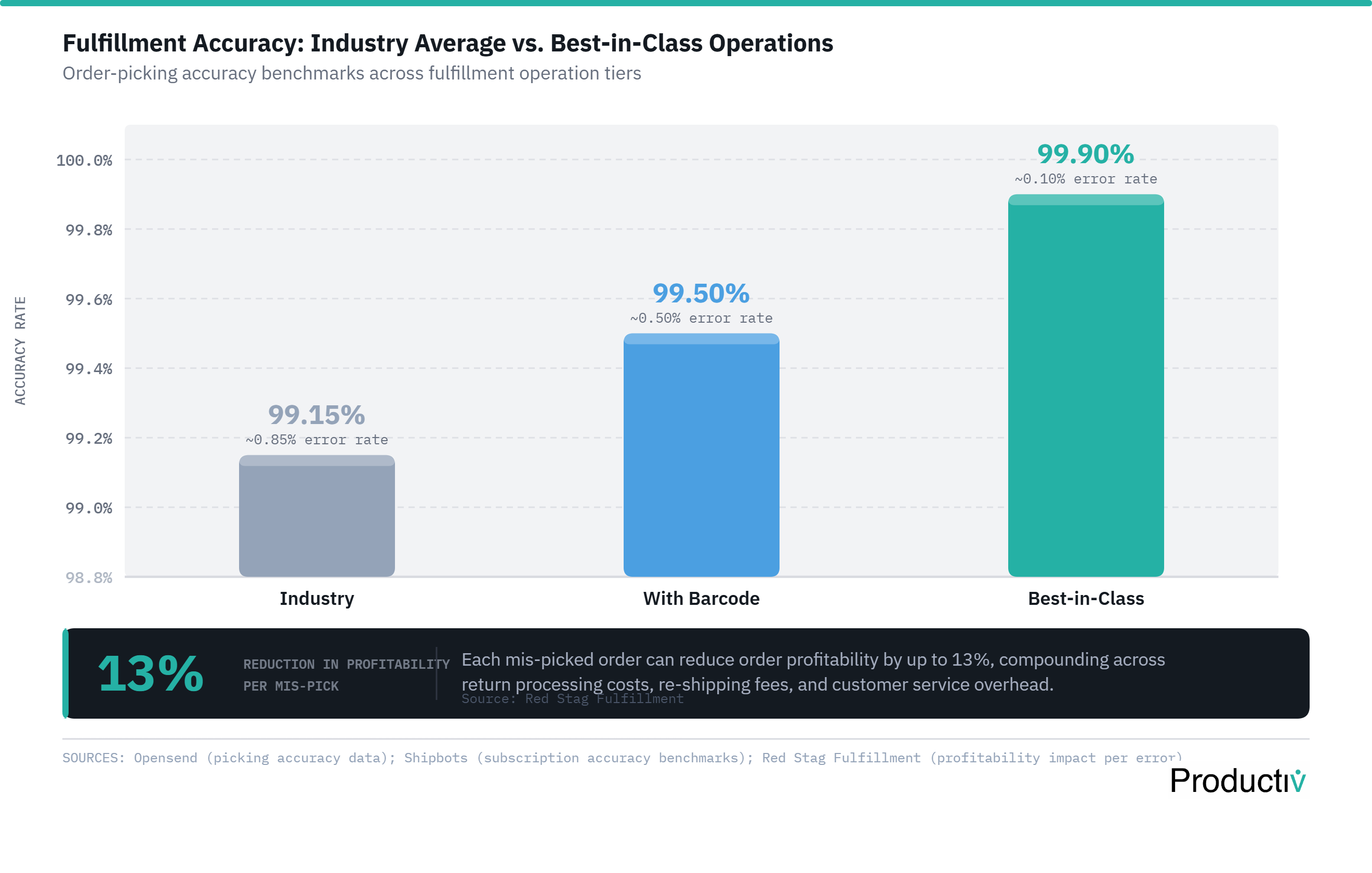
According to a consumer study from Voxware, 16 percent of shoppers will stop buying from a retailer entirely after receiving just one incorrect delivery. For subscription brands, that number matters more because a subscriber represents months of future revenue. Well-run operations consistently keep error rates below 0.5% by scanning items as they enter each kit and again at seal, catching mismatches before they ship rather than after the unboxing video goes up.
#3. Holding onto In-House Fulfillment Past the Breaking Point
Early-stage brands pack their own boxes for good reason: it keeps costs low and gives founders direct control over quality. The problem is recognizing when that model stops being an advantage and starts being a ceiling.
Most subscription businesses hit this point somewhere between 300 and 800 monthly orders, though the real signal is operational. You're spending more time in the warehouse than on the business, errors are creeping up because the team is rushed, and peak months are breaking the process entirely.
The decision between in-house and outsourced subscription box fulfillment isn't permanent, but getting the timing wrong is expensive. Switching mid-growth cycle means onboarding a new partner during high-volume periods. Evaluating the threshold before you hit it gives you time to transition during a slower cycle. It opens access to carrier discounts of 10-30% below standard rates that 3PLs (third-party logistics) with subscription volume can negotiate.
#4. Treating Packaging as a Shipping Container
The box that arrives at a subscriber's door is the only physical interaction your brand has with them that month. A damaged corner, a shifting product, tissue paper thrown in without thought – any of these signals to the subscriber that the operation doesn't care about the details.
Packaging in subscription fulfillment has two jobs: protect the contents during transit and deliver the unboxing moment the subscriber paid for. Optimizing only for the first sacrifices the experience that drives word-of-mouth, social sharing, and renewals.
What's worth noting here is that packaging problems at scale aren't usually about the wrong box choice, but about inconsistency across a batch. Standard operating procedures and a visual reference at every packing station help maintain consistent presentation quality when a team assembles hundreds of boxes under time pressure.
#5. Running Kitting Without a Documented Process
Subscription box kitting and assembly is not intuitive work when a team is under pressure to pack hundreds of boxes before a carrier cutoff. Without a documented assembly sequence, workers make individual decisions about how to build each kit, leading to inconsistency across the batch and recurring errors in the same position each cycle.
The most damaging kitting mistakes aren't random; they're systemic, and they only become visible when you're tracking performance at the kit level.
A bill of materials for each kit type, a visual reference at every workstation, scanning at each assembly step, and a weight check at seal close most of the accuracy gap without significant capital investment. Cross-training matters too: if only two people know how to assemble your main kit, a single absence can create a bottleneck that delays an entire month's shipment.
#6. Treating Shipping Cost as a Fixed Expense
Shipping is typically the largest single line item in subscription box unit economics, and it's the one most brands accept as fixed. It isn't. Carrier rates are negotiable. Zone distribution affects price. Dimensional weight rules affect price. The way a box is packed affects the price. Brands that don't actively reduce subscription-box shipping costs end up paying retail rates for commercial volume.
Beyond carrier selection, packaging dimensions have a direct cost impact: carriers charge based on whichever is greater, actual weight or dimensional weight. A box sized for a larger configuration generates unnecessary dimensional weight charges on every shipment. Distributing inventory across two or three strategically placed fulfillment locations also lowers average transit zones and cuts per-order shipping costs without requiring carrier renegotiation.
#7. Going Silent When Something Goes Wrong
When a vendor ships late, a product arrives damaged, or a carrier misses delivery windows, subscription brands often wait until subscribers start asking before communicating anything.
The silence is usually well-intentioned; teams don't want to raise alarm before they know the full picture. But subscribers who receive no communication and experience delays with their tracking links draw their own conclusions. A subscriber who gets a proactive update before they even notice a delay interprets the same situation entirely differently.
The subscriber relationship also depends on basic visibility: a working tracking link, shipping confirmation sent the same day as dispatch, and a clear contact channel when something doesn't arrive. These operational details belong in your subscription box fulfillment checklist and should be treated as non-negotiable. Proactive communication during fulfillment issues costs almost nothing and consistently reduces both cancellations and inbound support volume.
#8. Having No Plan for Peak Season
Holiday gifting cycles create a predictable surge in subscription box demand. First-time gift subscribers convert to long-term subscribers at high rates when the experience is good and churn just as fast when it isn't. Brands that don't plan for this spend January doing damage control instead of converting holiday subscribers into annual subscribers.
The operational mistakes are consistent: underestimating order volume, ordering inventory based on historical subscriber counts rather than projected gifting demand, and failing to build a staffing plan until the surge is already underway.
A carrier capacity commitment secured before October also matters; carriers add peak surcharges between October and January, and brands that didn't lock in volume commitments beforehand absorb those costs at the worst time. Knowing how to start and scale a subscription box business means building operational capacity before running the marketing campaign that fills it.
Frequently Asked Questions
#1. What are the most common subscription box fulfillment mistakes?
The most common mistakes are poor inventory forecasting that doesn't account for the batch nature of subscription shipping, skipping multi-stage quality control, and scaling in-house fulfillment past the operational breaking point. After those three, packaging inconsistency and the absence of proactive communication during delays round out the issues that most directly affect subscriber retention.
#2. What causes subscription box churn, and how does fulfillment affect it?
Churn in subscription boxes comes from two sources: perceived value (the box doesn't feel worth the cost) and operational friction (the receiving experience is frustrating). Fulfillment directly controls the second category. Late shipments, incorrect items, and damaged packaging are among the most cited reasons subscribers cancel. And because these boxes arrive monthly, a single bad experience leaves a stronger impression than it would in a one-time e-commerce purchase.
#3. When is the right time to outsource subscription box fulfillment?
The clearest signal is when the in-house operation is consuming time and resources that should be going toward product development, marketing, or subscriber retention. In practice, this tends to happen between 300 and 800 orders per month. However, the operational indicators matter more than the number: rising error rates, missed ship dates, and a team that's managing logistics instead of building the business. Choosing the right subscription box fulfillment partner before you hit the breaking point gives you time to transition during a slower cycle rather than during a surge.
#4. Is it better to fulfill subscription boxes in-house or use a 3PL?
Early-stage brands with low volume and tight margins often make more sense to fulfill in-house. As volume increases, the unit economics shift: a 3PL with subscription-specific experience can access carrier discounts unavailable to individual brands, bring WMS infrastructure that improves accuracy, and absorb volume spikes without requiring capital investment in warehouse space or staff. The right answer depends on where you are in the growth cycle, not on a fixed rule.
#5. How do I reduce shipping costs for my subscription box?
The three most effective levers are carrier negotiation (or working through a 3PL that already has discounted rates), right-sizing packaging to reduce dimensional weight charges, and distributing inventory across multiple fulfillment locations to lower average shipping zones. Carrier surcharges during peak season are also a significant cost driver that can be partially mitigated by securing volume commitments before October.
#6. How can I improve my subscription box unboxing experience?
The unboxing experience is largely a packaging and kitting consistency problem. Choosing the right box dimensions, tissue paper, inserts, and product placement is only part of it - the other part is making sure every box in a batch looks the same. That requires visual SOPs at every packing station, a QC step before sealing, and training that covers presentation standards, not just picking accuracy.
Key Takeaways
- Subscription box inventory planning works backward from a confirmed subscriber count and vendor lead times; regular e-commerce demand forecasting doesn't translate.
- Quality control needs three checkpoints: during assembly, before sealing, and a sampling pass before carrier handoff. End-of-line inspection alone misses systemic batch errors.
- Most brands hold onto in-house fulfillment too long. The transition threshold is operational, not just about order count.
- Packaging presentation directly affects retention. Inconsistency across a batch is almost always a process gap, not a staffing problem.
- Shipping costs are not fixed. Carrier negotiation, dimensional weight optimization, and zone distribution all have a measurable impact on per-order cost.
- Proactive communication during fulfillment issues consistently reduces cancellations compared to reactive support.
- Peak season planning requires volume projections, staffing schedules, and carrier commitments built at least two months in advance.
20 Years of Kitting Excellence
Ready to Streamline Your Supply Chain?
Join industry leaders achieving 99%+ SLA performance with flexible kitting, fulfillment, and 3PL solutions.
Get in Touch