Most subscription box founders price their box in the first week of planning – before they've calculated shipping, before they've talked to a 3PL (third-party logistics), and before they've thought hard about churn.
That guess becomes the number they're stuck defending for the next two years.
This guide walks through every cost that belongs in your pricing, the margin formulas that actually tell you if a price works, and the metrics you'll need to make informed pricing decisions at any stage of growth.
What Most Subscription Box Pricing Gets Wrong
The most common mistake is treating price as a product decision rather than a financial one. A founder picks a number that sounds competitive, then builds their cost structure around it. The problem is that a box priced to "feel affordable" and a box priced to stay solvent are rarely the same number.
Underpricing is the more dangerous error. When margins are thin, every unexpected cost - a supplier price increase, a shipping rate hike, a spike in return requests - pushes you closer to losing money on every box you ship. There's no buffer. The business that looked viable at launch starts to feel like a treadmill.
The opposite problem is real too. Overprice without clear value justification, and you'll see acquisition stall and churn accelerate before you have enough subscribers to learn from.
Getting the price right means understanding what the number actually needs to cover - and building backward from there.
The Full Cost Stack: What Belongs in Your Box Price
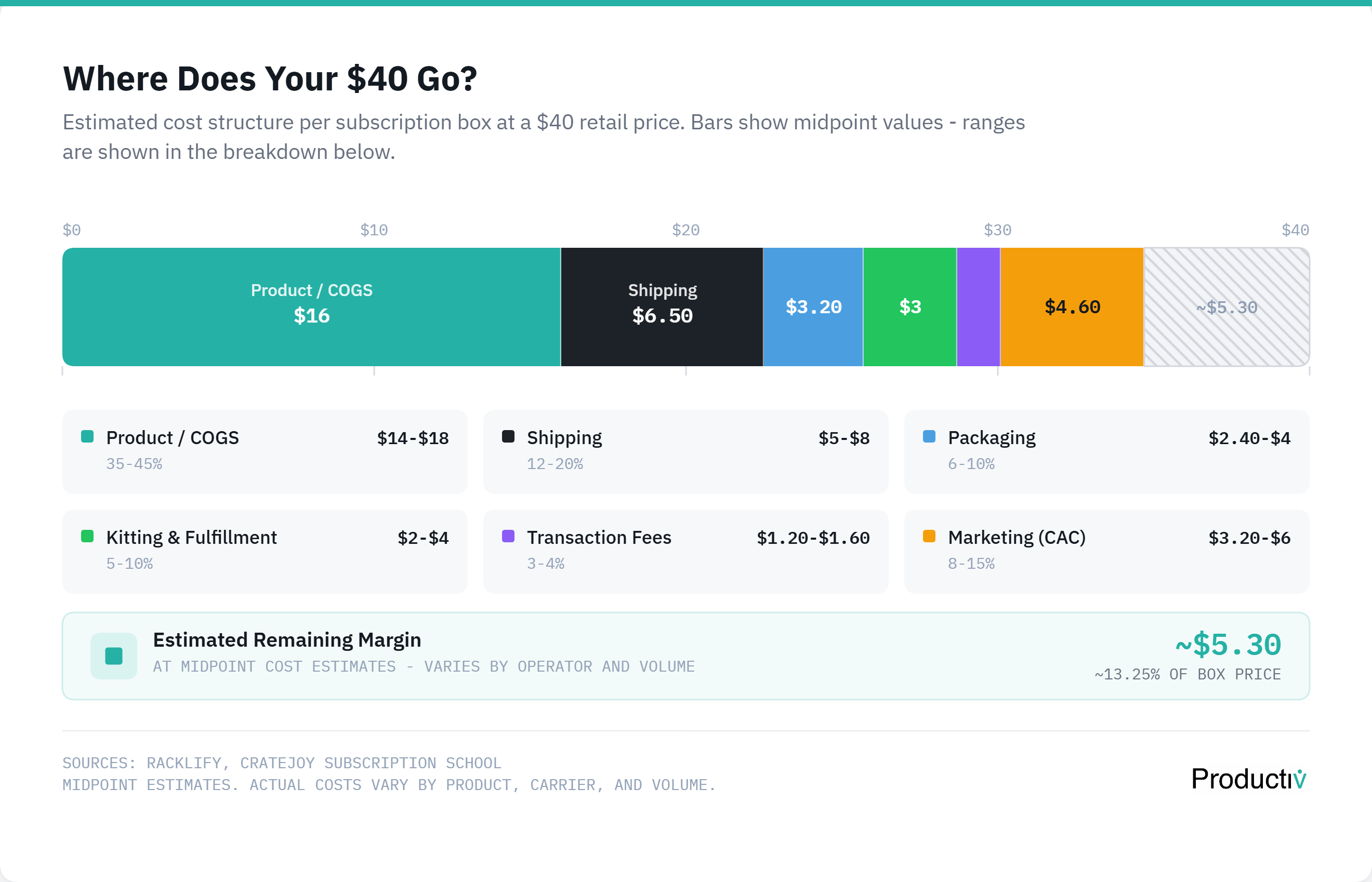
Before you can set a margin target, you need a complete picture of what each box costs you to produce and deliver. Here's every line item that belongs in your calculation.
#1. Product Cost (COGS)
Your cost of goods is the wholesale cost of everything that goes in the box. This is typically the largest single variable. A common mistake is budgeting product cost based on a sample month rather than accounting for the variance that comes with sourcing new products each cycle.
Budget conservatively. What you spend in a good sourcing month is not necessarily what you'll spend when a supplier falls through or a product arrives damaged.
#2. Kitting and Assembly
If you're handling kitting and assembly in-house or working with a 3PL to pack each box, that labor cost needs to be in your unit economics. The more complex your pack-out – inserts, multiple SKUs, tissue paper, custom placement – the higher your per-box assembly cost.
A standard 3PL pick-and-pack rate for subscription boxes typically runs $1.50 to $4.00 per box, depending on complexity and volume, but you should get actual quotes rather than assume the low end.
#3. Packaging Materials
This line is easy to underestimate. The outer mailer or shipper box, interior filler, tissue paper, branded inserts, stickers, thank-you cards, and tape all add up. Getting into custom subscription box packaging adds real design and tooling costs that are often treated as optional. They're not; packaging is part of the experience that drives retention.
#4. Shipping
Shipping is the cost that surprises founders most at scale. The rate you get for shipping 50 boxes a month isn't the rate you'll get at 500, and the rate you get at 500 changes again at 2,000.
Your average shipping cost will also vary by your subscriber geography. A box that ships primarily to urban zip codes in the Northeast will cost less per unit than one with heavy rural distribution.
Model a range, not a single number. Tools like Shippo and EasyPost let you run rate estimates across carrier options. Once your volume justifies it, either negotiated carrier rates or a 3PL's bulk shipping account can meaningfully reduce your subscription box shipping costs.
#5. Payment Processing Fees
Credit card fees are a fixed cost of doing business. Stripe charges 2.9% plus $0.30 per transaction as its standard rate. If you're on a marketplace like Cratejoy, there's an additional platform fee on top of that. These fees come directly from your margin and need to be included in your pricing model from the start.
#6. Marketing and Customer Acquisition Cost (CAC)
Your acquisition cost belongs in your unit economics even if it's variable. If you're spending $30 to acquire a subscriber who stays for 6 months and pays $35 a month, you recover your CAC in about a month. If your CAC is $80 and your margins are thin, you're funding a business that may never reach breakeven.
A common benchmark is to keep your CAC at 25-35% of your customer lifetime value. We'll cover how to calculate that below.
Price Ranges by Category: What the Market Actually Charges
Knowing your costs is half the job. The other half is understanding where your niche sits in the market's pricing landscape.
Research across thousands of U.S. subscription boxes shows four rough tiers:
- Under $20: Sample-size or consumable commodity boxes. Dollar Shave Club, Birchbox, and snack boxes typically live here. Margins are thin; volume and low churn are what make these work.
- $20-$35: Full-size items with a clear niche or lifestyle angle. BarkBox, Bean Box, and food discovery boxes. The most competitive price band in the market.
- $35-$50: Premium curation with stronger brand identity. Artisan products, specialty verticals, or boxes with a strong editorial or community angle.
- $50+: High-end or highly differentiated boxes where the product selection is hard to replicate and the perceived retail value of the contents is well above the box price.
The average subscription box in the U.S. costs roughly $43 per month, according to aggregated market data. That's an average, not a target; your price needs to reflect your cost stack and your niche positioning, not the mean of boxes that mostly aren't comparable to yours.
Understanding where you sit in the market also connects directly to how you build and run your subscription box business: higher price points allow for stronger margins but require more explicit value justification at acquisition.
4 Subscription Box Pricing Models
Your price point matters, but so does how you structure it. These are the most common models subscription box businesses use.
#1. Flat-Rate Pricing
One price, one box. Simple to communicate, simple to manage. Works best when your subscriber base is relatively homogenous, and your product offering is fixed. The risk is that a single price point either leaves money on the table with customers who'd pay more or excludes customers who'd subscribe at a lower tier.
#2. Tiered Pricing
Multiple versions of the box at different price points; typically a standard, premium, and sometimes a basic tier. A skincare brand might offer a 5-product standard box at $28 and a 9-product luxury tier at $58. This structure lets you capture a wider range of willingness-to-pay and creates a natural upsell path.
According to analytics from subscription management platforms, 61% of subscription businesses now offer at least three pricing tiers. Tiered pricing is the most common model among boxes that have scaled past a few hundred subscribers.
#3. Prepay Discounts
Offering discounts for 3-month, 6-month, or annual prepayment is one of the most effective ways to reduce churn without discounting month-to-month rates. Annual plans reduce churn by an average of 51% compared to equivalent monthly plans, according to Marketing LTB's subscription industry data.
The trade-off is that prepay pricing requires more careful inventory planning and cash flow management; you're collecting revenue upfront that you need to fulfill over several months.
#4. Add-Ons and Upsells
Rather than raising your core box price, some brands layer in optional add-ons that subscribers can purchase at checkout. This increases average order value without changing the acquisition price point. It's also a relatively low-risk way to test whether your subscribers are willing to spend more before you commit to a price increase.
4 Metrics Your Pricing Has to Account For
No matter which pricing model you use, four numbers determine whether your price is sustainable.
#1. Gross Margin Per Box
Gross margin is your selling price minus your direct per-box costs (COGS, packaging, shipping, and fulfillment). It doesn't include marketing or overhead.
The industry benchmark is a minimum gross margin of 40-50% per box. If your gross margin is below 30%, you have very little room to cover marketing, overhead, and surprises, and you're one cost increase away from losing money.
Formula: (Box price - direct per-box costs) / Box price = Gross margin %
#2. Customer Acquisition Cost (CAC)
Your CAC is your total monthly marketing spend divided by the number of new subscribers you acquired that month. If you spent $3,000 on ads in a month and acquired 200 new subscribers, your CAC is $15.
This number needs to be in your pricing model because it determines how long you need a customer to stay subscribed before you've recovered what you spent to get them.
#3. Monthly Churn Rate
Churn is the percentage of subscribers who cancel in a given month. Industry data on subscription boxes puts the average monthly churn rate at 10%-12%, though well-run boxes with strong retention programs can bring it below 5%.
Churn matters for pricing because it directly affects how long subscribers stay, which drives lifetime value. At 10% monthly churn, your average subscriber stays about 10 months. Get churn to 5%, and that extends to 20 months. That's the difference between recovering your CAC once and recovering it twice over.
#4. Customer Lifetime Value (CLTV)
CLTV is the total revenue a subscriber generates from sign-up to cancellation. The simplest formula:
CLTV = Monthly box price x Average subscriber lifetime (months)
If your box is $40 and your subscribers stay an average of 12 months, your CLTV is $480. That's the ceiling on how much you can spend to acquire a customer and still be profitable.
The Chargebee benchmark for CAC-to-CLTV is that the acquisition cost should stay at 25-35% of lifetime value. Using the $480 example, that means your sustainable CAC is $120-$168. If you're spending more than that to acquire subscribers, your pricing or retention is not keeping up with your acquisition engine.
Pricing Psychology: The Numbers That Convert
Once your economics work is done, your price still has to clear the psychological hurdles that determine whether a potential subscriber clicks "subscribe" or closes the tab.
A few patterns hold across the subscription box market:
- Price anchoring matters. Showing the retail value of box contents (e.g., "$120 value for $42") is one of the most effective ways to justify a price point. If a subscriber can't easily calculate the value they're getting, they'll judge the price in isolation, which almost always makes it feel expensive.
- Impulse buy zones are real. Prices like $29.95, $39.95, and $49.95 outperform their rounded equivalents in subscription acquisition. The $0.05 difference doesn't meaningfully affect your margin, but it does affect the perceived cost.
- A higher price does not mean higher churn. This counterintuitive finding comes from Subbly's churn data report, which found no meaningful correlation between average order value and churn rate across their merchant base. Subscribers at $100/month didn't cancel at a higher rate than subscribers at $25/month.
When (and How) to Raise Your Price
Most founders who've been operating for 18 months or more have priced themselves below where they should be. Costs such as supplier prices, carrier rate adjustments, and fulfillment overhead have crept up, but the box price hasn't moved.
Raising prices is recoverable. Absorbing losses until the business becomes unsustainable is not.
These principles for price increases don't spike cancellations:
- Lead with value, not with cost. Announce a price increase by telling subscribers what's changing or improving in the box: more products, better brands, improved packaging, new partnerships. A price increase paired with a visible improvement in value is far more defensible than a bare announcement.
- Give subscribers a runway. A 60-day notice period gives subscribers time to adjust their expectations and reduces the impulse to cancel. It also gives you time to offer prepay options at the current rate, which can lock in revenue and reduce churn from the increase.
- Raise gradually rather than in large jumps. A $5 increase on a $35 box (14%) is likely to generate some cancellations. A $10 increase (29%) will generate significantly more. If you need to move your price substantially, consider a staged increase over two or three cycles.
4 Common Subscription Box Pricing Mistakes
Getting pricing right is mostly about avoiding the mistakes that erode margin before you even realize it's happening. These are the most common pricing mistakes:
- Excluding fulfillment from cost calculations. If you're handling fulfillment yourself and not valuing your own labor, you're building a cost-based pricing model that breaks down the moment you need to outsource subscription box fulfillment.
- Treating introductory pricing as permanent. A discounted first month is a valid acquisition tool, but if those subscribers never transition to full-price plans, you're subsidizing retention rather than earning it.
- Not building in a margin buffer. Add a 5-10% buffer to your margin target to absorb the months when a supplier price changes, shipping rates tick up, or a product arrives short.
- Setting price based on competitors without understanding their costs. A competitor's price tells you nothing about their margins or supplier terms - use it as a positioning reference, not a substitute for your own cost math.
Pulling It Together: A Working Pricing Formula
Here's a clean sequence for arriving at a defensible price:
- Calculate your per-box cost stack. Add up COGS, packaging, shipping, assembly, and transaction fees. This is your floor.
- Apply a gross margin target. Divide your cost stack by (1 minus your target margin). If your costs are $22 per box and you want a 45% gross margin, your minimum price is $22 / 0.55 = $40.
- Stress-test against your market. Where does $40 sit in your niche? Is it competitive? Does it allow for a prepay discount? Does it feel right for the perceived value of your content?
- Model CLTV at realistic churn. Assume 10% monthly churn to start. If your CLTV is $400, your CAC budget is $100-$140. Can you acquire subscribers profitably at that ceiling?
- Build in the buffer. Add 5-10% to your target price to allow for cost volatility.
If you're still in the planning phase of starting your box, doing this math before you launch will save you from the most common source of early failure: pricing a product you can't sustain.
If you're already operating and suspecting your price is too low, run the formula above against your current costs. The gap between what you're charging and what you should be charging is usually visible within 20 minutes of honest math.
Operational efficiency is the other lever. If your subscription box inventory management is sloppy, with excess stock, frequent shortages, and poor supplier terms, you're paying more per box than you need to. Tightening your operations and your pricing gives you more room without a single price increase.
For founders ready to move from in-house fulfillment to a partner, Productiv's subscription box fulfillment service is built around the operational requirements of curated box businesses, from kitting and assembly to carrier-negotiated shipping rates that bring per-box costs down at scale.
Frequently Asked Questions
#1. How much should a subscription box cost?
The average U.S. subscription box is priced around $43 per month, but the right price depends on your cost structure and niche. Low-cost commodity boxes typically run $10-$20, mid-tier lifestyle boxes fall between $25-$45, and premium or artisan boxes often start at $50 or higher. The only reliable way to land on a number is to calculate your full per-box cost stack and apply a gross margin target of at least 40-50%; don't anchor on what competitors charge.
#2. How much does it typically cost to outsource subscription box fulfillment?
A standard 3PL pick-and-pack rate for subscription boxes runs approximately $1.50 to $4.00 per box, depending on volume and pack complexity. On top of that, expect storage fees, receiving fees, and in some cases, kitting surcharges if your assembly requires multiple SKUs or custom placement. The total per-box fulfillment cost at scale is usually lower than what most founders spend doing it in-house once their own labor is honestly accounted for.
#3. What gross margin should a subscription box have?
Target a minimum 40-50% gross margin per box, meaning your direct per-box costs (product, packaging, shipping, fulfillment) should not exceed 50-60% of your selling price. Margins below 30% leave almost no room for marketing spend, overhead, or the cost volatility that comes with running a physical product business month to month.
#4. What causes subscription box churn, and how does fulfillment affect it?
Most voluntary churn traces back to perceived value; subscribers cancel when the box stops feeling worth the price, not necessarily because the price is high. Fulfillment affects churn more concretely: late shipments, damaged packaging, missing items, and inconsistent pack quality all erode the unboxing experience that keeps subscribers renewing.
#5. Should I include shipping in my subscription box price or charge separately?
Most subscription boxes include shipping in the box price, particularly in the U.S. market. Charging separate shipping creates visible friction at checkout that a built-in rate doesn't. If you include shipping, model a realistic range of shipping costs across your subscriber geography rather than assuming your best-case rate - underestimating this line item is one of the most common sources of margin erosion early on.
#6. When should I raise my subscription box price?
Raise prices when your gross margin has compressed below 40% due to rising costs, when you've made meaningful improvements to the box, or when retention data suggests subscribers would stay at a higher rate. Give subscribers 60 days' notice and frame any increase around what's improving in the box, not around your costs going up. Gradual increases of $3-$5 at a time generate far less cancellation pressure than a single large jump.
Key Takeaways
- Your box price needs to cover product cost, packaging, shipping, fulfillment, transaction fees, and a portion of your customer acquisition cost, not just what goes in the box.
- The minimum viable gross margin for a subscription box is 40-50%. Below 30% and there's no room for volatility.
- Monthly churn has more impact on lifetime value than price does. At 10% monthly churn, subscribers stay about 10 months; at 5%, that extends to 20 months.
- Annual plans reduce churn by an average of 51% compared to monthly billing; prepay options should be in your pricing structure from launch.
- There is no meaningful correlation between box price and churn rate. Perceived value drives cancellations, not price level.
- Price increases are recoverable. Lead with a value story, give subscribers a runway, and move in smaller increments.
20 Years of Kitting Excellence
Ready to Streamline Your Supply Chain?
Join industry leaders achieving 99%+ SLA performance with flexible kitting, fulfillment, and 3PL solutions.
Get in Touch