
A Complete Guide to Warehouse Capacity Planning
Running out of warehouse space during peak season cripples fulfillment operations and damages customer relationships.
With U.S. warehouse vacancy rates at historic lows and real estate costs rising, miscalculating storage needs is an expensive mistake.
Effective warehouse capacity planning prevents these costly surprises, helping you match inventory levels to available space while maintaining the flexibility to scale operations when demand shifts.
Here’s how to plan your warehouse capacity to maximize efficiency and avoid costly surprises!
What is Warehouse Capacity Planning?
Warehouse capacity planning is the process of analyzing, forecasting, and managing your facility's storage and operational space to meet current and future inventory demands.
It involves calculating the physical space you need for products, equipment, and workflows, then aligning those requirements with your business growth projections. For companies without in-house resources, professional warehousing solutions can handle this complexity.
This planning discipline goes beyond simple square footage calculations. True space optimization accounts for vertical storage potential, aisle configurations, receiving and shipping areas, staging zones, and the movement patterns of workers and equipment throughout the facility.
5 Benefits of Warehouse Capacity Planning
Strategic capacity planning delivers measurable improvements across warehouse operations. Organizations that invest in proper planning see gains in efficiency, cost control, and customer satisfaction.
Some of the most important benefits include:
- Reduced operational costs. Reducing operational costs starts with proper planning that prevents both overpaying for unused space and the emergency expenses of last-minute overflow storage. Companies that match capacity to actual needs avoid 20-30% carrying costs associated with excess inventory.
- Improved order fulfillment speed. When products have designated locations and workers have clear pathways, pick times decrease, and your pick rate improves. Well-planned warehouses reduce travel time between picks and minimize congestion in high-traffic zones.
- Better inventory accuracy. Organized storage systems with defined locations reduce misplaced items and counting errors. This accuracy directly supports customer satisfaction by preventing stockouts and shipping delays.
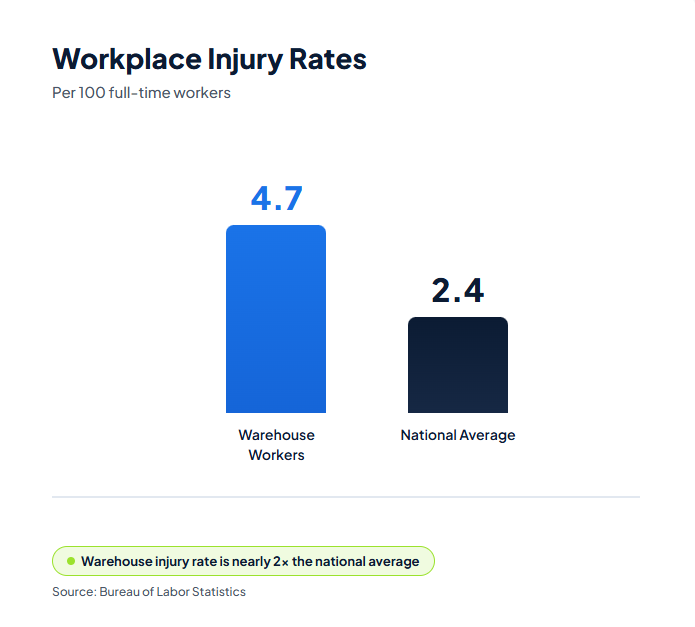
- Increased workforce safety. Proper capacity planning ensures adequate aisle widths, clear emergency exits, and appropriate spacing between storage areas. According to the Bureau of Labor Statistics, warehouse workers have an injury rate of 4.7 per 100 full-time workers. Proper space planning helps reduce these incidents.
- Scalable growth. Planning means your warehouse can accommodate seasonal peaks and business expansion without emergency relocations or costly facility changes. Strong fulfillment scalability is key to sustainable growth.
6 Factors Influencing Warehouse Capacity Planning
Multiple variables determine how much usable space your warehouse actually provides. Understanding these factors prevents overestimating available capacity.
- Product characteristics. Item dimensions, weight, stackability, and special storage requirements (temperature control, hazmat compliance) directly impact how many SKUs fit in a given area.
- Inventory turnover rates. Fast-moving products require accessible locations and additional staging space, while slow-moving products can be stored in higher-reach vertical storage.
- Order profiles. The mix of full-pallet shipments versus split-case picking operations affects aisle width requirements and workflow space needs.
- Seasonal demand patterns. Peak periods may require an additional 20-30% of capacity. Effective seasonal demand management accounts for these fluctuations without incurring the expense of year-round excess space.
- Equipment and technology. Forklift types, conveyor systems, and automation equipment each have specific clearance and operational space requirements.
- Labor workflow patterns. Worker movement paths, break areas, and workstation spacing affect the available floor space for storage.
7 Key Steps to Efficient Warehouse Capacity Planning
#1. Conduct a Comprehensive Space Audit
Start by measuring every area of your facility, not just storage zones. Document total square footage, ceiling heights, column placements, dock door locations, and any structural limitations. Calculate cubic capacity by multiplying usable floor space by clear height.
Identify dead zones where space sits unused due to poor layout or access issues. Many warehouses use less than 70% of their available vertical space, representing significant untapped capacity.
#2. Analyze Current Space Utilization
Calculate your current utilization rate by dividing occupied space by total available space. Industry benchmarks suggest warehouses should maintain approximately 80% utilization for optimal warehouse efficiency; higher rates create bottlenecks, while lower rates indicate wasted overhead.
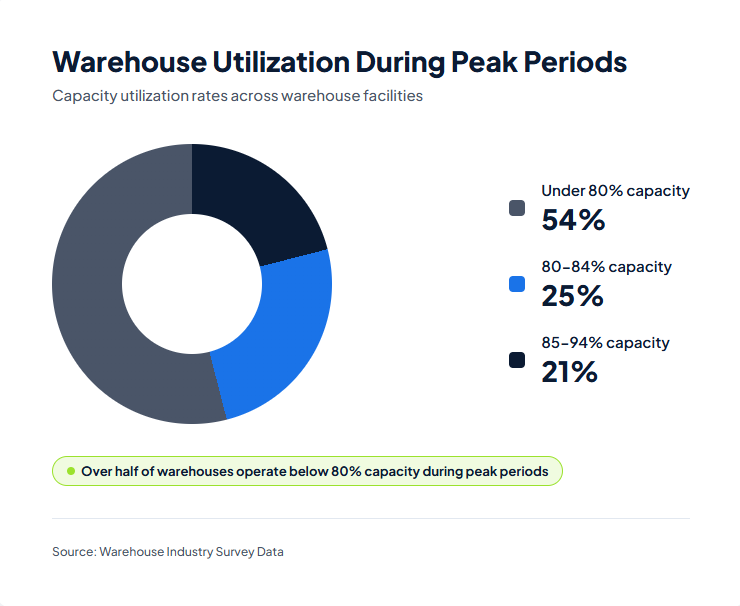
A 2024 survey by Peerless Research Group found that 21% of warehouse officials reported utilization rates of 85%-94% during peak periods, indicating that capacity constraints persist. The same study found 37% cited the storage area as their most congested zone.
#3. Forecast Future Demand
Review historical sales data, seasonal patterns, and growth projections to estimate future storage requirements. Factor in planned product line expansions, new customer acquisitions, and market trends that could affect inventory levels.
Build forecasts for multiple scenarios: baseline growth, aggressive expansion, and conservative estimates. This range helps you plan for flexibility rather than a single fixed outcome.
#4. Evaluate Storage Systems and Layout
Assess whether your current racking, shelving, and layout configurations make efficient use of available space. Consider these options:
Storage System | Best For | Space Efficiency |
Selective pallet racking | High SKU variety, frequent access | Moderate |
Drive-in/drive-through racking | High-volume, low-SKU operations | High |
Push-back racking | LIFO inventory, medium rotation | High |
Mezzanine systems | Light goods, picking operations | Maximizes vertical |
Narrow-aisle configurations | Limited floor space, forklift operations |
Reconfiguring storage systems often increases capacity without expanding your footprint.
#5. Account for Non-Storage Space Requirements
Allocate appropriate space for operational areas that support, but don't directly store, inventory:
- Receiving and shipping docks (typically 10-15% of total space)
- Quality inspection and returns processing zones
- Packing and value-added services areas
- Office space and break rooms
- Equipment charging stations and maintenance areas
- Safety clearances and emergency access routes
#6. Implement Technology for Real-Time Visibility
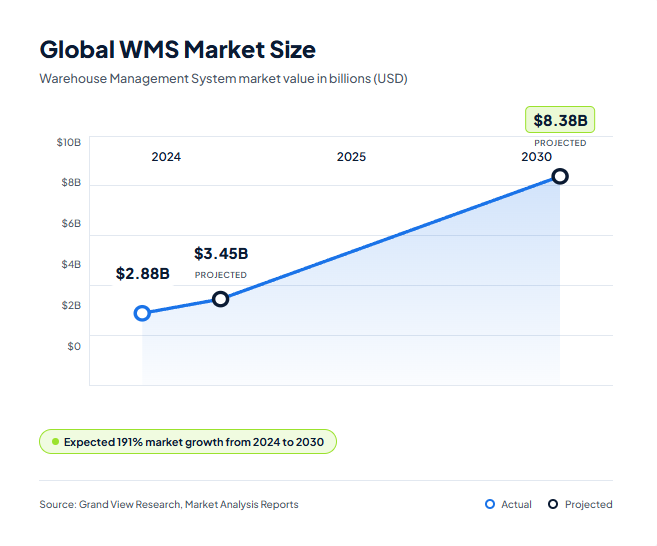
Modern warehouse management systems (WMS) provide data that supports capacity planning decisions. According to Grand View Research, the global WMS market reached $2.88 billion in 2024 and is projected to grow at a 19.9% annual rate through 2030, reflecting how fulfillment technology trends are reshaping the industry.
A WMS tracks inventory levels by location, identifies underused storage areas, and provides historical data for demand forecasting. This visibility helps you spot capacity issues before they become operational problems.
#7. Build Flexibility Into Your Plan
Design capacity plans that accommodate change. Options include:
- Modular racking systems that can be reconfigured as needs shift
- Relationships with overflow storage providers for peak periods
- Cross-training staff to work efficiently across different warehouse zones
- Reviewing and updating capacity plans quarterly rather than annually
The Peerless Research Group survey found 61% of warehouses reported leasing additional space during peak periods over the past five years. It demonstrates that even well-planned operations need flexibility. Partnering with seasonal 3PL services offers built-in flexibility for these peaks. For a month-by-month plan that ties capacity into forecasting, labor, and carriers, see our complete guide to peak season fulfillment readiness.
5 Risks of Poor Warehouse Capacity Planning
Neglecting capacity planning creates operational problems that compound over time. These issues affect costs, customer satisfaction, and workforce performance.
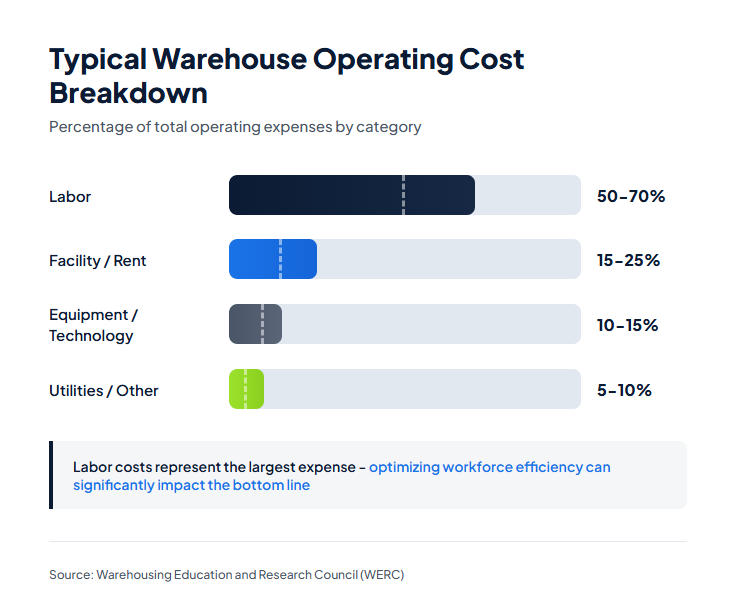
- Increased labor costs. Labor represents 50-70% of warehouse operating costs, according to a BOSTONtec report. Overcrowded facilities force workers to navigate around obstacles, increasing pick times and reducing the number of units processed per hour.
- Higher error rates and product damage. Cramped storage conditions lead to misplaced inventory, incorrect picks, and damaged goods from improper stacking or handling.
- Missed delivery commitments. When congestion slows receiving, put-away, and picking operations, orders ship late. These challenges in order fulfillment damage customer relationships and can trigger contract penalties with retail partners.
- Emergency storage expenses. Facilities that exceed capacity during peak periods face premium rates for last-minute overflow space, often 30-50% higher than contracted storage costs.
- Safety incidents and compliance violations. Blocked aisles, unstable stacking, and inadequate clearances create hazards. Beyond injury risks, OSHA violations carry penalties up to $16,550 per violation.
Frequently Asked Questions
#1. How do you calculate warehouse capacity?
Calculate total warehouse capacity by multiplying usable floor space (in square feet) by the clear stacking height (in feet) to get cubic footage. Then subtract space required for aisles, staging areas, and non-storage zones. Divide the current inventory volume by this available space to determine your utilization percentage.
#2. What is the ideal warehouse utilization rate?
Most operations target a utilization range of 80-85% as ideal. This provides sufficient buffer capacity to absorb fluctuations and seasonal demand spikes while avoiding the inefficiencies of excess space. Operating above 85% typically creates congestion that slows picking and put-away processes.
#3. How often should warehouse capacity be reassessed?
Review capacity plans quarterly and conduct comprehensive audits annually. Reassess immediately when you experience major changes such as new product launches, significant customer wins or losses, or shifts in order profiles from pallet shipments to split-case fulfillment.
#4. What is the difference between storage capacity and throughput capacity?
Storage capacity is the amount of inventory your warehouse can hold at any given time. Throughput capacity is the number of orders or units your facility can process per unit time. A warehouse may have adequate storage space but lack the throughput capacity to handle peak order volumes efficiently.
#5. How does automation affect warehouse capacity planning?
Automation typically increases both storage density and throughput capacity. Automated storage and retrieval systems (AS/RS) can increase floor space by up to 85% by utilizing vertical space and reducing aisle width, while goods-to-person systems increase picking rates. However, automation requires capital investment and may reduce layout flexibility.
Key Takeaways
- Warehouse capacity planning matches storage and operational space to current and projected inventory demands, preventing both costly overflows and wasted overhead.
- Target 80-85% utilization rates to balance efficiency with flexibility for demand fluctuations.
- Conduct space audits that account for vertical capacity, not just floor square footage.
- Labor costs account for 50-70% of warehouse operating expenses; poor capacity planning increases these costs by inefficient worker movement.
- WMS technology provides real-time visibility into space utilization and supports data-driven capacity decisions.
- Build flexibility into plans through modular systems and overflow storage relationships.
- Review capacity quarterly and conduct full audits annually to catch emerging constraints early.
20 Years of Kitting Excellence
Ready to Streamline Your Supply Chain?
Join industry leaders achieving 99%+ SLA performance with flexible kitting, fulfillment, and 3PL solutions.
Get in Touch