
12 Proven Ways to Improve Warehouse Efficiency
Warehouse inefficiency bleeds money in ways that don't always show up on a single line item.
Labor costs spiral, picking errors trigger returns and chargebacks, and slow fulfillment pushes customers toward competitors.
The most frustrating part is that improvement efforts fail because changes are made randomly rather than systematically.
In this article, we’ll cover 12 practical methods that address root causes rather than symptoms to reduce waste, speed up fulfillment, and lower costs.
What Is Warehouse Efficiency?
Warehouse efficiency measures how well a facility converts resources, such as labor, space, equipment, and time, into completed orders with minimal waste. An efficient warehouse processes more orders per hour, maintains accurate inventory, and ships products faster while keeping costs under control.
The goal is simple: do more with less. This means reducing the time workers spend walking, eliminating redundant handling steps, and making sure inventory is always where it needs to be when pickers arrive.
Key Metrics for Measuring Warehouse Efficiency
Tracking the right metrics helps identify bottlenecks and measure improvement over time. Focus on these core indicators:
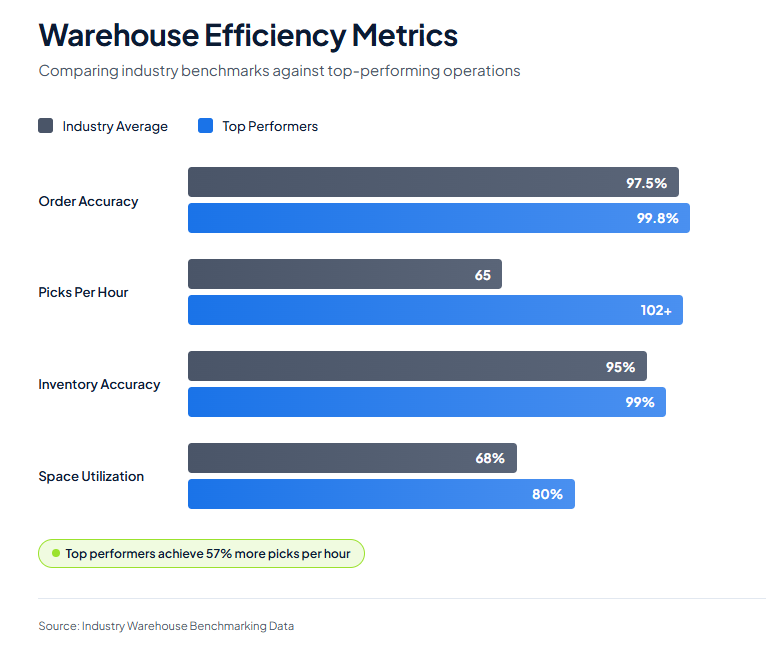
- Order Accuracy Rate. The percentage of orders shipped without errors. Industry benchmark is 99.5% or higher. Errors lead to returns, refunds, and customer churn.
- Picks Per Hour. The number of items a worker picks in one hour. The average ranges from 60 to over 100, depending on warehouse layout and technology in use.
- Inventory Accuracy. How closely do physical counts match system records? Target 97% minimum to avoid stockouts and overstocking.
- Order Cycle Time. Total time from order receipt to shipment. Same-day or next-day fulfillment is now the standard expectation for many customers.
- Space Utilization. Percentage of available storage space in use. Industry guidance suggests maintaining around 80% utilization for peak operational efficiency; higher utilization can create bottlenecks during receiving.
- Cost Per Order. Total fulfillment costs divided by the number of orders shipped. This includes labor, materials, and overhead.
- Inventory Turnover Ratio. How many times inventory sell and is replaced annually? Higher ratios indicate efficient capital use and reduced warehouse operational costs.
12 Ways to Improve Warehouse Efficiency
1. Implement a Warehouse Management System (WMS)
A warehouse management system coordinates inventory tracking, order routing, and labor allocation from a single platform. Over 90% of facilities either use or plan to use a WMS by 2025, according to ClickPost industry analysis.
A WMS eliminates manual spreadsheet tracking and provides real-time visibility into stock levels. The system can direct workers to the fastest pick paths, assign tasks based on priority, and flag discrepancies before they cause shipping delays.
Key features to prioritize include barcode or RFID scanning integration, automated replenishment triggers, and reporting dashboards that surface productivity trends through supply chain data analytics.
2. Reorganize Your Warehouse Layout
Product placement directly affects how far workers walk and your overall warehouse pick rate. The average warehouse worker walks 5-10 miles per shift, and much of it is unnecessary.
Apply ABC analysis to your inventory and place your fastest-moving products (A items) closest to packing stations and at waist height for easy grabbing. Medium-velocity items (B) go in secondary positions, while slow-movers (C) occupy harder-to-reach locations.
Group products are frequently ordered together in the same zone. If customers regularly buy items X and Y together, storing them near each other reduces travel time and the risk of missed items.
Review and adjust slotting quarterly. Seasonal shifts and new product introductions change velocity patterns. What belonged in prime real estate six months ago may now be taking up valuable space and contributing to inventory waste.
3. Standardize Picking Methods
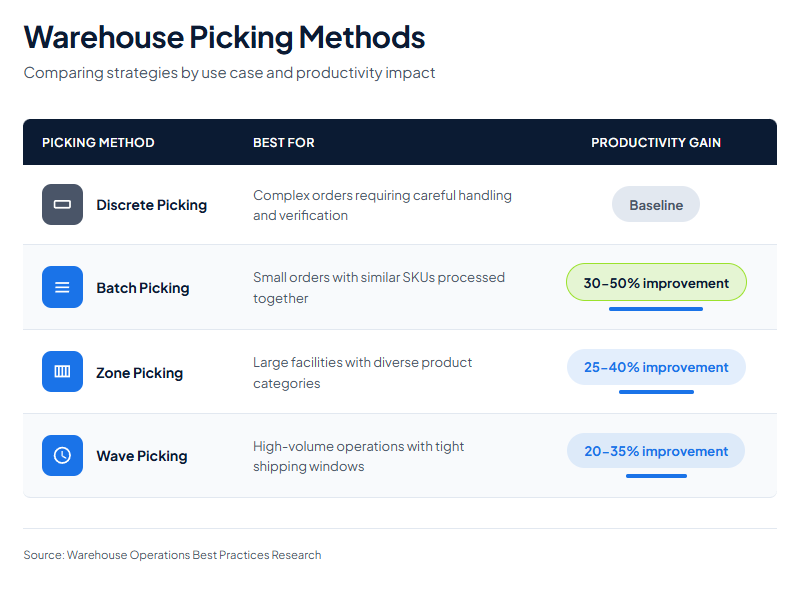
Random, unstructured picking creates inefficiency. Choosing the right picking strategy for your order profile can double throughput:
- Batch picking groups multiple orders together. A worker collects items for 10-20 orders in a single trip through the warehouse, then sorts them at a central station. This works well for operations with many small orders containing similar SKUs.
- Zone picking assigns workers to specific areas. Each picker handles only items in their zone, passing orders to the next zone. This reduces training time and eliminates congestion from workers crossing paths.
- Wave picking releases orders in scheduled batches aligned with carrier pickup times. This approach balances workload throughout the shift and ensures orders are ready when trucks arrive.
Match your method to your order characteristics. Single-item orders benefit from batch picking, while multi-item orders with diverse products are well-suited to zone approaches. Test different methods with time studies before committing to a facility-wide change.
4. Invest in Employee Training
Untrained workers make more errors and work more slowly. According to Bureau of Labor Statistics data, warehousing and storage saw the largest increase in hours worked among service-providing industries from 2007 to 2019, at 8%. This growth puts pressure on operations to onboard workers faster without sacrificing quality.
Cross-training builds flexibility into your workforce. When employees can move between receiving, picking, and packing based on daily needs, supervisors can respond to volume spikes without scrambling. These workers also develop better instincts about how their role affects downstream processes.
Documented procedures prevent knowledge from degrading as it passes from one employee to the next. Written SOPs provide workers with a reliable reference when questions arise, and including photos or diagrams helps visual learners absorb information more quickly.
Safety training deserves consistent attention. The warehousing industry has an injury rate of 4.7 cases per 100 workers, which is higher than the national average. Beyond the human cost, every workplace accident triggers paperwork, coverage gaps, and potential OSHA involvement, disrupting operations.
5. Use Barcode and RFID Technology
Manual data entry causes errors. Scanning technology captures information accurately in seconds.
Barcodes remain the cost-effective standard for most operations. Workers scan items at receiving, putaway, picking, and shipping checkpoints. The system updates inventory counts automatically and creates a digital trail for every movement.
RFID (Radio Frequency Identification) offers faster scanning without line-of-sight requirements. A reader can capture dozens of tagged items simultaneously as they pass through a doorway. This speeds receiving and cycle counting but requires a higher upfront investment in tags and readers.
Start with barcodes if you're not already using them. The technology is tested, affordable, and integrates with most WMS platforms. Consider RFID for high-value items or situations where speed matters more than tag cost.
6. Reduce Touches Per Order
Every time a product gets handled, it costs labor time and creates order fulfillment challenges, including damage and loss. Map your current processes and count how many times items get picked up, moved, and set down.
Look for opportunities to streamline fulfillment and eliminate steps. Can receiving place items directly into pick locations instead of a staging area? Can pickers place items straight into shipping containers rather than totes that require repacking?
Cross-docking bypasses storage entirely for fast-moving products. Items arrive at the receiving dock and are transferred immediately to outbound shipping, bypassing long-term storage. This approach works best for high-velocity SKUs with predictable demand.
Finally, design workflows so products flow in one direction through the facility. Backtracking wastes time and creates congestion.
7. Maintain Equipment Regularly
Equipment breakdowns halt operations. A dead forklift blocks aisles. A jammed conveyor stops all downstream processes.
Preventive maintenance schedules keep material handling equipment running. Daily inspections catch small problems before they become big ones, and regular servicing extends equipment life while avoiding the catastrophic failures that halt entire operations.
The equipment problem is getting worse, not better. According to industry surveys, 45% of warehouses cite outdated equipment as a problem: a 10% increase compared to 2023. Aging infrastructure limits what workers can accomplish and drives up maintenance costs. At some point, the math favors replacement over another repair cycle.
Stocking spare parts for common failure points is cheaper than it looks. The carrying cost of keeping a critical component on the shelf pales compared to the productivity lost while waiting days for a replacement to arrive.
8. Implement Quality Control Checkpoints
Catching errors before shipment costs far less than managing reverse logistics. The key is building verification into the workflow at natural transition points.
Scanning checkpoints work best when placed where items change hands, from picking to packing, and from packing to shipping. When the system flags a mismatch between picked items and order requirements, workers can fix the problem in seconds rather than triggering a return cycle weeks later.
Weight verification adds another layer without slowing anyone down. If an order should weigh approximately 2.3 pounds and the scale shows 1.8 pounds, something is missing. This passive check runs in the background while workers continue their normal process.
Error tracking by worker, shift, and zone often reveals patterns that point to root causes. A spike in one zone might be traced back to product placement, poor lighting, or confusing labels rather than individual performance issues, preventing avoidable mistakes that would otherwise flow into warehouse returns processing.
9. Set Clear Performance Standards
Workers perform better when they understand expectations. The challenge is setting targets that reflect reality in your specific facility.
Engineered labor standards based on actual time studies work better than industry averages. Walking distances, product characteristics, and equipment all vary from one operation to another, and generic benchmarks often miss the mark in either direction.
Visibility drives improvement. Daily or weekly scorecards let people see how they compare to targets and peers, and most workers genuinely want to perform well when they know what "well" looks like.
Incentives can accelerate results when structured correctly. Even small bonuses for exceeding accuracy or productivity targets motivate improvement. The caveat: rewarding speed alone leads to errors. Effective programs balance both throughput and quality metrics.
10. Plan for Demand Fluctuations
Volume spikes expose weaknesses; operations that run smoothly at 80% capacity can collapse at 120%.
Historical data takes most of the guesswork out of demand planning. Most operations experience predictable peaks around holidays, promotions, and seasonal trends, and seasonal 3PL services are designed to handle these patterns. The warehouses that handle these surges well are the ones that staff up and pre-position inventory before the rush hits.
Workforce flexibility makes a difference when volume swings. Cross-trained permanent staff can shift to bottleneck areas as needed, while established relationships with temporary staffing agencies provide surge capacity for major peaks.
Staging overflow inventory outside primary pick areas before peak periods buys extra breathing room. Effective seasonal demand management also includes pre-picking popular items into batch-ready configurations: when volume surges, that preparation translates directly into faster processing.
11. Reduce Walking Distance
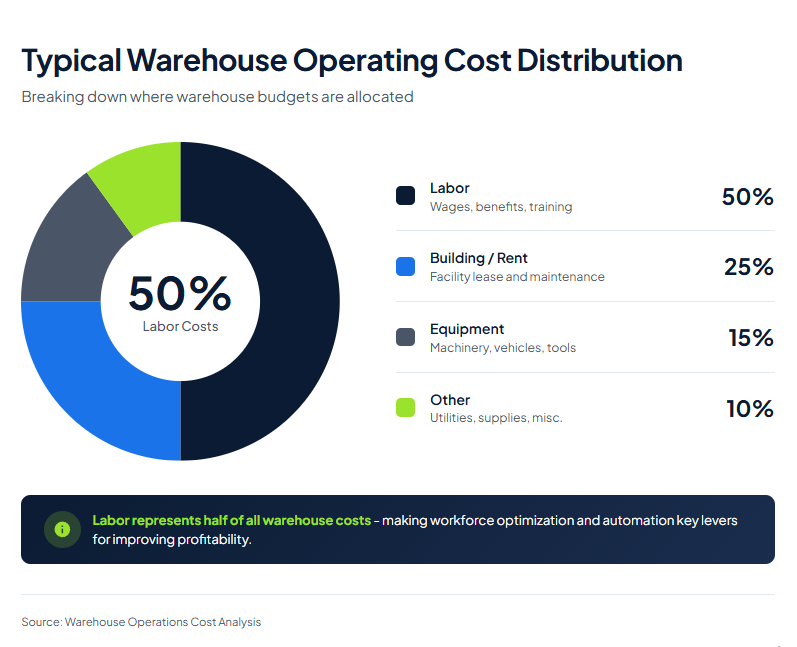
Labor costs account for the largest share of warehouse operating expenses, and a surprising amount of that labor time is spent walking rather than on productive work.
Packing station placement matters more than it might seem. Positioning them close to high-velocity pick zones shaves steps off every order; savings that compound quickly across thousands of daily shipments.
Conveyors or carts that move products between zones free workers from carrying items by hand. The result is reduced fatigue and higher capacity per worker throughout the shift.
For high-volume operations, new fulfillment technology trends, such as goods-to-person systems, flip the traditional model on its head. Instead of workers walking to products, automated systems bring products to stationary pick stations. The investment is substantial, but deployments have delivered ROI above 250% with payback periods under 24 months according to Mordor Intelligence analysis.
12. Conduct Regular Audits and Reviews
Efficiency is not a one-time project; it requires partnering with a complete logistics provider committed to continuous improvement. Continuous improvement requires ongoing measurement and adjustment.
Quarterly reviews of key metrics keep performance on track. Comparing current numbers to historical baselines and industry benchmarks reveals which processes have degraded over time - and points toward root causes worth investigating.
Floor time is equally valuable. Executives and managers who regularly observe actual operations spot problems that never surface in reports. Frontline workers often know exactly what slows them down; they just need someone to ask.
According to Gartner research, 76% of logistics transformations fail to meet critical performance metrics, including budget, timeline, and KPI targets. The primary cause is internal resistance to change. Leaders who engage teams from the start and incorporate feedback improve their odds of success by 62%.
Treat efficiency improvements as ongoing operational discipline, not as discrete projects with end dates.
 Frequently Asked Questions
#1. What is a good order accuracy rate for warehouses?
Industry leaders achieve order accuracy rates of 99.5% or higher. The average warehouse operates at 97%-99% accuracy. Every percentage point improvement reduces return processing costs, prevents customer complaints, and protects your reputation. Tracking errors by type helps identify whether problems stem from picking mistakes, packing errors, or shipping label issues.
#2. How much can warehouse automation reduce labor costs?
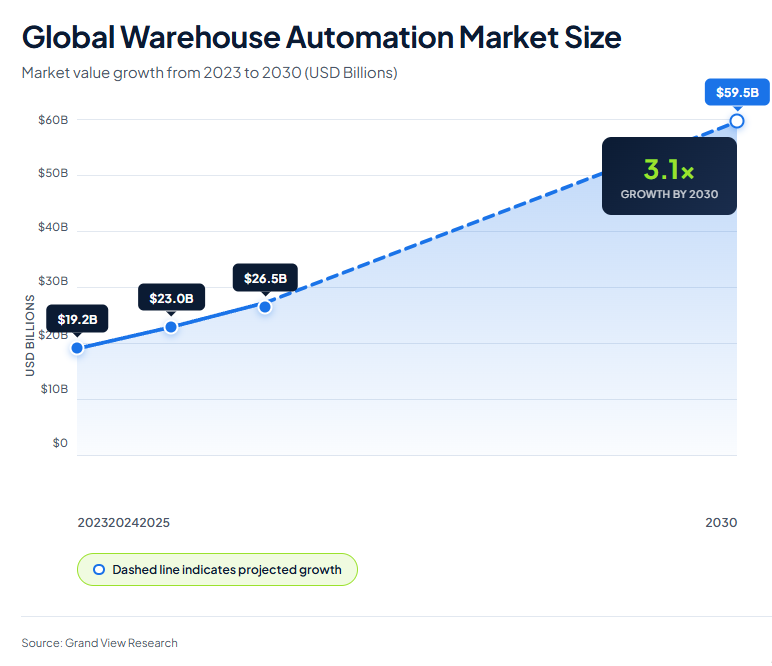
Automation investments can reduce manufacturing and labor costs by 25-30% according to industry analyses. The actual savings depend on your current processes, order volume, and the types of automation deployed. Mobile robots and automated storage systems show the fastest ROI, with some implementations achieving payback in under 24 months.
#3. What causes low warehouse productivity?
The most common causes include poor facility layout that forces excessive walking, inadequate training that slows workers and increases errors, and outdated equipment that frequently breaks down. Other factors include unclear performance expectations, misaligned incentive structures, and inventory inaccuracy that sends workers on searches for misplaced products.
#4. How often should warehouse layouts be reviewed?
Review product slotting and overall layout at least quarterly. Seasonal demand shifts, new product introductions, and changes in order patterns all affect which products should occupy prime locations. Annual reviews of major infrastructure, like racking configurations and conveyor paths, help identify larger optimization opportunities.
#5. What is the biggest expense in warehouse operations?
Labor represents the largest cost category, accounting for 45-57% of total operating expenses according to industry benchmarks. This includes wages, benefits, overtime, and training costs. The percentage varies by automation level and geographic location. High-cost markets and manual-intensive operations fall at the higher end of this range.
#6. How do you measure picking efficiency?
Picks per hour is the standard metric - the number of individual items a worker picks in 60 minutes. Track this metric by worker, shift, and zone to identify variations. Also measure pick accuracy (correct items selected) and lines per hour (number of order lines completed) for a complete picture of picking performance.
Key Takeaways
- Labor accounts for 45-57% of warehouse operating costs; small efficiency gains compound into significant savings.
- Implement a WMS to coordinate inventory, labor, and order routing from a single platform.
- Reorganize layouts using ABC analysis to put fast-moving items in prime pick locations.
- Match your picking method to your order profile: batch, zone, or wave picking can double your throughput.
- Scan everything with barcodes or RFID tags to eliminate manual data-entry errors.
- Reduce touches per order by eliminating unnecessary handling steps.
- Train workers thoroughly and set clear, measurable performance standards.
- Proactively maintain equipment to prevent costly breakdowns.
- Engage teams in improvement initiatives; projects with employee input succeed 62% more often.
20 Years of Kitting Excellence
Ready to Streamline Your Supply Chain?
Join industry leaders achieving 99%+ SLA performance with flexible kitting, fulfillment, and 3PL solutions.
Get in Touch