10 Tips to Maximize Storage with Warehouse Space Optimization
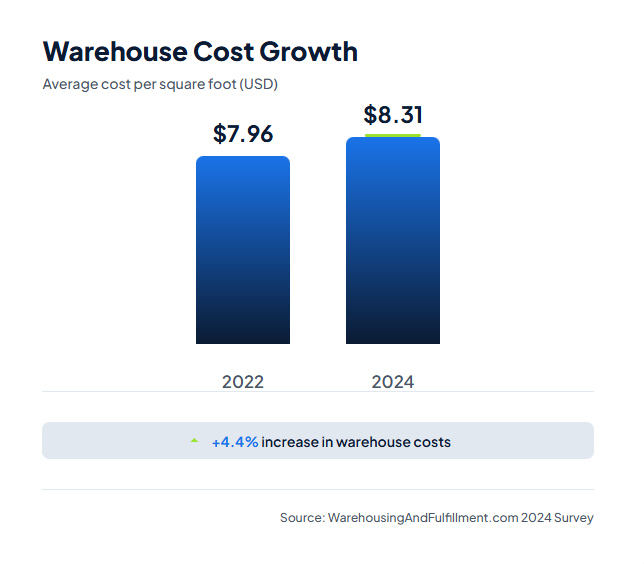
Warehouse space is getting more expensive every year, yet many facilities operate with significant wasted capacity.
Poor space management creates a cascade of problems: rising storage costs, slower order fulfillment, and difficulty meeting customer expectations.
The solution isn't always to lease more square footage; it's to get more from what you already have.
This guide covers 10 practical warehouse space optimization strategies to help you do exactly that.
Why Is Warehouse Space Optimization Important?
Space optimization directly impacts your bottom line. Online retail requires approximately three times as much logistics space as traditional brick-and-mortar retail for the same sales volume, according to CBRE.
With U.S. online sales projected to reach 30% of all retail by 2030, according to Prologis research, demand for warehousing solutions will only grow. Getting more from existing facilities becomes a competitive advantage rather than just a cost-saving measure.
10 Strategies for Optimizing Warehouse Space
#1. Conduct a Comprehensive Space Audit
Before making changes, understand your current state. Calculate your space utilization rate using this formula:
Space Utilization Rate = (Used Space / Total Available Space) x 100.
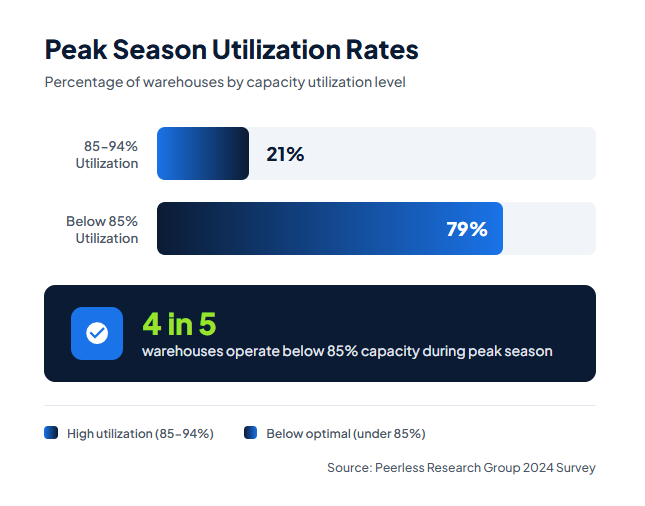
Industry benchmarks suggest warehouses should maintain approximately 80% utilization for peak operational efficiency; high enough to avoid wasted overhead costs, but low enough to prevent bottlenecks during receiving and put-away processes.
Walk the floor systemically. Document dead zones, underused areas, and spaces where inventory piles up. Identify aisles that are wider than necessary and vertical space that goes unused. A thorough audit often reveals that facilities have more capacity than managers realize; they just need to reconfigure how it's used.
#2. Maximize Vertical Storage Capacity
Most warehouses significantly underutilize their vertical space. Vertical storage solutions - including pallet racking systems, mezzanines, and vertical lift modules (VLMs) - allow you to store more inventory without expanding your footprint.
According to Southwest Solutions Group, some storage manufacturers report that vertical carousels and VLMs can save up to 80-90% of floor space compared to traditional horizontal storage.
Consider these vertical options based on your needs:
- Pallet racking systems. Cost-effective, flexible, and compatible with forklifts for high-level access.
- Mezzanines. Semi-permanent structures built between the floor and ceiling that create additional floor space.
- Vertical lift modules. Automated systems that deliver trays to workers at ergonomic heights.
- Vertical carousels. Rotating shelves that bring items to operators, reducing retrieval time.
When implementing vertical storage, ensure your facility can support the weight loads and that you have appropriate equipment (forklifts, order pickers) for safe access.
#3. Implement ABC Inventory Slotting
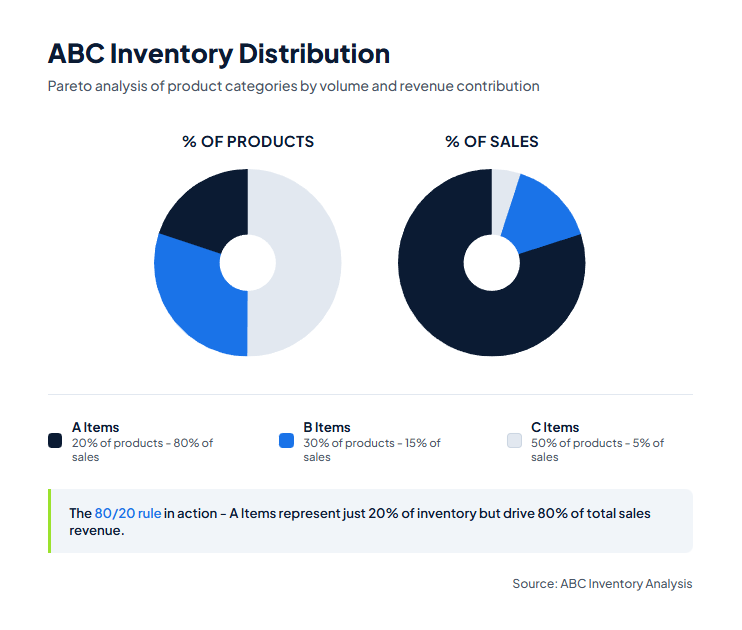
Not all inventory moves at the same velocity. ABC analysis categorizes products by their sales volume and movement frequency:
- A items: Top 20% of products generating roughly 80% of sales
- B items: Middle 30% of products generating about 15% of sales
- C items: Remaining 50% of products generating approximately 5% of sales
Place A items in prime locations: areas closest to packing stations, at ergonomic heights, and along the shortest pick paths. B items go in moderate-access locations, while C items can be placed in harder-to-reach areas, such as high shelves or distant zones.
This approach reduces picker travel time and better uses premium space. Reassess categories quarterly, as product velocity varies with seasons, promotions, and market trends.
#4. Reduce Aisle Width Strategically
Standard warehouse aisles often exceed what's actually needed for operations. Narrowing aisles, even modestly, can reclaim substantial floor space for additional storage. Conventional aisles typically run 11-13 feet wide to accommodate counterbalance forklifts. Narrow aisle configurations (8-10 feet) work with reach trucks.
Very narrow aisle (VNA) setups, as narrow as 5-6 feet, require specialized equipment such as turret trucks or order pickers. Before reducing aisle width, evaluate your equipment, picking methods, and safety requirements.
The gains in storage density must offset any equipment investments and potential changes in throughput. For many operations, switching from traditional forklifts to reach trucks offers a practical middle ground.
#5. Adopt a Warehouse Management System (WMS)
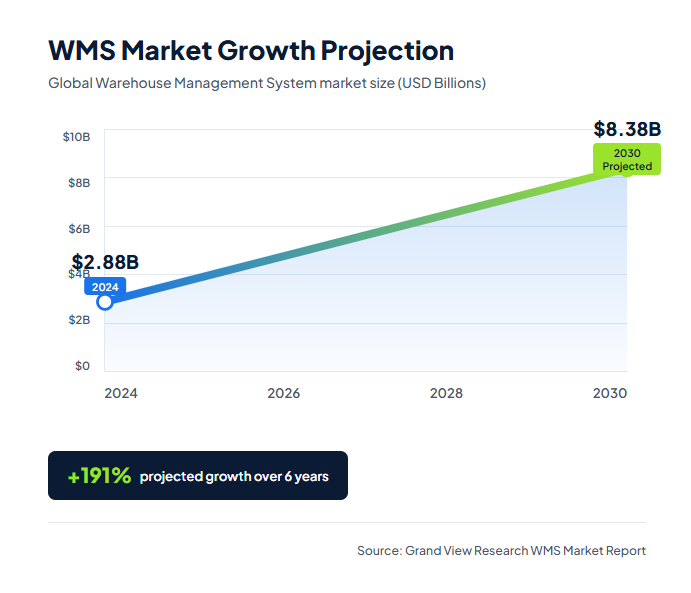
Manual tracking methods cannot match the precision of a WMS. These systems provide real-time inventory visibility through supply chain data analytics, direct workers to optimal storage locations, and continuously track space utilization metrics.
The global WMS market reached an estimated $2.88 billion in 2024 and is projected to grow at a 19.9% compound annual growth rate through 2030, according to Grand View Research. This growth reflects broader trends in fulfillment technology and the essential role these systems play in space management.
A WMS delivers space optimization benefits through directed putaway (placing items in the most appropriate locations), slotting analysis (identifying where products should be stored based on velocity), and improved inventory accuracy, reducing the need for excess safety stock.
#6. Create Dedicated Zones for Workflow Stages
Organize your warehouse into distinct zones by workflow stage rather than just product categories. Common zones include:
- Receiving. Designated dock doors and staging areas for inbound shipments.
- Bulk storage. High-density storage for reserve inventory.
- Pick/active storage. Fast-access areas for order fulfillment.
- Packing and shipping. Stations near outbound docks.
- Returns processing. Separate area for reverse logistics.
E-commerce businesses should allocate dedicated space specifically for returns processing. Consumer returns reached $890 billion in 2024, according to the National Retail Federation, and each return requires dedicated space for receiving, inspection, and restocking.
Clear zone boundaries reduce cross-traffic, prevent congestion, and make scaling operations easier. Evaluate traffic patterns and place high-interaction zones close together while keeping incompatible activities separated.
#7. Use Cross-Docking for High-Velocity Items
Cross-docking moves products directly from receiving to shipping with minimal or no storage time. For products with predictable demand and tight delivery windows, this approach eliminates the need for storage space entirely.
Identify candidates for cross-docking by focusing on items with high turnover, predictable order patterns, and time-sensitive delivery requirements. Products that arrive and ship in full pallets are particularly good candidates.
Even partial cross-docking, where a portion of an inbound shipment is moved directly to outbound while the rest is sent to storage, reduces space requirements and supports streamlined fulfillment processes.
#8. Implement Just-in-Time Inventory Practices
Excess safety stock consumes space and ties up capital. Just-in-time (JIT) practices align inventory levels more closely with actual demand, reducing inventory waste that fills your warehouse. JIT requires accurate demand forecasting, reliable supplier relationships, and shorter order cycles.
Start JIT implementation with stable, high-volume SKUs where demand patterns are predictable. Expand gradually as your forecasting accuracy and supplier coordination improve. The space savings compound over time as you reduce safety stock across more product lines.
#9. Consolidate and Rationalize SKUs
More SKUs mean more complexity and more space consumed by slow-moving inventory, creating order fulfillment challenges. Conduct regular SKU rationalization to identify products that no longer justify their storage footprint and analyze each SKU's sales velocity, profit margin, and strategic importance.
Products that haven't sold in 12 months, carry thin margins, and don't serve strategic purposes are candidates for discontinuation or liquidation. Before discontinuing SKUs, consider whether consolidation is possible: combining similar products into fewer variations.
Also, evaluate whether some products could shift to drop-ship arrangements, where suppliers ship directly to customers without inventory passing through your warehouse.
#10. Consider Flexible Storage Solutions
Demand fluctuates, and static warehouse configurations struggle to adapt. Build flexibility into your storage infrastructure to handle seasonal peaks without permanent overhead. Options for flexible storage include:
- Adjustable pallet racking. Beam heights that change based on product mix
- Mobile shelving units. Racks on tracks that eliminate aisles when not in use
- Third-party logistics (3PL) partnerships. Overflow capacity during peak periods
- Pop-up warehouse space. Short-term leases or on-demand storage facilities
According to the 2025 AutoStore State of Warehouse Management report, 93% of supply chain leaders consider improving throughput a key priority for the year ahead, with space optimization closely tied to fulfillment scalability. Building flexibility into your storage approach positions you to maximize space year-round rather than sizing for peak demand alone.
8 Factors Contributing to Fluctuating Inventory Levels
Inventory fluctuations complicate space planning. Understanding what drives these variations helps you design more resilient storage strategies and avoid both overcrowding and wasted capacity.
- Seasonal demand cycles. Holiday seasons, weather patterns, and back-to-school periods create predictable spikes and troughs in many product categories.
- Promotional activities. Sales events, discounts, and marketing campaigns generate short-term demand surges that require additional stock.
- Economic conditions. Recessions tighten consumer spending on discretionary goods, while economic growth increases demand across categories.
- Supply chain disruptions. Natural disasters, geopolitical events, and transportation issues disrupt supply flows, leading to either shortages or inventory buildups when shipments finally arrive.
- Consumer preference shifts. Changes in buyer behavior, such as moves toward sustainable products, alter which items move quickly and which stagnate.
- Competitor actions. Rival promotions, new product launches, or pricing changes affect demand for your products.
- Lead time variability. Inconsistent supplier delivery times force higher safety stock levels to avoid stockouts. Reliable transportation management helps reduce this variability.
- The bullwhip effect. Small variations in consumer demand amplify as orders move up the supply chain, leading to overreactions in inventory ordering.
Frequently Asked Questions
#1. What is the ideal warehouse space utilization rate?
Most industry experts recommend maintaining an 80-85% warehouse space utilization rate. This range provides enough capacity to operate efficiently while leaving buffer space for seasonal fluctuations and operational flexibility. Utilization above 85% often leads to congestion, slower fulfillment, and safety concerns.
#2. How do I calculate warehouse space utilization?
Divide your used storage space by total available storage space, then multiply by 100 to get a percentage. For example, if you use 40,000 square feet of a 50,000-square-foot facility, your utilization is 80%. Track this metric monthly to identify trends and plan capacity needs.
#3. Can warehouse automation improve space utilization?
Yes, automation technologies like vertical lift modules, automated storage and retrieval systems, and goods-to-person systems increase storage density by reducing aisle requirements. Automated systems can recover up to 90% of floor space compared to traditional storage methods while improving picking accuracy and speed.
#4. How often should I reorganize my warehouse layout?
Review your warehouse layout quarterly and conduct major reorganizations annually or when significant business changes occur. Shifts in product mix, sales channels, or order volume warrant a reassessment of the layout. Regular slotting updates, including moving products to appropriate locations based on current velocity, should happen more frequently.
#5. What role does demand forecasting play in space optimization?
Accurate demand forecasting allows you to maintain appropriate inventory levels without excessive safety stock. Better forecasts mean less buffer inventory consuming space, reduced overstocking during slow periods, and better preparation for demand peaks. Invest in forecasting tools and regularly compare predictions to actual demand to improve accuracy.
#6. How do I handle space constraints during peak seasons?
Plan peak season capacity months in advance using historical data. Options include temporary staffing to increase throughput, 3PL partnerships for overflow storage, extended operating hours, pre-positioning inventory based on forecasted demand, and implementing cross-docking for fast-moving items to minimize storage time.
#7. Is vertical storage suitable for all warehouse types?
Vertical storage works in most facilities but requires adequate ceiling height and floor load capacity. Consider the weight and dimensions of your products, the equipment required for safe access, and your order-picking methods. Smaller items typically work well with vertical lift modules, while palletized goods suit high-rise pallet racking.
Key Takeaways
- Warehouse space costs increased 8.3% from 2022 to 2024, making space optimization a direct cost-saving opportunity.
- Conduct comprehensive space audits to understand current utilization before implementing changes.
- Vertical storage solutions can recover up to 80-90% of floor space compared to traditional horizontal configurations.
- ABC inventory slotting places fast-moving items in prime locations, reducing picker travel and improving throughput.
- Warehouse management systems provide real-time visibility and directed putaway to maximize space efficiency.
- Create dedicated workflow zones and allocate appropriate space for returns processing in e-commerce operations.
- Cross-docking and just-in-time practices reduce storage requirements by speeding product through the facility.
- Regular SKU rationalization eliminates slow-moving inventory that consumes valuable space.
- Build flexibility into storage configurations to handle demand fluctuations without permanent overcapacity.
20 Years of Kitting Excellence
Ready to Streamline Your Supply Chain?
Join industry leaders achieving 99%+ SLA performance with flexible kitting, fulfillment, and 3PL solutions.
Get in Touch