Every third-party logistics (3PL) partner will tell you they handle subscription boxes. Most of them mean they can pack a box and stick a label on it.
That's not the same thing. Subscription fulfillment runs on tight batch windows, multi-SKU kitting, and a subscriber base that cancels after one bad experience. When the wrong items arrive, or the box shows up a week late, or the packaging looks nothing like what you approved, the damage compounds across your entire active subscriber count at once.
Knowing how to choose a subscription box fulfillment partner means knowing which questions to ask, which capabilities are non-negotiable, and which red flags to avoid before you're locked into a contract. Here's how to evaluate each one.
Why Subscription Box Fulfillment Is Different from Standard E-commerce
Standard e-commerce processes individual orders as they arrive. Subscription fulfillment is the opposite: predictable in timing, intense in volume, and coordinated around a fixed batch window that affects every active subscriber at once.
Every cycle, you're kitting multiple SKUs (Stock Keeping Units), inserting branded materials, and shipping to a presentation standard that drives renewal decisions. Standard 3PLs are built for reactive fulfillment. Subscription boxes require the proactive kind, and those are genuinely different operational models.
Understanding how subscription box fulfillment works end-to-end is the foundation for evaluating a partner, because you can't ask the right questions without knowing what the process actually entails.
5 Signs You're Ready to Outsource
Most subscription box brands start fulfillment in-house. That's reasonable at small volumes. The model starts to break down in recognizable ways:
- Packing days have become company-wide events that pull everyone away from core work
- Shipping errors are creeping up, and there's no time to audit them systematically
- Subscriber growth is outpacing your team's physical capacity to pack
- You're turning down new subscribers because you can't absorb them
- Carrier relationships are weak, and your per-shipment costs reflect it
The difference between in-house and outsourced subscription box fulfillment comes down to whether a 3PL's infrastructure, labor efficiency, and carrier discounts can offset its fees. For most brands, that crossover happens somewhere between 200 and 500 orders per month, though the more complex your kitting, the earlier it happens.
7 Criteria for Evaluating a Fulfillment Partner
#1. Subscription-Specific Experience
General 3PL experience and subscription box experience are not interchangeable. A partner that handles random DTC orders all day operates on fundamentally different workflows than one built around monthly batch processing.
Ask how many subscription box clients they currently serve, what their average monthly volumes look like, and whether they have clients in your product category. A provider with genuine subscription experience can describe how they sequence kitting windows, handle cutoff dates, and document their error rate for batch shipments.
#2. Kitting and Assembly Capabilities
For most subscription boxes, kitting is the most labor-intensive part of fulfillment, and the part most likely to go wrong if the 3PL isn't set up for it. An assembly involving multiple SKUs, printed inserts, custom tissue paper, and branded packaging requires a dedicated workflow rather than spare capacity in a standard pick-and-pack operation.
Ask whether kitting happens in a dedicated zone with trained staff, or whether it gets handled by whoever is available. Ask for their documented kit accuracy rate.
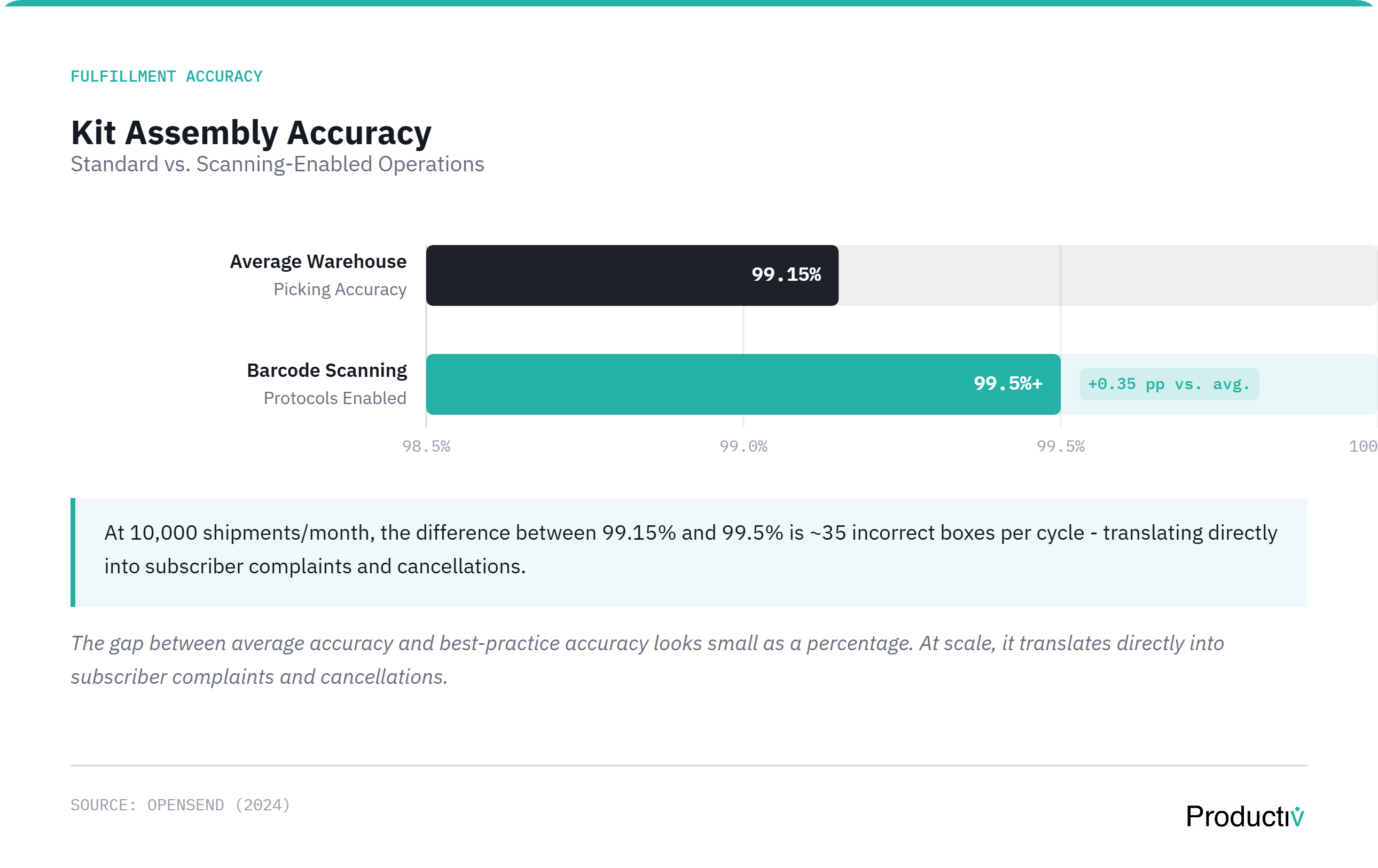
According to Opensend, average order-picking accuracy across warehouses is 99.15%, while operations with proper scanning and verification protocols consistently reach 99.5% or higher. For subscription boxes, that gap matters: a 0.35% error-rate difference across 10,000 shipments amounts to 35 incorrect boxes, and each one is a potential cancellation.
Understanding what good subscription box kitting and assembly looks like operationally will help you distinguish a genuine capability from a marketing claim.
#3. Technology Integrations
Your subscription management platform needs to push orders to your fulfillment partner without manual uploads. Manual order handling introduces errors and delays that cascade during a high-volume shipping week.
Ask specifically which platforms they integrate with natively, and how inventory data syncs between their warehouse management system and your storefront. Real-time inventory visibility is non-negotiable. Overselling because your WMS and storefront are out of sync is one of the most avoidable subscription box fulfillment mistakes a scaling brand can make, and it happens most often when system integrations are patched together rather than built properly.
#4. Pricing Transparency
Subscription box fulfillment pricing is more layered than standard ecommerce, because kitting adds a per-kit labor charge on top of the standard pick-and-pack fee. Receiving fees, storage rates, kitting rates, packaging surcharges, and monthly minimums all vary by provider.
When evaluating a specific partner, you're looking for line-item clarity; a per-kit assembly rate, not just "kitting available on request." Get the full rate card before any commercial discussion. If a provider can't or won't give you itemized pricing for kitting and storage, treat that as a red flag, not a negotiation style.
#5. Scalability
Your fulfillment partner needs to absorb growth without constraining it. Subscription box businesses add volume in uneven spikes, such as a podcast mention, a promotional campaign, or a holiday gift push, which can double your subscriber count in a short window. That surge needs to hit your fulfillment center without affecting ship dates.
Ask what percentage of their current capacity is in use, how they staff for volume spikes, and whether they have overflow arrangements. A partner already running near capacity when you sign is a growth ceiling you don't want. If scaling your subscription box business is part of the plan, your fulfillment infrastructure needs to be built for where you're going, not just where you are.
#6. Packaging Support
If your brand depends on a specific subscription box packaging and unboxing presentation, it requires custom-printed boxes, branded inserts, specialty tissue paper, and custom tape. Your fulfillment partner needs documented procedures for handling it consistently. Some 3PLs have in-house packaging procurement. Others expect you to ship materials to them and simply use whatever arrives.
The risk isn't that they can't physically handle custom packaging. The risk is inconsistency: boxes assembled correctly 90% of the time, with the other 10% missing an insert or using the wrong tissue color. Detailed production documentation and quality checkpoints at the assembly stage are what separate consistent execution from best-effort effort.
#7. Location and Carrier Relationships
Where your fulfillment center sits on the map determines your average shipping zone, which directly affects cost per shipment. A single fulfillment center on the East Coast means West Coast subscribers pay more and wait longer, and vice versa.
Ask about the average zone distribution across their subscription client base. If the provider has a multi-warehouse network, ask how they handle inventory allocation across nodes for subscription clients. For brands focused on reducing subscription box shipping costs, the location question is often the highest-impact decision in the whole evaluation.
Strong carrier relationships matter too. 3PLs with high volume across multiple clients typically negotiate better rates than any individual brand can achieve - but the size of that discount varies significantly by provider.
6 Red Flags to Watch For
A provider's behavior during the sales process is a preview of how they'll operate once you're a client. Watch for these:
- Vague or unavailable data on kitting accuracy and error rates
- No dedicated account manager - a ticketing-only support model is a problem during a ship week
- Long-term contracts before you've shipped a single order with them
- Rate cards that bundle kitting into "fulfillment" without per-unit line items
- Missing integrations with your subscription platform, or integrations described as "workarounds."
- References they won't provide or clients they can't name
Reliable subscription box fulfillment partners have nothing to hide in the evaluation process. The ones worth working with will hand you reference clients, walk you through their kitting workflows, and give you their full rate card without being asked twice.
30M+ Kits Per Year
Hold Us to Your Own Criteria
You just read seven criteria for evaluating a fulfillment partner. See how our subscription box operation measures up against each one.
See Our Subscription Box Operation7 Questions to Ask Before Signing
These questions will separate providers with real subscription experience from those who have added "subscription box fulfillment" to their service list without changing their operations:
- How many subscription box clients do you currently serve, and what volumes are they shipping monthly?
- Is kitting handled in a dedicated area with trained staff, or is it folded into standard pick-and-pack operations?
- Which subscription management platforms do you integrate with natively - no middleware required?
- What is your documented kit assembly accuracy rate?
- How do you handle configuration changes or product substitutions mid-cycle?
- What does your full rate card look like, including all kitting, receiving, and storage fees?
- What is your process when a batch ships with errors?
Frequently Asked Questions
#1. What should I look for when choosing a subscription box fulfillment company?
Prioritize subscription-specific experience over general 3PL size. The most important factors are kitting capability, native integrations with your subscription platform, transparent per-unit pricing, documented accuracy rates, and a named account manager. A provider that handles standard e-commerce may struggle with the batch coordination and assembly requirements of subscription boxes.
#2. When is the right time to outsource subscription box fulfillment?
Most brands reach the outsourcing threshold somewhere between 200 and 500 orders per month, though the exact point depends on kit complexity. The clearest signal is when fulfillment consumes time and resources that should be directed toward subscriber acquisition and retention. If packing days are disrupting operations or errors are going unaddressed, the threshold has likely already been exceeded.
#3. What's the difference between subscription box fulfillment and regular ecommerce fulfillment?
Standard ecommerce fulfillment processes individual orders as they arrive, with random SKU combinations and no fixed ship window. Subscription box fulfillment is batch-driven: large volumes of identical kits ship in a compressed window tied to billing cycles. It requires dedicated kitting operations, batch scheduling, and a different approach to inventory planning and carrier coordination.
#4. What causes subscription box churn, and how does fulfillment affect it?
Churn has multiple causes, but fulfillment failures, including late shipments, incorrect items, damaged packaging, or missing components, are direct triggers for cancellation. You can regain a subscriber who received a broken box once. A subscriber who received three consecutive late deliveries, on the other hand, usually can't. Fulfillment consistency is one of the few controllable variables that directly affects monthly retention.
#5. How important are carrier relationships when choosing a fulfillment partner?
Carrier relationships determine your per-shipment cost and your average delivery window. A 3PL shipping high volume across many clients typically negotiates better rates than a brand can achieve independently. Ask specifically about rate discounts and the carrier mix they use for subscription clients; some providers default to expensive options unless you ask.
#6. What happens if I need to change my kit configuration mid-cycle?
This is a common scenario for subscription brands, and your fulfillment partner's flexibility here matters. Ask specifically how they handle last-minute product substitutions, add-ins, or packaging changes. Providers with dedicated subscription operations typically have a change management process—those who handle subscriptions as a side service often don't.
#7. Do I need a multi-warehouse fulfillment network?
Not necessarily at launch, but location affects your average shipping zone, which affects cost and delivery speed. If more than 30% of your subscribers are far from your fulfillment center, a second node can meaningfully reduce average transit time and per-shipment cost. This is worth modeling with potential partners before signing, especially if you're planning growth in specific geographic markets.
Key Takeaways
- Subscription box fulfillment is a different operational model from standard e-commerce: batch-oriented, kitting-intensive, and tied directly to subscriber retention.
- Evaluate kitting capability, technology integrations, pricing transparency, scalability, packaging support, and location before choosing a partner.
- 34% of consumers say branded packaging affects their brand perception, making the unboxing execution your fulfillment partner delivers a brand asset, not just a logistics task.
- Kit assembly accuracy should be above 99%. Ask for documented rates, not estimates.
- Red flags during the sales process, such as vague pricing, no references, and missing integrations, are previews of operational behavior once you're signed.
- Get a full line-item rate card before any commercial discussion. Kitting fees vary widely and compound at scale.
20 Years of Kitting Excellence
Ready to Streamline Your Supply Chain?
Join industry leaders achieving 99%+ SLA performance with flexible kitting, fulfillment, and 3PL solutions.
Get in Touch