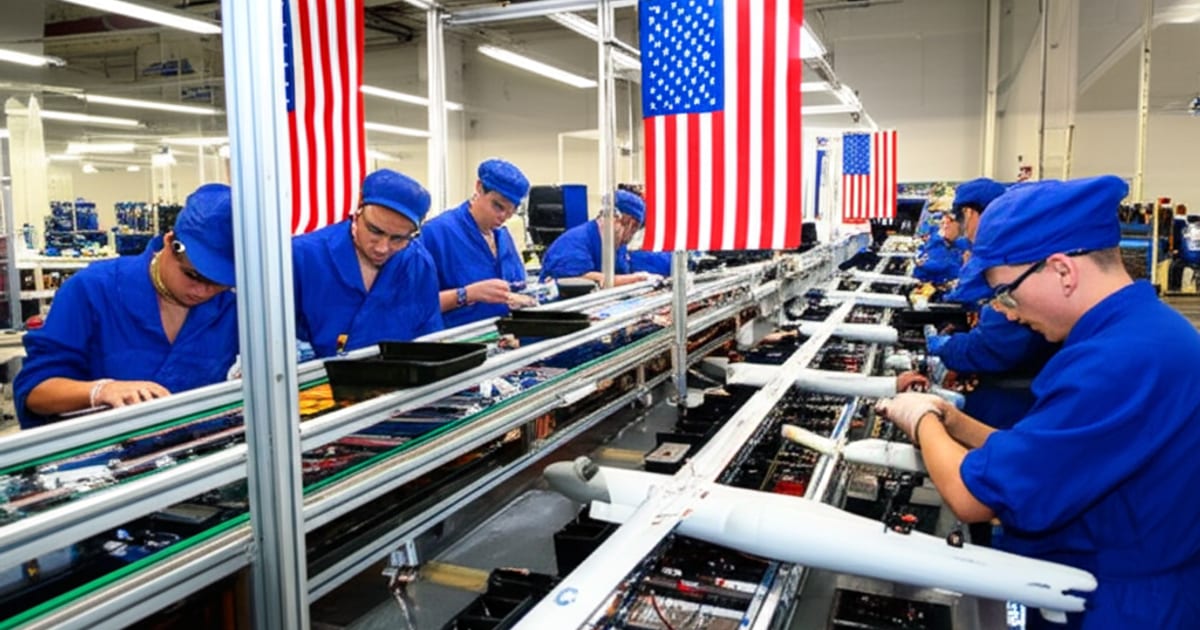
The Pentagon's Drone Dominance Program ran its first Gauntlet at Fort Benning in February 2026. Twenty-five vendors competed. Delivery orders totaling approximately $150 million are being placed now.
For the OEMs that earned a Phase I slot, the immediate challenge isn't the competition anymore — it's production. Winning the Gauntlet proves your system works. Delivering on the contract proves your operation works. Those are different problems entirely.
Most drone OEMs are engineered for the first problem. Almost none are staffed for the second.
What the Drone Dominance Program Actually Requires from Vendors
The Drone Dominance Program (DDP) — a $1 billion initiative from the Defense Innovation Unit (DIU), now executed through DIU, the Test Resource Management Center, and Naval Surface Warfare Center Crane — is not a traditional procurement. It's structured as competitive evaluation events called "Gauntlets," where military operators fly and score vendor systems under operational conditions.
Phase I ended with prototype delivery orders. Phase II narrows the field dramatically — DoD has signaled it may award as few as three vendors for the largest delivery phase. By 2027, the program is targeting 200,000+ low-cost, lethal drones that can produce effects in high-threat environments.
"Drone dominance will do two things: drive costs down and capabilities up. We will deliver tens of thousands of small drones to our force in 2026, and hundreds of thousands of them by 2027."
— Secretary of Defense Pete Hegseth, DefenseScoop, February 2026
That trajectory means two things for OEMs:
- Delivery timelines are immediate. Phase I orders started shipping within weeks of the Gauntlet. There is no extended ramp window built into the program schedule.
- Volume requirements escalate fast. Phase I prototype quantities are modest by defense procurement standards. Phase II volumes are not. OEMs that can't demonstrate production scalability won't survive the Phase II evaluation — regardless of system performance.
The official Drone Dominance program framework explicitly emphasizes "rapid transition from prototype to repeatable production." That language is a production operations requirement, not a design requirement. Your engineering team got you into Drone Dominance. Your production operation will determine whether you stay.
The Gap Between Winning a Gauntlet and Delivering at Scale
There is a well-documented pattern in defense hardware programs: small companies build excellent prototype systems that perform well in competitive evaluations, then miss delivery on the production contract. The failure mode is consistent — engineering capability and production execution are different disciplines, and they require different infrastructure.
For Drone Dominance specifically, the failure risks are:
Workforce scalability. Building 50 units in a prototype shop with your own engineers is fundamentally different from building 5,000 units per month with a trained production workforce. The second operation requires standard operating procedures, work instructions at the station level, trained operators who are not your engineers, and a quality control system that doesn't depend on a lead engineer reviewing every unit.
Supply chain documentation. The DoD has been clear: beginning in Phase II, Drone Dominance will preclude systems using motors or battery systems from covered countries. The department will inspect bills of materials, capitalization stacks, and physical components. An OEM whose assembly operation can't produce traceable documentation for every component on every unit will fail that review.
Surge capacity without lead time. Defense programs deliver against contracts, not forecasts. When DoD places an order, it expects delivery on schedule — not "we're ramping our production floor." OEMs need a production partner with real surge capacity already in place: trained workforce, established SOPs, and the ability to increase output in weeks, not months.
What "Repeatable Production" Means for Drone Assembly Operations
The phrase "repeatable production" appears throughout Drone Dominance program documentation. It is a production engineering standard, not a marketing phrase. Here is what it requires at the assembly operations level:
Documented SOPs at the station level. Every assembly step — motor torque, wire harness routing sequence, firmware load verification, functional test pass/fail criteria — must be written as a work instruction that any trained operator can follow. SOPs that live in a lead engineer's head are not repeatable. Production stops when that engineer is unavailable.
First article inspection as a formal checkpoint. Before volume production starts, the first units off the line must be assembled and reviewed against the full specification. Every discrepancy between the SOPs and actual assembly requirements is identified and resolved. First article inspection is the gate between onboarding and production — skipping it means the production run discovers specification errors at volume, not at unit one.
Unit-level documentation as a standard output. Every unit that ships must come with a documentation package: serial number, component lot numbers, firmware version, QA sign-off, and test results. This is not a custom deliverable for government programs — it is the baseline output of a production operation that tracks what it builds.
Defect tracking and root cause resolution. When a defect surfaces — and in any production operation, defects will surface — the production system must be able to identify where in the assembly process it occurred, trace it back to lot, and resolve the root cause before the next production run. An operation that treats defects as isolated events and not as process signals is not repeatable. It is variable.
NDAA Compliance at the Assembly Level
NDAA compliance is frequently treated as a drone design question. It is equally an assembly operations question — and the assembly level is where compliance reviews most commonly fail.
The National Defense Authorization Act prohibits components from covered countries (China, Russia, Iran, North Korea) in systems operated by or sold to DoD and federal agencies. The restriction applies to critical components: flight controllers, radio transmitters, data links, cameras, gimbals, and core electronics. Not all hardware, but the specific components that define the system's core capability.
For Drone Dominance specifically: Phase II compliance review will include inspection of bills of materials and physical components. That review is against the assembled unit — not just the design specification. If your assembly partner substitutes a component mid-run due to supply chain pressure, and that substitution is from a covered country, your unit fails compliance regardless of what your specification document says.
What this requires from your assembly partner:
- Approved vendor list (AVL) discipline. Every component source must be on an approved vendor list. No substitutions without OEM approval and documentation update. This is standard in aerospace and medical device manufacturing. It is not standard in commercial assembly operations.
- Lot-level component traceability. Every component on every unit must be traceable to the specific lot and vendor it came from. This enables compliance review, defect root cause analysis, and recall isolation if a lot-level quality issue surfaces.
- Supply chain documentation on demand. Your assembly partner should be able to produce supply chain documentation for any unit they have built, within a reasonable response window. If this is a novel request — not a standard operational output — their documentation infrastructure is not built for serious programs.
Why Assembly at Scale Requires a Dedicated Production Partner
The alternative to a dedicated assembly partner is building the production floor yourself. For Drone Dominance-tier programs, here is what that requires: facility space, equipment, a trained production workforce separate from your engineering team, an HR infrastructure to manage that workforce, QC systems, documentation systems, and the operational management bandwidth to run a production operation while your leadership team is executing the program.
Most drone OEMs cannot build that infrastructure in the timeline Drone Dominance requires. Phase I delivery orders don't come with a 12-month production ramp window. They come with a delivery date.
A production partner with existing infrastructure — trained operators, established SOPs, documentation systems, QC frameworks — can onboard a new drone program in 2–4 weeks. That is the difference between meeting your first delivery milestone and explaining to DoD why you're behind.
How Productiv Supports Drone Dominance-Tier Programs
Productiv is a US-based assembly operation with active drone and advanced electro-mechanical assembly programs. Our facilities are in Dallas and Charlotte. Our workforce model runs 1,200+ trained operators with unit-rate economics — we are not temp-agency dependent, and our production capacity can surge in weeks against hard delivery windows.
The operational credibility for defense programs specifically: our CEO is Doug Legan, a former operator in US Army Special Operations Command and the architect of "The Productiv Way" — our lean process engineering operating system applied to every production floor we operate. Military-grade process discipline, documentation rigor, and no tolerance for defects that compound are built into how we run operations. This is not language we use for marketing. It is how we were trained.
We execute 1B+ manual operations annually. We do clean room assembly for a major medical device manufacturer with the same unit-level documentation infrastructure that DoD programs require. Our surge proof point: 2.7 million meals assembled and delivered to Puerto Rico in 33 days for Hurricane Maria disaster relief. Compressed timeline, hard delivery requirement, no margin for process failure. That is the operational model Drone Dominance-tier programs require.
If you're a Drone Dominance vendor evaluating how to scale your assembly operation — or an OEM preparing a Phase II bid and building your production plan — talk to our team. We can walk through your delivery schedule, your documentation requirements, and what a production partnership with Productiv looks like for your specific program.
See Productiv's drone and electro-mechanical assembly capabilities →
Also see: Outsourcing Drone Assembly: What to Know Before Your First Production Run — a guide for OEMs evaluating assembly partners for any production program.
Frequently Asked Questions
What does the Drone Dominance program require from OEM vendors?
Drone Dominance requires vendors to demonstrate not just a functioning drone system, but the ability to transition from prototype to repeatable production at volume. Phase I places approximately $150M in prototype delivery orders with hard delivery timelines. That means OEMs must have — or partner with — a production operation capable of scaling to thousands of units per month on a compressed schedule, with NDAA-compliant supply chain documentation.
How quickly do Drone Dominance vendors need to ramp production?
Phase I delivery orders began immediately after the February 2026 Gauntlet at Fort Benning. The program is targeting 200,000+ drones by 2027. OEMs selected for Phase II face even larger volumes as unit prices decline and competition narrows to approximately 3 vendors. Ramp timelines are measured in weeks, not months.
What NDAA compliance documentation does Drone Dominance require?
Beginning in Phase II, Drone Dominance will preclude systems using motors or battery systems from covered countries. The DoD will inspect bills of materials, capitalization stacks, and physical components. Assembly partners must maintain supply chain documentation that traces critical components — flight controllers, radios, cameras, gimbals — to non-covered country sources, reviewable on demand.
Can a drone OEM use an outside assembly partner for Drone Dominance programs?
Yes. The program requires domestic assembly in US facilities, but does not require OEMs to self-assemble. A US-based assembly partner with documented NDAA-compliant supply chain controls, unit-level QC documentation, and demonstrated surge capacity can fully support Drone Dominance program delivery requirements.
What makes drone assembly for DoD programs different from commercial assembly?
DoD programs require unit-level traceability — serial numbers, component lot tracking, firmware version, QA sign-off, and test results for every unit, reviewable for audit. Documentation must be maintained as a standard deliverable, not a custom request. The assembly operation must also demonstrate surge capability against hard delivery dates, not just steady-state production volume.
US-Based Drone Assembly — NDAA Compliant
Scaling a Drone Dominance Program? Let's Talk.
Productiv assembles drones and advanced electro-mechanical systems at scale for OEM and defense programs. US facilities in Dallas and Charlotte. NDAA-compliant. Unit-rate pricing. 2–4 week onboarding.
Talk to Our Team