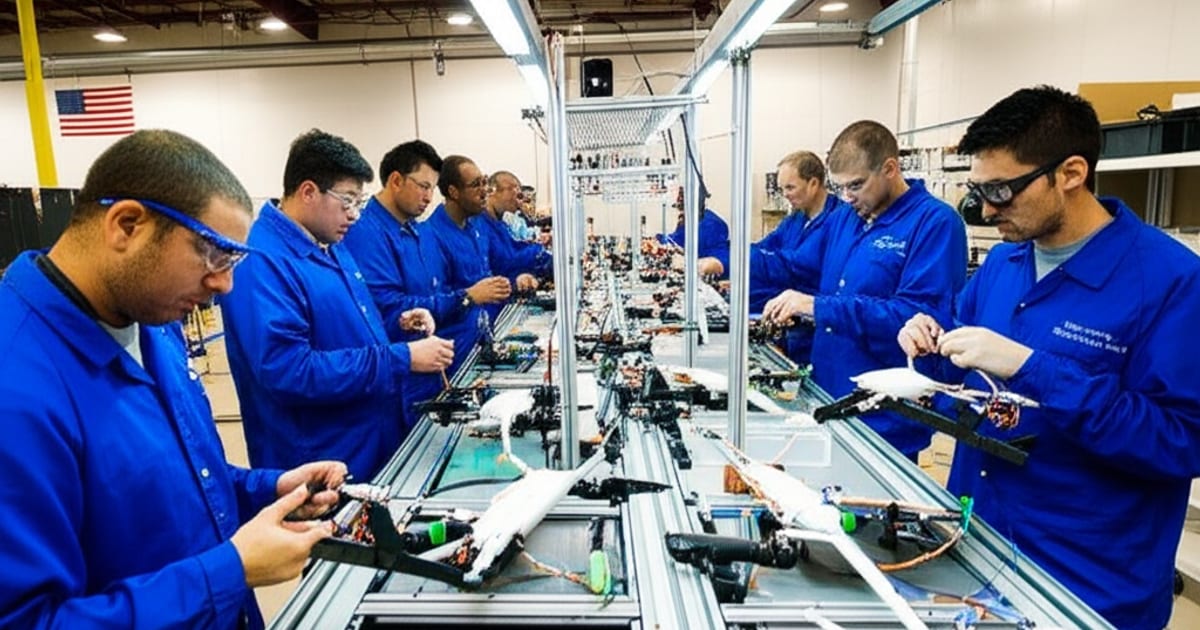
You spent two years designing the drone. You got the contract. Now you need to assemble 5,000 units by Q3, and your engineering team is already maxed building prototypes.
This is the moment most drone OEMs hit the same wall: they're great at designing unmanned systems, and terrible at scaling physical production. The engineering that makes a drone worth buying is the opposite of the operational discipline that makes a drone assembly line work.
Outsourcing drone assembly is the right call for most OEMs at some point in their growth. The mistakes happen in how they evaluate partners — and what they assume a "contract manufacturer" actually means for drone programs.
Why Drone OEMs Outsource Assembly
The answer isn't complicated: engineering time is the scarcest resource in any drone company. Every hour an engineer spends on a production assembly is an hour not spent on the next design revision, the next firmware update, or the next program bid.
This is true at every scale. A startup building 200 units/month for a commercial operator is burning its best people on production work. An established OEM that just won a DoD contract for 10,000 units in 18 months cannot hire and train a production floor in time. The math is the same — design capability and production execution are different disciplines, and trying to run both in-house is expensive and slow.
The right outsourcing partner adds production scale without adding permanent overhead. You send components. Finished, QA'd units come back. Your engineers work on the next version.
What to Look for in a Drone Assembly Partner
The evaluation criteria that matter are not the ones most OEMs lead with. Here's what to actually assess:
1. Final assembly experience, not electronics manufacturing. There are two very different capabilities in the contract manufacturing market. Electronics contract manufacturers (ECMs) handle PCB fabrication, soldering, and circuit board production. That is not what most drone OEMs need. Drone assembly is final mechanical assembly: airframe integration, motor and propeller installation, wiring harness routing, sensor mounting, camera gimbal assembly, firmware loading, and functional flight testing. Ask directly: do you do final assembly, or electronics manufacturing?
2. Demonstrated surge capacity. Drone programs don't arrive in predictable monthly volumes. A DoD contract comes with a delivery schedule. A commercial operator doubles their fleet order. A new program launches faster than planned. Your assembly partner needs to be able to ramp from 500 to 5,000 units in weeks — not months. Ask for examples of production surges: how fast, from what baseline, to what peak volume.
3. Unit-level documentation as a standard deliverable. Defense and government programs require traceability at the unit level: serial numbers, component lot tracking, firmware version, QA sign-off, and test results for every unit. This is non-negotiable for DoD programs and increasingly required for commercial programs. If an assembly partner treats unit-level documentation as a custom request, their QC infrastructure is not built for serious programs.
4. NDAA-compliant US facilities. Any program with federal, DoD, or law enforcement end users has NDAA implications. Assembly in US facilities by a domestic partner is the baseline. The harder question is supply chain documentation: what components are sourced where, and can the partner document the supply chain for compliance review? This is a pre-qualification question, not an afterthought.
5. Unit-rate pricing, not hourly billing. Hourly billing misaligns incentives — a slower assembly process costs you more. Unit-rate pricing — a fixed cost per assembled, tested unit — aligns the assembly partner's incentives with your throughput. As the partner's efficiency improves, your cost per unit should decrease. Ask how pricing is structured and whether efficiency gains get passed through.
The NDAA Question: What It Actually Means for Assembly
NDAA compliance for drone assembly means two things: where the assembly happens, and whether the supply chain can be documented. Most discussions focus on the first and skip the second — which is where programs actually fail compliance review.
The National Defense Authorization Act restricts components from covered countries (China, Russia, Iran, North Korea) from use in systems sold to or operated by DoD and federal agencies. The restriction applies to critical components — flight controllers, radio transmitters, data links, cameras, gimbals, and core electronics — not to all materials or hardware.
For a drone assembly partner, NDAA compliance means:
- Domestic assembly location. The final assembly must occur in US facilities. This is the easy part — any domestic assembly partner satisfies this requirement.
- Supply chain documentation. The assembly partner must be able to document the provenance of components for compliance review. This is where most assembly partners fall short. Unit-level traceability and lot tracking are prerequisites for supply chain documentation.
The Blue UAS designation — the DIU's approved list of NDAA-compliant small UAS — adds additional requirements for systems seeking that certification. Blue UAS certification involves third-party assessment of the full platform, not just the assembly. An assembly partner cannot certify a platform for Blue UAS, but they can build the documentation infrastructure that supports the certification process.
Ask any prospective assembly partner directly: what does your QC documentation cover, and how does it support NDAA compliance review? A credible answer is specific. A vague answer is a warning sign.
How to Evaluate Scale Capability
Steady-state production volume is the wrong metric. What matters is surge capability — the ability to ramp production fast when a contract lands or an order spikes.
DoD programs in particular arrive with hard delivery schedules. The Pentagon's Drone Dominance program — a $1B initiative from the Defense Innovation Unit — is targeting delivery of 30,000 one-way attack systems by mid-2026, with over 300,000 units in total by 2028. That kind of delivery cadence requires an assembly partner with genuine surge capacity, not just a production floor that runs at a consistent pace.
The questions to ask:
- What is your peak production volume on record, and over what timeframe?
- How do you flex labor capacity? Do you own the workforce model or depend on temp agencies?
- What is the maximum ramp rate from your current baseline to peak — in units per day?
- What triggers a capacity constraint, and how do you resolve it?
An assembly partner that owns a disciplined, scalable workforce model — not one that relies on temp agency headcount — can give you credible answers to these questions. One that depends on temp labor for surge capacity will give you vague reassurances.
What the Ramp-Up Process Should Look Like
A well-run drone assembly onboarding follows a predictable sequence. If a prospective partner can't describe this sequence specifically, their process infrastructure is underdeveloped.
Week 1–2: Assessment and SOP Development. The assembly partner reviews your bill of materials, assembly drawings, test procedures, and packaging specifications. Standard operating procedures are drafted, reviewed with your engineering team, and finalized. Work instructions are written at the step level — not a summary, but actual instructions for each assembly station.
Week 2–3: First Article Inspection. The first units off the line are assembled, tested, and reviewed in detail against your specifications. Any discrepancies between the SOPs and actual assembly requirements are identified and resolved before volume production starts. First article inspection is the checkpoint between onboarding and production — don't skip it, and don't accept a partner who wants to.
Week 3–4: Production Ramp. Volume production begins with enhanced monitoring. QC checkpoints are validated at production rates, documentation workflows are confirmed, and firmware testing throughput is measured against your delivery requirements. Any bottlenecks surface here and are resolved before the program reaches peak volume.
This sequence — for a product with clear documentation — typically takes 2–4 weeks from agreement to first production units. Partners who promise faster timelines without first article inspection are cutting a corner that will surface later, usually in the form of a defect rate you discover at delivery.
How Productiv Handles Drone Assembly
Productiv is an active drone assembly operation. We've assembled drones and advanced electro-mechanical systems for programs that require the documentation discipline and process rigor that DoD and defense programs demand.
Our operations are US-based — facilities in Dallas, Charlotte, Reno, and embedded operations nationally. Our workforce model is not temp agency dependent: 1,200+ trained operators with unit-rate economics and "The Productiv Way," our lean process engineering operating system that drives continuous improvement on every production floor.
The operational credibility for defense programs: our CEO is Doug Legan, a former operator in US Army Special Operations Command. Military-grade process discipline is built into how we operate every production line — documentation, traceability, accountability, and no tolerance for defects that compound. We also execute clean room assembly for a major medical device manufacturer, with the same unit-level QC infrastructure that defense drone programs require.
On surge capacity: we assembled and delivered 2.7 million meals to Puerto Rico in 33 days for Hurricane Maria disaster relief. The operational model — flexible workforce, documented SOPs, rapid ramp — applies equally to a drone program with a hard Q3 delivery window.
We execute 1B+ manual operations annually. 9 of our top 10 clients are billion-dollar brands. Scale and documentation discipline are not aspirational — they are operational baseline.
If you are evaluating assembly partners for a drone program — commercial, defense, or federal — talk to our team. We can walk through your specific program requirements, what the onboarding would involve, and what unit costs look like at your target volumes. We've done this before. We can tell you exactly what to expect.
Learn more about Productiv's drone and electro-mechanical assembly capabilities →
Also see: The Drone Dominance Program: What Winning OEMs Need to Know About Scaling Assembly and Blue UAS Certification: What Drone Manufacturers Need from Their Assembly Partner.
Frequently Asked Questions
When should a drone OEM outsource assembly?
The optimal transition point is when your design is stabilizing and you're scaling beyond what your engineering team can produce in-house — typically 100+ units. If engineers are spending time on builds instead of R&D, or if you've won a contract requiring volume delivery within a fixed window, outsourcing assembly lets you scale without building a production floor.
What does NDAA-compliant drone assembly mean?
NDAA compliance for drone assembly means the assembly is performed in US facilities by a domestic partner, with documented supply chain controls that exclude restricted components from covered countries (China, Russia, Iran, North Korea). The assembly partner's QC and documentation must be audit-ready for DoD or federal program requirements.
How is a drone assembly partner different from an electronics contract manufacturer?
An electronics CM handles PCB fabrication, soldering, and circuit board assembly. A drone assembly partner handles final mechanical assembly — airframe integration, motor installation, wiring harness routing, sensor mounting, firmware loading, and functional testing. These are different capabilities. Most drone OEMs need final assembly, not electronics manufacturing.
What production volumes can an outsourced assembly partner handle?
A capable assembly partner should be able to scale from 100 to 50,000+ units without requiring the OEM to build out a production floor. Look for demonstrated surge capacity — the ability to ramp from 500 to 5,000 units in weeks when a contract arrives — not just steady-state production.
How should drone assembly quality be documented for defense programs?
Defense and DoD programs require traceability at the unit level — serial numbers, component lot tracking, firmware version, QA sign-off, and test results for each unit. Assembly SOPs must be documented and reviewable. The assembly partner should be able to provide this documentation as part of standard deliverables, not as a custom request.
US-Based Drone Assembly Partner
Ready to Scale Your Drone Program?
Productiv assembles drones from hundreds to tens of thousands of units. NDAA-compliant US facilities, unit-rate pricing, 2–4 week onboarding, and the process discipline defense and commercial programs require.
Get a Quote