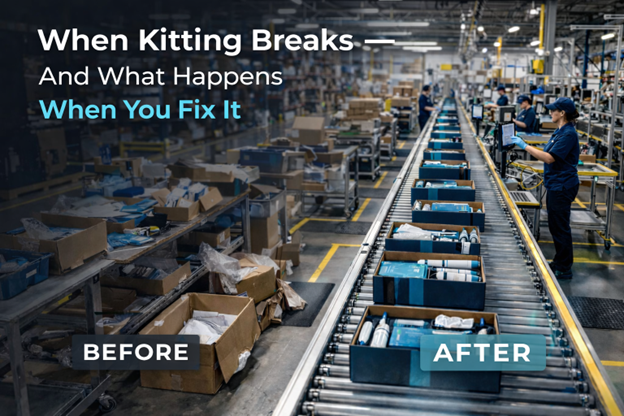
Kitting is where fulfillment complexity hides. One missing component triggers a $12–15 customer service call, a return, a reshipment, and a packaging write-off. One error, five cost events.
At a 5% error rate across 5,000 kits per month, that's $35,000+ in avoidable spend. Every month.
Most 3PLs treat kitting like a staffing problem. Throw more bodies at it. Bill more hours. Hope it holds. That's why the same problems come back quarter after quarter.
At Productiv, we've run kitting operations for nearly 20 years. We don't sell hours — we own outcomes. Here are three stories that show what changes when you fix the model, not just the symptoms.
99%+ SLAs in 30 Days — Consumer Goods
A consumer goods brand was drowning in late shipments and mis-assembled kits. They'd already fired one 3PL. The problem wasn't headcount — it was process.
Productiv deployed pre-engineered kitting workflows with built-in quality verification and real-time SLA dashboards. The turnaround was immediate.
| Metric | Before | After |
|---|---|---|
| On-time fulfillment | Failing SLAs | 99%+ |
| Order accuracy | Frequent mis-ships | 99%+ |
| Inventory accuracy | Unreliable | 99%+ |
| Time to improvement | — | 30 days |
Within six months, they moved all their work to Productiv. What started as a trial became their entire operation.
"We are hitting all the SLAs over and over again. Productiv has led the charge and brought so many improvements to the table over the last two years."
— Kelli Overson, EVP of Operations, Pourri
20–50% Throughput Gains — Medical Device Kitting
A medical device manufacturer couldn't keep up with hospital demand. Their kitting operation had a recurring problem: line stoppages caused by missing components at the point of assembly. The internal team was chasing parts instead of running kits.
Productiv tracked the downtime data, identified the pick stage as the root cause, and moved upstream to operate picking directly. Eliminating the hand-off eliminated the stoppages. Throughput improved 20–50%.
| Metric | Before | After |
|---|---|---|
| Throughput | Failing to meet demand | 20–50% increase |
| Line stoppages | Frequent — missing components | Eliminated at root cause |
| Productiv scope | Kitting only | Picking + kitting |
In most operations, speed and accuracy compete. Productiv engineers them to reinforce each other.
"Productiv has always done a really good job. They get people to come in and say we're going to knock this out, we're here to work and we make more money if we work more efficiently."
— VP Operations, Global Medical Device Manufacturer
10-Point Efficiency Uplift — Contract Manufacturing
A global contract manufacturer had a shift running below its efficiency potential. The problem wasn't equipment or capacity — it was process discipline on the floor. Work rules weren't being enforced consistently. Operators didn't have clear task ownership. The shift was busy, but not productive.
Productiv put together a dedicated crew focused specifically on floor discipline: rules, ownership, and a clear understanding of the job at every station. No new equipment. No new headcount. Just a structured approach to how the work was actually run.
| Metric | Before | After |
|---|---|---|
| Shift efficiency | Underperforming | +10 points |
| Driver of change | — | Process discipline, not headcount or equipment |
"We had a shift that was inefficient from a people perspective. We got together with Productiv and put a crew together as an experiment focused around discipline, the rules in the building, and understanding the job on the floor. With just that, we had a 10 point uptick in efficiency."
— Tosh Patterson, General Manager, Fareva
The Pattern Is Clear
Every one of these operations had the same underlying problem: a model that was selling inputs — hours, bodies, floor space — instead of improving outputs. The same fires came back because the incentives weren't aligned with the outcome.
What the right model consistently produces:
- 99%+ SLA performance achieved within 30 days of onboarding
- 20–50% throughput improvement when Productiv expands scope to eliminate the actual bottleneck — not just the visible symptom
- Measurable efficiency gains from process discipline, before any equipment investment
If your kitting operation isn't getting measurably better every quarter, the model is the problem.
Start a conversation with Productiv — no pitch decks, no pressure. Just a conversation about whether we make sense for your operation.
Related Resources
Key Takeaways
- →One kitting error triggers five cost events: a customer service call, a return, a reshipment, a packaging write-off, and lost operator time. At a 5% error rate across 5,000 kits per month, that's $35,000+ in avoidable spend — every month.
- →99%+ SLA performance is achievable within 30 days when you fix the process model, not just add headcount. The same problems recur when the underlying incentives stay broken.
- →Kitting throughput problems are usually upstream. In medical device kitting, moving the pick stage under Productiv's control — before components reached the kit line — eliminated line stoppages and drove 20–50% throughput improvement.
- →Process discipline alone produced a 10-point efficiency uplift at a global contract manufacturer — no new equipment, no additional headcount.
- →Hourly billing misaligns incentives. When a 3PL bills by the hour, slow and fast operations cost the client the same. Per-unit pricing means the operator's economics improve only when throughput and accuracy improve.
Frequently Asked Questions
Why does kitting keep breaking at my current 3PL?
The most common root cause is misaligned incentives. If your 3PL bills hourly, they have no economic reason to improve throughput or accuracy — slow runs cost you the same as fast ones. The problems recur because the model doesn't change. The fix isn't more oversight or more headcount; it's switching to a per-unit pricing model where the operator's margin improves only when your outcomes improve.
How long does it take to fix a broken kitting operation?
Productiv achieves 99%+ SLA performance within 30 days of onboarding in most programs. The first week is typically process setup and First Article Inspection. By week two or three, the line is running with documented quality verification at each stage. The speed depends on program complexity — a simple DTC subscription program stabilizes faster than a retail B2B operation with EDI requirements and monthly configuration changes.
What causes kitting errors?
The most common sources are vendor concealed shortages (a packing list says 500 units but the carton has 492), missing or wrong components reaching the kit line, and lack of a formal handover process between the warehouse team and the production team. Most kitting errors are introduced before kitting begins — at receiving or at the pick stage — not on the kit line itself. Catching them at receiving is a 10-minute fix. Catching them mid-run, after inventory has been committed to a job, is a much bigger problem.
How do you improve kitting throughput without adding headcount?
Start by identifying where the actual bottleneck is — it's rarely on the kit line itself. In operations with line stoppages, the root cause is almost always upstream: components not arriving at the line when needed, or quality issues not caught before production begins. Moving the pick stage or receiving verification under the same operational team as kitting eliminates the hand-off where most delays and errors are introduced. Productiv expanded scope from kitting to picking for a medical device manufacturer and improved throughput 20–50% without adding kit line headcount.
What's the difference between a kitting specialist and a general 3PL for kitting?
A general 3PL treats kitting as floor space and extra labor. They quote it hourly, staff it with temp workers, and handle it as a side operation. That works for simple, low-volume programs. It breaks down when volume is high, configurations change monthly, lot and batch control is required, or kitting runs from the same inventory pool as active fulfillment. A kitting specialist runs dedicated production infrastructure, quotes per unit, employs a permanent workforce with institutional knowledge, and has formal processes for change management, inventory handover, and quality verification. The difference in cost per kit and error rate becomes obvious within the first quarter.
20 Years of Kitting Excellence
Ready to Streamline Your Supply Chain?
Join industry leaders achieving 99%+ SLA performance with flexible kitting, fulfillment, and 3PL solutions.
Get in Touch