Miss a shipment window, and you don't just ship late; you give subscribers a reason to cancel.
Subscription box companies operate on an unforgiving cycle. Customers expect the same box, at the same time, every month. When inventory management breaks down — a stockout mid-cycle, the wrong component in the kit, a supplier shipment that arrives two days after pack day — the damage hits your churn rate immediately.
The global subscription box market reached USD 37.5 billion in 2024 and is projected to hit USD 116.2 billion by 2033. That growth brings more competition and less room for operational errors. Managing inventory well is one of the clearest operational advantages a subscription brand can build.
Here are eight subscription box inventory management tips that address the specific demands of the subscription model.
Why Subscription Box Inventory Differs From Standard E-commerce
Most e-commerce businesses replenish inventory based on real-time daily demand. Subscription boxes don't work that way.
Every cycle, a fixed number of subscribers expect delivery of the same set of items. Inventory doesn't flow out gradually; it's consumed in a single large batch. That batch dynamic creates a different set of risks: you either have the full quantity needed for every subscriber, or you have a fulfillment problem. There's no partial success.
This makes standard e-commerce inventory practices insufficient. You need forecasting that accounts for subscriber growth and churn, not sales velocity. You also need cycle-specific reorder points, not rolling replenishment. And your supplier lead times need to map precisely to your pack schedule.
Understanding the subscription box fulfillment process from start to finish is the starting point for identifying exactly where inventory errors can enter the cycle.
8 Subscription Box Inventory Management Tips
#1. Forecast From Subscriber Count, Not Sales Velocity
Standard demand forecasting uses historical sales data to project what you'll need. For subscription boxes, your forecast input is your subscriber count. including projected growth and expected churn for the upcoming cycle.
Subscription box churn averages 10-12% monthly, according to Recurly's subscription benchmarks research, which analyzed more than 900 subscription sites over 24 months. That means roughly 1 in 10 subscribers may not renew. If you order inventory based on your current subscriber count without accounting for churn, you'll consistently overstock.
A practical approach: calculate your expected subscriber count at pack date (current count minus projected churn, plus new signups with a confirmed cut-off date), then add a 5-8% buffer for last-minute upgrades or gifts. That buffer should reflect your own data, not a generic rule.
#2. Set Reorder Points Around Pack Day
Most inventory systems calculate reorder points based on average daily usage and lead time. That model assumes continuous demand, which subscription boxes don't have.
Your inventory consumption is event-driven. Pack day happens once a month. Your reorder point needs to account for how many weeks before pack day you need inventory on the shelves, factoring in your supplier's lead time and inbound receiving processing at your warehouse.
If your 3PL needs three days to process a shipment and your supplier needs 10 days to fulfill, inventory for the upcoming cycle needs to be on order at least 13 days before pack day. Review these windows every quarter; supplier lead times shift, and the window that worked at 1,000 subscribers may need adjustment at 5,000.
#3. Perform Cycle Counts Between Shipment Windows
Physical inventory counts between pack cycles catch discrepancies before they become fulfillment problems. The industry average inventory accuracy rate is 83%, according to CAPS Research, as cited by NetSuite, meaning nearly 1 in 5 items in a typical warehouse may be miscounted, mislabeled, or misplaced.
For subscription boxes, a discrepancy discovered on pack day is a crisis. Discovering it two weeks prior is manageable.
Cycle counting doesn't require a full warehouse audit each month. Focus on the specific components going into your next box, reconcile any gaps against your WMS records, and reorder if quantities are short. If you're working with a 3PL, confirm that regular cycle counts are part of their standard service.
#4. Apply FIFO or FEFO to Every Inbound Shipment
First-In, First-Out (FIFO) means the oldest inventory ships before newer stock. For subscription boxes that include food, supplements, beauty products, or anything with a shelf life, this isn't optional; it's a compliance and customer experience requirement.
FEFO (First-Expired, First-Out) applies when products have varying expiration dates, and receiving date alone doesn't capture which items expire soonest. A shipment received later might carry an earlier expiration date, depending on production timing.
Whichever protocol applies to your products must be enforced at the physical storage level, not just in your system. If your subscription box kitting and assembly involve products with expiration dates, document the protocol in your assembly SOPs to avoid ambiguity on pack day.
#5. Integrate Your Subscription Platform With Your WMS
When your subscriber count lives on one platform, and your inventory data lives on another, you're making decisions based on incomplete information. Integration between your subscription management software and your warehouse management system closes that gap.
With integrated systems, your WMS pulls the subscriber count for the upcoming cycle directly and calculates how much of each SKU is needed. Reorder alerts fire automatically when components fall below the threshold. When subscribers cancel or add on mid-cycle, required inventory quantities update in real time.
According to a 2024 Logistics Management warehouse operations survey, 93% of warehouses now use WMS software — if you're managing inventory through disconnected spreadsheets, you're at a structural disadvantage.
This integration also supports subscription box fulfillment accuracy at the kit level. If a subscriber upgrades their tier and receives an extra item, your system flags that against available inventory immediately rather than surfacing the shortage at pack.
#6. Pre-Kit During Slow Periods
The week before your monthly shipment is the worst time to discover a kit component is missing. Pre-kitting resolves this by building boxes during slower periods, well ahead of your ship window.
When your fulfillment team assembles kits early, they have time to catch missing components, flag quality issues, and reorder any items that are short without delaying shipment.
The difference between in-house and outsourced subscription box fulfillment is most visible here: a 3PL with dedicated kitting capacity can absorb a large monthly assembly run without the staffing strain that hits internal teams.
Schedule kitting with a buffer of at least five to seven business days before your ship date.
#7. Build Buffers Into Your Supplier Calendar
One of the most common subscription box inventory failures happens upstream. A supplier ships late, or ships short, and there's no recovery time built into the calendar.
Your planning calendar should treat supplier lead times as minimums, not guarantees. If a supplier quotes 10 days, build your order deadline around a 14-day window. Communicate your pack date up front so suppliers can flag potential issues early, rather than telling you on day 10 that the order will be delayed.
Build even larger buffers for custom items, such as branded merchandise, exclusive SKUs, or anything unique to your box. Avoiding common subscription box fulfillment mistakes means treating supplier timelines as part of your inventory plan from the start.
#8. Recognize When Complexity Outpaces In-House Capacity
There's a point at which subscription box inventory management becomes more than a small team can reliably handle, and that point arrives before most founders expect. Signs that internal management is becoming a liability: cycle count discrepancies are climbing, pack day is stressful every month, and errors are reaching customers.
Outsourcing to a subscription box fulfillment partner transfers the operational complexity without requiring you to build a warehouse team. 3PLs typically include WMS access, cycle counting, FIFO/FEFO compliance, and real-time inventory reporting as part of their service.
A review of your subscription box pricing that accounts for your current error rate and rework costs often changes the make-vs-outsource math considerably.
How Inventory Management Affects Churn
Most churn analysis focuses on product quality and pricing. Inventory management rarely gets named directly — but its fingerprints are on a significant share of cancellations.
A subscriber who receives the wrong item, a box missing a product, or a delayed shipment doesn't file a fulfillment complaint. They cancel.
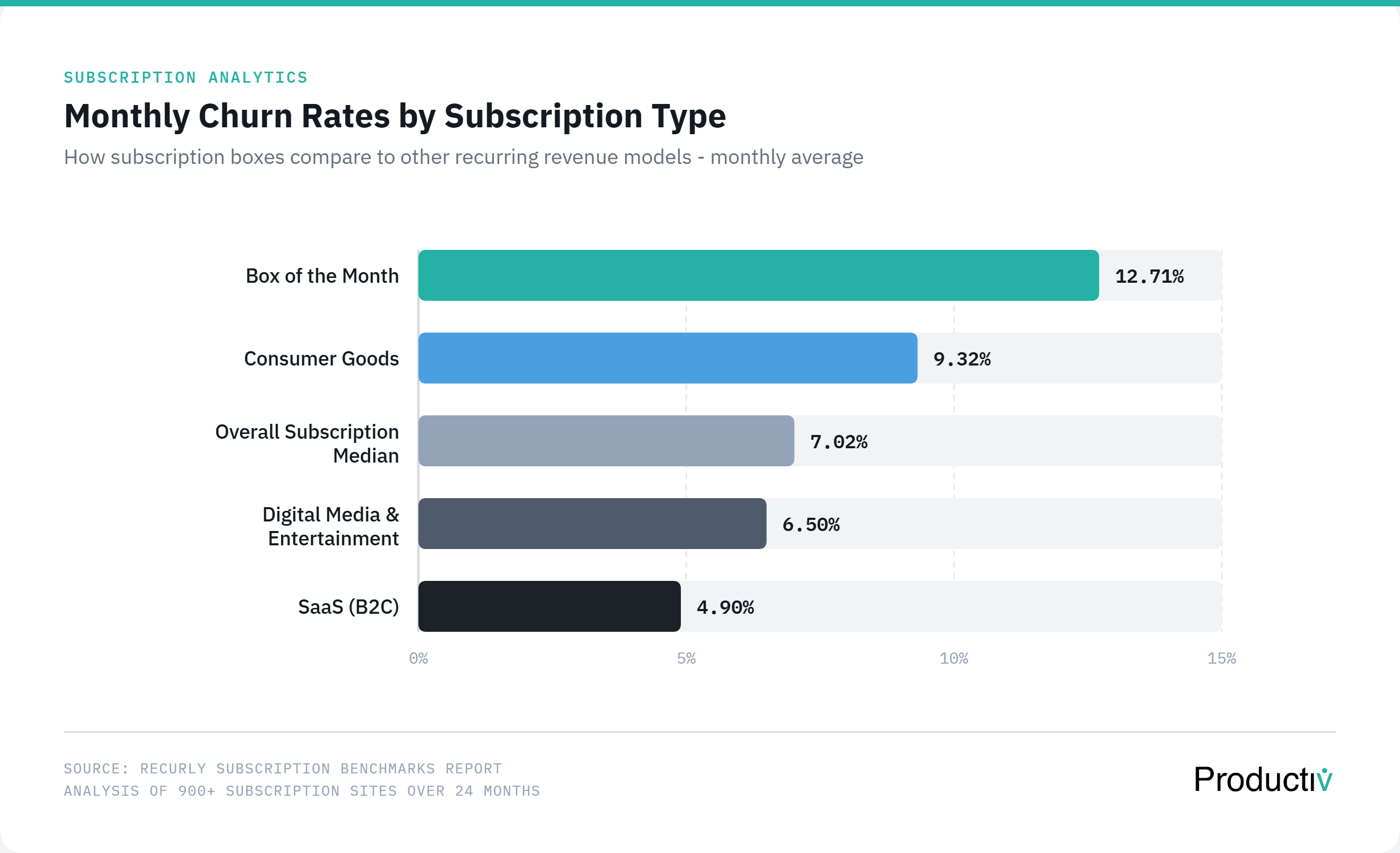
According to Recurly's subscription benchmarks, box-of-the-month subscriptions have the highest churn rate of any subscription category at 12.71%, well above the all-industry median of 7.02%. Part of that is product expectation management, but part is operational: when a box doesn't arrive or doesn't contain what was promised, the subscriber's reason to stay disappears.
If you're working to start and scale a subscription box business, inventory management isn't a back-office function. It's a direct input into customer retention.
Frequently Asked Questions
#1. How do I manage inventory for a monthly subscription box?
Build your process around your fulfillment cycle. Set reorder points based on your pack date and supplier lead times, cycle counts between shipments, and integrate your subscriber platform with your WMS so inventory requirements update automatically. Pre-kitting at least a week before ship day gives you time to identify component gaps before they become a problem.
#2. What causes subscription box churn, and how does fulfillment affect it?
A mix of product disappointment, pricing, and fulfillment failures drives churn. On the fulfillment side, the most common drivers are late shipments, missing or incorrect items, and damaged packaging — all of which trace directly to inventory management. According to Recurly, box-of-the-month subscriptions churn at 12.71% monthly, the highest rate of any subscription category.
#3. When should I outsource subscription box fulfillment?
Evaluate outsourcing before inventory problems start reaching subscribers — specifically when monthly volume exceeds what your team can handle without recurring errors, or when pack-day execution is consistently stressful. Use the subscription box fulfillment checklist to identify gaps in your current process.
#4. How much inventory buffer should I hold each cycle?
A 5-10% buffer above your confirmed subscriber count is a reasonable starting point, adjusted for your growth rate, supplier reliability, and whether you offer last-minute gifting or upgrades close to cut-off. Use actual subscriber data as your forecast input rather than a generic buffer rule.
#5. Does a 3PL improve subscription box inventory accuracy?
Generally, yes. A qualified 3PL operates a WMS that tracks inventory at the lot level, runs regular cycle counts, and enforces FIFO/FEFO protocols automatically. The industry average inventory accuracy rate is 83%; 3PLs running barcode scanning and WMS protocols consistently reach 95% or higher.
#6. How does inventory management affect shipping costs?
Accurate inventory management lets you plan package sizes, negotiate carrier rates based on predictable volumes, and avoid expedited fees caused by late supplier deliveries. A stockout that forces a split shipment effectively doubles your shipping cost for affected subscribers. Reducing subscription box shipping costs requires the same cycle-level planning that solid inventory management produces.
Key Takeaways
- Subscription box inventory runs on a batch model, not continuous demand. Your reorder points, forecasting inputs, and supplier calendars all need to be built around your pack date, not standard e-commerce replenishment logic.
- Subscription box churn averages 10-12% monthly, according to Recurly. Forecasting against your actual subscriber count, not last month's sales, prevents both chronic overstocking and mid-cycle shortfalls.
- The industry-average inventory accuracy rate is 83%, per CAPS Research, as cited by NetSuite. Cycle counting between shipment windows catches discrepancies before you run out of time to fix them.
- FIFO and FEFO protocols need to be enforced at the physical storage level, not just in your system. For shelf-stable products, the right protocol should be included in your assembly SOPs.
- According to a 2024 Logistics Management survey, 93% of warehouses use WMS software. Integrating your subscriber platform with your WMS closes the data gap that causes most mid-cycle inventory surprises.
- Pre-kitting five to seven business days before the ship date surfaces component shortages early, when they're still solvable.
- Treat supplier lead times as minimums. Build 3-4 extra days into every order window, and more for custom or exclusive items.
- When inventory complexity starts costing you subscribers, the financial case for outsourcing to a 3PL is straightforward. The fixed costs of building that infrastructure in-house almost always exceed the variable costs of a fulfillment partner.
20 Years of Kitting Excellence
Ready to Streamline Your Supply Chain?
Join industry leaders achieving 99%+ SLA performance with flexible kitting, fulfillment, and 3PL solutions.
Get in Touch