
We fulfill major brands to Dick's Sporting Goods. That carries a lot of operational weight, because Dick's is a retailer where general retail compliance experience is not enough. Their labeling requirements are stringent enough that we had to purchase a specialty thermal transfer printer—standard thermal labels do not pass their compliance checks. They have a detailed routing guide with specifications that differ from mass retailers in important ways. And they issue purchase orders through multiple formats, each requiring different ASN configuration to avoid automatic compliance failures.
That level of retailer-specific complexity is not unique to Dick's. It is characteristic of specialty retailers in general. Where mass retailers like Walmart and Target have standardized their compliance programs at enormous scale, specialty retailers often have more particular requirements in specific areas—requirements that reflect their supply chain needs rather than industry convention. A 3PL that treats Dick's like “just another retailer” will discover the differences through chargebacks rather than through proper setup.
This guide covers what we have learned about Dick's Sporting Goods compliance from operating it in practice—the specific requirements, the setup work involved, and what the experience teaches about managing specialty retailer compliance more broadly.
The Thermal Transfer Labeling Requirement
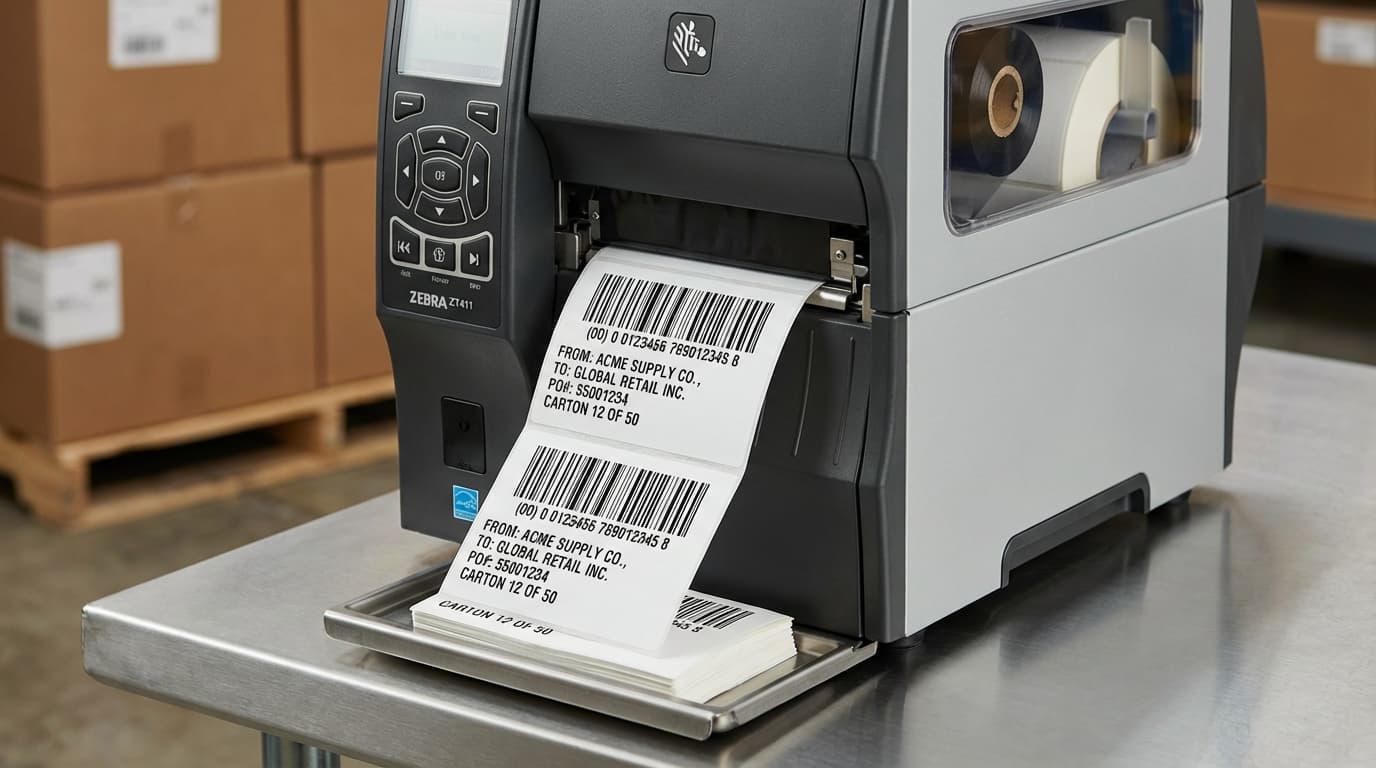
The most immediately visible difference between Dick's and many other retailers is their labeling specification. Dick's requires label quality that exceeds what standard direct thermal printing can achieve. Direct thermal labels print by applying heat directly to chemically treated paper—the image appears where the print head touches the label. These labels are fast and inexpensive, but they have a weakness: the image degrades with exposure to heat, friction, light, and moisture.
In a supply chain where labels may sit on pallets in warm warehouses, go through truck trailers in varying temperatures, and be handled multiple times during distribution center receiving, label durability matters. A barcode that was scannable when printed but has faded by the time it reaches Dick's DC will fail their scan checks and trigger a chargeback. This is not a theoretical concern—it is the specific failure mode that Dick's thermal transfer requirement is designed to prevent.
Thermal transfer printing uses a heated ribbon to transfer ink onto the label material. The resulting image is significantly more durable than direct thermal —resistant to heat, chemicals, abrasion, and UV exposure. The trade-off is that thermal transfer printing requires different equipment (a thermal transfer-capable printer) and ongoing supply cost (ribbon inventory in addition to labels).
For a 3PL, this requirement means maintaining thermal transfer printing capability in the facility, stocking the correct ribbon and label media for Dick's specifications, and configuring the printer for the correct print speed, darkness, and resolution to produce consistently scannable barcodes. This is equipment and expertise that a 3PL either has or does not have—it cannot be improvised.
Multi-Format Purchase Orders and ASN Configuration
The second area where Dick's compliance requires specific attention is how they issue purchase orders. Dick's uses multiple PO types that each require different handling: Bulk orders (SA) for warehouse replenishment, Single Store orders (SA) for individual location delivery, Replenishment orders (RE) for ongoing inventory, Consolidated POs that combine multiple destinations, Parent-Child POs (BK/RL) for linked order sets, and Prepack POs for pre-assorted product bundles. Each format structures data differently in ways that affect downstream EDI processing.
This matters because the ASN (EDI 856) must be generated correctly regardless of which PO format triggered the order. Dick's requires the ASN to be transmitted within one hour of the shipment departing the facility—the same timing applies to the EDI 810 invoice. If the EDI system is configured to handle one PO format but not another, the system will generate correct ASNs for some orders and incorrect ASNs for others. The symptom is intermittent ASN failures—some shipments pass compliance and others trigger chargebacks, with no obvious pattern until someone traces the failures back to the PO format that originated them.
Every ASN must also carry the TMS Shipment ID (CSxxxxxxxxx) in the required REF*BB segment, exactly as assigned in the Transportation Management System. The Ship ID must match the PO(s) on the ASN—using a Ship ID that does not match what is assigned in TMS will trigger additional compliance chargebacks. Dick's also requires the EDI 997 Functional Acknowledgment for each transaction. On the invoicing side, non-compliance with EDI 810 requirements carries a $25 chargeback per invoice under specific codes: LMI (late/missing invoice), ERR (errors on invoice), DUP (duplicate invoices), PRC (incorrect pricing), MAN (manual invoice instead of EDI), and RES (resubmission errors).
The solution is comprehensive during onboarding: map every PO format Dick's may issue for the account, configure ASN generation for each one, and test with sample data that covers all formats before going live. This is setup work that takes days rather than months, but it must be done deliberately. A 3PL that configures for the first PO type they receive and assumes the rest will work the same way will discover the configuration gaps through chargebacks.
Chargebacks on some Dick's POs but not others?
That pattern usually means an unmapped PO format. We have thermal transfer printing capability, Dick's-specific EDI connections, and direct experience fulfilling to Dick's stores—we can trace which PO type is generating the failures.
Talk to our teamDick's Routing Guide: Key Specifications
Dick's routing guide covers the full range of shipment preparation requirements: packaging, labeling, documentation, transportation, and delivery scheduling. Several specifications warrant particular attention because they differ from what many 3PLs default to.
Carton and Pallet Specifications
Dick's defines two carton categories with specific dimension windows. Conveyable cartons must fall between 9×6×3 inches (minimum) and 48×30×30 inches (maximum) at no more than 50 pounds. Anything outside these dimensions is classified as non-conveyable and follows different label placement rules. Carton strength requirements are also specified: a minimum of 32 ECT board strength for products under 65 pounds, scaling up to 55 ECT for heavier items according to their corrugated board equivalency chart.
Carton sealing mirrors the industry trend: staples are prohibited, and banding or strapping on conveyable cartons is not permitted. Metal straps are never allowed. Dick's requires reinforced kraft packaging tape or pressure-sensitive poly tape at a minimum of 2 mil thickness, with all outer seams sealed using strips not less than 2 inches wide. Cartons must not bulge from over-packing and should not have more than 0.25 cubic feet of air space per cubic foot of carton volume.
Dick's also has an extensive list of prohibited packing materials: no safety pins, tiebacks, rubber bands, foam coverings on hangers, cardboard dividers, tissue or paper between product layers, and no filler material like bubble wrap, Styrofoam peanuts, or shredded paper. These requirements must be built into standard work instructions for any Dick's order so that warehouse staff follow them automatically.
Label Content and Placement
Dick's requires UCC-128 labels (SSCC-18 format) on every carton shipping to their DCs, with no exceptions. The barcode specifications are precise: 4×6 inch label format, barcode length of 3.02 inches, height of 1.25 inches, ratio of 2:1, with a 0.25-inch quiet zone on each side. Print quality must be ANSI A or B grade. Ink jet and laser printing are explicitly not acceptable—thermal printing is the required method to avoid smudging during transit.
Label content follows a zone-based system with mandatory fields: vendor name and address (Zone A), Dick's DC or store address (Zone B), PO number with department number and name in 14-point bold (Zone E), and the SSCC-18 barcode (Zone I). The department number and name must be the largest text on the label—no other information may be larger. The sort letter from the EDI 850 must appear in the 25th position of the department name line exactly as transmitted. Mixed-UPC cartons must read “Mixed” in the UPC field.
Placement rules: labels go on the right side of the carton, 2 inches from the natural base and 2 inches from the vertical edge. Cartons 4 inches or shorter get the label on top, 2 inches from the right corner. Non-conveyable cartons (exceeding 48 inches in length) get the label on the end. Labels must never fold over a corner or edge, and must never overlap a taped seam. New vendors must get their labels approved by Dick's Vendor Relations prior to first shipment.
A detail that catches many vendors: no other 20-digit barcode can be visible on the carton unless it matches the UCC-128 label. Any vendor internal barcodes that do not match must be defaced with a vertical stripe using a china marker or grease pencil before shipping.
Delivery and Appointment Scheduling
All shipments to Dick's must be routed through their Transportation Management System (TMS) at logistics.dcsg.com—no exceptions, regardless of whether freight is collect or prepaid. Collect shipments must be routed no less than 2 business days prior to the Cancel If Not Shipped By (CINSB) date, with specific deadlines based on the day of the week: a Monday CINSB requires routing by the previous Thursday, Tuesday by the previous Friday, and so on. Orders that miss the original CINSB date are subject to late ship compliance fees outlined in the compliance offset schedule. DSG business hours for routing are Monday through Friday, 7:30 AM to 4:30 PM EST.
Routing metrics depend on shipment size. Shipments of 8 or fewer standard pallet positions (40×48 inches) are routed as palletized freight—the pallet and carton count in TMS must match the physical shipment exactly. Shipments of 9 or more pallet positions must be entered as floor-loaded, with accurate cube calculations required in TMS. LTL shipments must be palletized and shrink-wrapped, with pallets at a minimum of 7 feet in height and cartons not overhanging more than 1 inch on any side. Truckload and intermodal shipments must be floor-loaded using a brick layer pattern (no column loading), with barriers and load restraints required to secure freight in transit.
Bill of lading preparation is detailed: two copies must be provided to the carrier at pickup, listing the TMS Shipment ID on the first page, carrier full name (not abbreviated), vendor name and number, total carton count, number of pallets, weight, and seal number for truckload shipments. Vendors are responsible for verifying the correct shipment ID is being loaded on the correct truck—if the driver does not have the shipment ID, Dick's instructs vendors not to load the truck until the driver contacts dispatch.
Speed of EDI setup is particularly important for specialty retailers where the business volume per retailer may be smaller but the compliance requirements are just as detailed. A 3PL that can get Dick's compliance stood up in weeks rather than months reduces the exposure period where chargebacks can accumulate.
Vendor Certification and Inventory Accuracy
Dick's operates a Vendor Certification Program that audits shipment inventory integrity by randomly selecting cartons and comparing physical contents to ASN data at the carton level. These are concealed inventory checks—the issues found by the QA team are ones that would not be identified unless the carton was opened and contents reviewed in detail.
Vendors are categorized into three performance tiers based on past audit results: Gold (99.75–100% accuracy), Silver (99.50–99.74%), and Bronze (99.49% and below). The better the accuracy results, the fewer cartons will be selected for future audits —which means Gold vendors experience less disruption and fewer compliance charges. The main chargeback code is IN (inventory), with subcodes for concealed shortage (SS), concealed substitution (SU), concealed overage (OS), unscannable UPC (ST), missing UPC (MU), and invalid UPC (VC). Maintaining Gold-tier accuracy requires tight pick-and-pack QC processes and ASN data that matches physical carton contents exactly.
What Dick's Teaches About Specialty Retailer Compliance
Dick's Sporting Goods is a useful case study for specialty retailer compliance in general because it illustrates patterns that repeat across many specialty and mid-tier retailers.
Niche Requirements That Matter
Every specialty retailer has at least one compliance requirement that differs meaningfully from mass retailer standards. For Dick's, it is thermal transfer labeling. For other retailers, it might be specific inner-pack configurations, unique barcode symbologies, particular documentation formatting, or delivery scheduling nuances. The operational discipline is the same: identify the retailer's specific requirements during setup, configure for them explicitly, and validate before the first live shipment.
PO Variability Within a Single Retailer
Specialty retailers are more likely than mass retailers to have PO format variability because their systems may have evolved organically rather than being standardized across a massive operation. This means ASN configuration must account for more PO types than you might expect. The safe approach is to assume variability and map every PO type during onboarding rather than configuring for the first type received and hoping the rest follow the same format.
Smaller Compliance Teams
Specialty retailers often have smaller compliance and vendor management teams than mass retailers. This can mean slower dispute resolution, less formalized onboarding support, and fewer resources available to help new vendors navigate compliance requirements. Having a 3PL with pre-existing retailer relationships and connections compensates for this—the 3PL already knows how the retailer's systems work and does not need to learn through the onboarding process.
Operational Setup Checklist for Dick's Compliance
Based on our experience setting up and operating Dick's Sporting Goods compliance, here is the setup sequence that prevents chargebacks from the first shipment.
Equipment and Infrastructure
- Confirm thermal transfer printing capability in the facility. If equipment needs to be procured, factor lead time into the onboarding schedule.
- Stock the correct label media and ribbon for Dick's specifications. Thermal transfer ribbon must match the label material for optimal print quality and barcode scannability.
- Configure printer settings (print speed, darkness, resolution) for consistent output that meets Dick's scan quality requirements.
EDI and Label Configuration
- Set up EDI connections for all required transaction sets (850, 855, 856, 810, 997) using Dick's specific formatting requirements.
- Map every PO format Dick's may issue for the account. Configure ASN generation for each format.
- Build or activate Dick's-specific label templates with correct data fields, barcode format, and placement specifications.
- Test ASN generation against sample data for every PO type. Do not go live until all types produce correct ASNs.
- Print sample labels and validate barcode scannability, data accuracy, and placement compliance.
Operational Procedures
- Build Dick's pallet and carton specifications into standard work instructions for warehouse staff.
- Calculate transit buffers for every lane between your facility and Dick's DCs.
- Establish delivery appointment scheduling procedures per Dick's requirements.
- Set up compliance monitoring to track on-time delivery, ASN accuracy, and chargeback data specifically for Dick's.
We are hitting all the SLAs over and over again. Productiv has led the charge and brought so many improvements to the table over the last two years. There's nothing glaring that stands out anymore and now we are just fine tuning.
That trajectory is what Dick's compliance should look like over time. The initial setup period may surface a few configuration issues—that is normal with any new retailer. But within weeks, those issues should be resolved and the operation should be running at consistent compliance. If chargebacks are still occurring months into the relationship, the operational setup was not thorough enough.
What to Look for in a 3PL for Dick's and Specialty Retailer Compliance
If you are shipping to Dick's Sporting Goods or other specialty retailers, here is what separates a 3PL that can handle the compliance requirements from one that will learn on your account.
- Thermal transfer printing capability. Ask whether they have thermal transfer printers in the facility. If the answer is no, they cannot meet Dick's labeling requirements without a capital investment and setup time.
- Active Dick's EDI connections. Ask whether they currently ship to Dick's for other clients. Existing connections mean tested configurations. New connections mean a learning curve on your account.
- Experience with multiple PO formats. Ask how they handle PO format variability. A provider that maps all formats during onboarding prevents intermittent ASN failures. A provider that configures for the first format and reacts to failures on subsequent formats generates chargebacks.
- Specialty retailer breadth. Ask how many specialty retailers they ship to. A provider with experience across multiple specialty retailers understands the pattern of niche requirements and knows to look for them during setup. A provider whose retail experience is limited to mass retailers may underestimate the setup work required.
- Retailer-level compliance reporting. Ask what Dick's-specific compliance data they provide. Chargeback data, delivery performance, and ASN accuracy should be visible at the retailer level, not buried in aggregate metrics.
Specialty retailer compliance is not harder than mass retailer compliance—it is different. The volume may be smaller, but the requirements are just as specific and the chargebacks are just as real. The brands that succeed in specialty retail do so with a 3PL that treats each retailer as a distinct compliance environment and invests the setup work to get it right from the start. If you are shipping to Dick's or planning to launch with specialty retailers, start a conversation with our team. We can walk through what the setup involves and how to avoid the chargebacks that catch most brands during initial shipments.
Auditing your setup before your first Dick's shipment? Work through the 3PL compliance checklist — EDI, labeling, and SLA accountability in one self-audit.
Paul Baker
CFO, Productiv
Paul co-leads Productiv alongside Doug Legan, bringing two decades of hands-on experience in 3PL operations, kitting, fulfillment, and embedded manufacturing. Clients reference Paul by name when describing the direct leadership access that sets Productiv apart from enterprise providers. Paul is leading Productiv's push into AI and robotics to give Productiv's clients the greatest competitive advantage against their competitors as we enter the age of AI.
Frequently Asked Questions About Dick's Sporting Goods & Specialty Retailer Compliance
What makes Dick's Sporting Goods compliance requirements different from other retailers?
Dick's Sporting Goods has labeling requirements that are more stringent than most retailers — stringent enough to require specialty thermal transfer printing rather than standard direct thermal labels. Their routing guide includes specific carton and pallet configurations, and they have multiple methods for issuing purchase orders that each require different ASN handling. These specifics make Dick's a retailer where general retail compliance experience is not sufficient — you need Dick's-specific setup and testing.
Why does Dick's require thermal transfer labels instead of standard thermal labels?
Dick's Sporting Goods specifies label durability and print quality standards that exceed what standard direct thermal printing can achieve. Direct thermal labels fade with exposure to heat, friction, and light — which can render barcodes unscannable during transit, storage, or DC processing. Thermal transfer printing uses a ribbon to create more durable images that remain scannable throughout the supply chain. Meeting this requirement means investing in thermal transfer printing equipment and ribbon inventory, which is a setup cost that your 3PL must absorb and manage.
How do Dick's multiple PO formats cause ASN failures?
Dick's Sporting Goods may issue purchase orders through multiple channels or formats — different programs, seasonal versus replenishment, or different business units may use different PO structures. Each format can require different handling for ASN generation. If your EDI system is configured to generate ASNs for one PO format but not properly set up for another, shipments fulfilled against the second format will produce ASN errors. These failures repeat on every shipment of that PO type until the configuration issue is identified and corrected.
What is Dick's routing guide, and what does it require?
Dick's Domestic Vendor Routing and Supply Chain Guide (revised February 2025) covers carton specifications (conveyable: 9×6×3" to 48×30×30", 50 lb max; 32 ECT minimum board strength), UCC-128 label requirements (thermal transfer only, 4×6" format, ANSI A/B grade, zone-based content system), TMS routing requirements (all shipments must be routed through logistics.dcsg.com at least 2 business days before the CINSB date), shipping and loading specifications (LTL must be palletized and shrink-wrapped, truckload must be floor-loaded in brick layer pattern), EDI requirements (850, 997, 856, 810 — ASN and invoice within 1 hour of departure), and vendor certification (QA audits with Gold/Silver/Bronze tier system). The guide is updated at least every six months and requires continuous monitoring for changes.
How long does it take to set up Dick's Sporting Goods compliance?
With a 3PL that has existing Dick's EDI connections and pre-built label templates (including thermal transfer capability), setup typically takes 2 to 4 weeks including testing and validation. Without existing infrastructure, setup can take 2 to 3 months — longer if the 3PL needs to procure thermal transfer printing equipment. We maintain Dick's-specific label templates and EDI configurations that we have built and validated through actual fulfillment operations, which means new client onboarding for Dick's involves configuration rather than development from scratch.
What chargebacks does Dick's issue for compliance failures?
Dick's issues chargebacks across multiple compliance categories, all outlined in their Exhibit C compliance offset schedule. Key areas include: invoicing non-compliance ($25 per invoice for late/missing, errors, duplicates, incorrect pricing, manual instead of EDI, or resubmission errors), inventory accuracy violations (concealed shortage, substitution, overage, unscannable or missing UPC — assessed based on Gold/Silver/Bronze vendor certification tier), late ship compliance fees for orders missing the original CINSB date, ASN and labeling violations, routing non-compliance (missing TMS routing, incorrect metrics), and shipping violations (BOL discrepancies, missing shipment ID, incorrect 3rd-party billing). Labeling chargebacks are particularly common for new vendors because the thermal transfer requirement catches suppliers who assume standard labeling will suffice.
Can Dick's chargebacks be disputed?
Yes, Dick's provides a formal dispute process through their vendor portal at dsgfreight.com. Vendors must submit a deduction task in the portal upon receipt of the chargeback notification email — the user role 'Email – Vendor Deductions' must be configured to receive these automated notifications. There are critical time windows: disputes must be filed promptly upon receipt of the notification, and any research requested on chargebacks older than 3 months from the date the charge is approved will incur a $25 research fee per item. Dick's will not research any charge over 6 months old. The same timelines apply to RTV (Return to Vendor) disputes — the RA identifier must be provided within 2 business days of the request. Prevention through proper operational setup remains the most effective strategy.
What EDI transactions does Dick's require?
Dick's requires the EDI 850 (Purchase Order), 997 (Functional Acknowledgment), 856 (Advance Shipping Notice), and 810 (Invoice). Both the ASN and invoice must be transmitted within 1 hour of the shipment departing the facility — this is a strict timing requirement. The ASN must carry the TMS Shipment ID (CSxxxxxxxxx format) in the REF*BB segment, matching exactly what is assigned in the Transportation Management System. The Ship ID must correspond to the PO(s) on the ASN — mismatches trigger additional compliance chargebacks. Non-EDI vendors must submit packing slips via email but are still required to transition to EDI. New vendors can download the EDI setup form from the EDI folder in the vendor portal's Project Library at dsgfreight.com to establish their connection for testing.
How does Dick's TMS routing work, and why does it cause compliance issues?
All shipments to Dick's must be routed through their Transportation Management System (TMS) at logistics.dcsg.com — no exceptions, regardless of freight terms. New vendors must complete a TMS Profile immediately upon receiving their vendor agreement, as you cannot route or ship first orders without it (setup takes up to 5 business days). All POs going to the same destination must be combined on one routing request — submitting individual requests per PO triggers compliance charges. The routing request must include an accurate ready date that is at least 1 future business day out, and the freight must physically be ready on that date. Collect shipments must be routed at least 2 business days before the CINSB date. Once routing is submitted and a Shipment ID is assigned, that ID cannot be reused and must appear on both the BOL and the EDI 856 ASN.
Does Dick's require RFID, and what should vendors prepare for?
Dick's is rolling out RFID requirements in phases. Phase 1 launched in January 2024, Phase 2 went active in January 2025, and Phase 3 is currently in progress as of January 2026. The specific product categories in scope for each phase are outlined in the RFID Playbook available in the vendor portal's Project Library. RFID tags must meet Auburn University ALEC (ARC Lab for E-Commerce) certification standards. If your product categories fall into the current RFID rollout phases, you need to factor RFID tag sourcing, encoding, and application into your fulfillment workflow. Working with a 3PL that has existing RFID capability avoids the capital investment and learning curve of building this in-house.
Is Dick's compliance similar to other specialty sporting goods retailers?
Many specialty retailers share similar compliance patterns: specific labeling requirements that exceed basic UCC-128 standards, routing guides with particular packaging and documentation rules, and vendor performance monitoring that affects business relationships. The specific requirements differ between retailers, but the operational principles are the same — proper setup during onboarding, retailer-specific EDI and label configurations, automated validation, and ongoing monitoring. Experience with one specialty retailer like Dick's builds operational patterns that transfer to others, even when the specific requirements differ.
How does shipping to Dick's through a 3PL work operationally?
When shipping to Dick's through a 3PL, the 3PL handles receiving purchase orders via EDI, picking and packing to Dick's specifications (including ecommerce VAS requirements like poly-bagging soft goods, one SKU per carton for ecommerce orders, and 40-pound carton weight limits), generating compliant labels using thermal transfer printing, creating and transmitting accurate ASNs within 1 hour of departure, routing through TMS, scheduling delivery appointments, and managing carrier selection. Direct to Store (DTS) orders require UCC-128 labels with complete store addresses including the chain name (Dick's Sporting Goods, Golf Galaxy, etc.) in Zone B of the label. The brand maintains the vendor relationship while the 3PL executes operational compliance. The critical success factor is that the 3PL has Dick's-specific infrastructure and experience rather than treating Dick's as a generic retail account.
What should I ask a 3PL about their Dick's Sporting Goods capabilities?
Ask specific questions: Do you currently ship to Dick's for other clients? Do you have thermal transfer printing equipment? Do you have pre-built Dick's label templates? How do you handle Dick's multiple PO formats for ASN generation? What is your typical onboarding timeline for a new Dick's vendor? What compliance data do you track and report? A 3PL that answers with specifics has real Dick's experience. A 3PL that gives general answers about retail compliance is likely learning on your account.
How do specialty retailers in general differ from mass retailers for compliance?
Specialty retailers often have more specific requirements in certain areas compared to mass retailers. Where Walmart and Target have standardized processes at massive scale, specialty retailers may have niche requirements — like Dick's thermal transfer labeling — that reflect their particular supply chain needs. Specialty retailers may also have less standardized EDI processes, more variation in PO formats, and compliance teams that are smaller and potentially slower to resolve disputes. The operational challenge is that each specialty retailer requires its own setup work, and the volume per retailer may not justify the 3PL learning curve — which is why having a provider with pre-existing specialty retailer connections matters.
Have an Operator Trace Your Dick's Chargebacks
Most Dick's deductions come back to a setup gap: direct thermal labels failing scan checks, an unmapped PO format generating bad ASNs, or a TMS Shipment ID that doesn't match the 856. We have thermal transfer printing capability, Dick's-specific EDI connections and label templates, and direct experience fulfilling to Dick's stores. Bring your deduction report and we'll find the root cause.
Get Your Chargebacks Traced