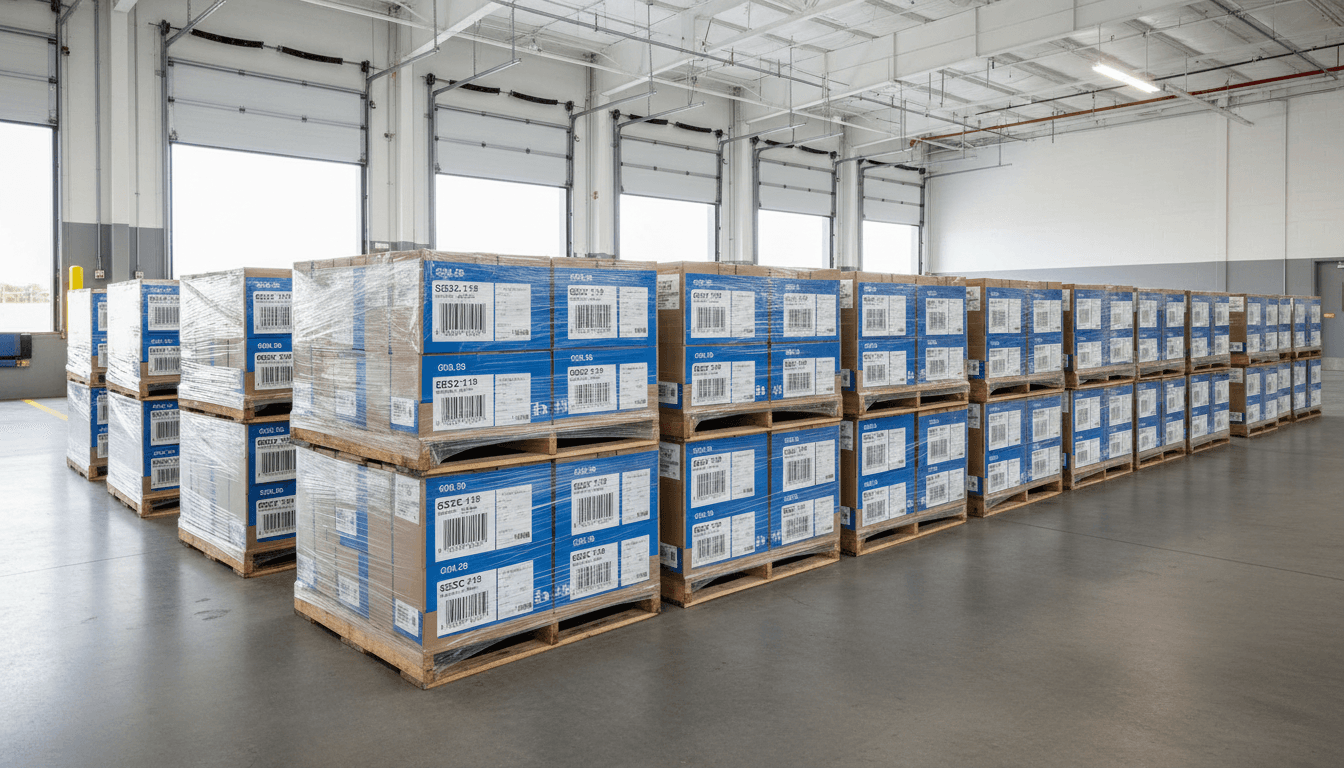
Walmart is the largest retailer in the world, and their vendor compliance expectations reflect that scale. Their OTIF program —On-Time In-Full—is not a suggestion. It is an automated penalty system that deducts 3% of the cost of goods from supplier invoices when shipments fail to arrive on time or in the correct quantity. At a 98% compliance threshold, there is very little margin for operational error.
For brands shipping into Walmart through a 3PL, the operational reality is straightforward: your 3PL's capabilities determine your OTIF score, but your brand absorbs the penalty when they fall short. A 3PL that does not understand how Walmart's MABD windows work, how their PO types differ, or how their ASN validation operates will generate chargebacks—and the learning curve gets charged to your account.
We ship into Walmart for multiple brands across different product categories. This guide covers what we have learned about meeting their compliance requirements consistently —the specific operational details that determine whether you stay above the 98% threshold or start seeing deductions on your invoices.
How Walmart's OTIF Program Works
Walmart measures OTIF at the purchase order line level. Every line item on every PO is evaluated independently on two criteria: Did the correct quantity arrive? And did it arrive by the Must Arrive By Date? If either condition fails for any line, that line is scored as non-compliant and the 3% penalty applies to the cost of goods for that line.
Walmart tracks prepaid and collect shipments separately. For prepaid shipments—where the supplier arranges transportation—the supplier owns both the delivery timing and the quantity accuracy. For collect shipments —where Walmart arranges pickup—the supplier is responsible for having the correct quantity ready at the scheduled pickup time, while Walmart assumes transit responsibility. Both categories carry a 98% compliance threshold and the same 3% penalty.
The penalty calculation compounds quickly. A brand shipping $10 million annually into Walmart with a 95% OTIF rate is paying $15,000 per month in avoidable fines. Move that rate to 92% and it becomes $24,000 per month. These are not one-time costs—they recur every month the compliance gap exists.
The Must Arrive By Date: Where Most Failures Start
The MABD is the single most important date in Walmart compliance. It is the date by which your shipment must check in at the specified Walmart distribution center. Not “ship by”—“arrive by.” The distinction matters because it means you need to work backward from the MABD to determine your ship date, accounting for carrier transit time, potential delays, and DC receiving schedules.
Common MABD failures stem from three sources:
- Insufficient transit buffer. Shipping on the last possible day that could theoretically make the MABD leaves no room for carrier delays, weather disruptions, or DC receiving backlogs. Successful operations build 1–2 days of buffer into their shipping schedule.
- Appointment scheduling delays. Walmart DCs operate on appointment-based receiving. If you cannot secure an appointment within the MABD window, the shipment will be scored as late regardless of when the truck arrives at the facility. Appointment availability tightens significantly during peak seasons.
- Carrier reliability on specific lanes. Not all lanes perform equally. A carrier that consistently hits 2-day transit on one lane may average 3 days on another due to routing, terminal transfers, or congestion. Tracking carrier performance by lane—not just in aggregate —identifies reliability issues before they become OTIF failures.
The operational discipline required is planning shipments around the MABD from the moment the PO is received, not treating it as a deadline to be aware of after the order is picked and packed.
In-Full Compliance: More Than Pick Accuracy
The “in-full” component of OTIF measures whether the quantity delivered matches the quantity ordered at the PO line level. A purchase order for 500 units of SKU A and 300 units of SKU B that ships 500 of SKU A but only 280 of SKU B fails on one line—and the penalty applies to that line.
In-full failures typically trace back to inventory problems rather than pick errors. The most common causes include:
- Inventory discrepancies. If WMS inventory counts do not match physical inventory, a PO may be accepted and allocated against stock that does not actually exist. The shortfall is not discovered until pick time, at which point it is too late to procure additional inventory.
- Allocation conflicts. When the same inventory serves both DTC and retail channels, a surge in DTC orders can consume stock that was implicitly allocated to an open Walmart PO. Without channel-level inventory reservation, retail orders compete with DTC demand.
- Receiving delays. Inbound inventory that arrives late from the manufacturer may not be processed and put away in time to fulfill an open Walmart PO. The gap between “inventory has arrived at the facility” and “inventory is received into WMS and available for allocation” can be measured in days at some 3PLs.
We manage in-full compliance through real-time inventory visibility across channels, with retail PO quantities reserved at the time of order acknowledgment. This means the inventory earmarked for Walmart is protected from DTC allocation, and any shortfalls are identified at PO acceptance rather than at pick time.
Navigating Walmart's Routing Guide
Walmart's Supply Chain Packaging Guide is a 408-page document—updated twice annually in January and July—that specifies exactly how shipments must be prepared, labeled, and transported. The guide covers everything from corrugated board specifications to automation-eligible case dimensions to pallet load characteristics. Violations trigger chargebacks separate from the OTIF program—meaning you can be OTIF-compliant and still receive penalties for routing guide failures.
Walmart enforces compliance through their Supplier Quality Excellence Program (SQEP), which phases in defect categories over time. Phase 1 covers PO accuracy defects—overages, canceled PO shipments, items not on PO, wrong pack configurations, missing ASNs, and ASN errors. Phase 2 adds barcode and labeling defects: wrong format, missing barcodes, barcodes not on the required two sides, and GTIN mismatches. Phase 3 escalates to packaging, pallet, and load quality—weak packaging, incorrect pallet labeling, improper securement, pallet build defects, overhang, height violations, and load stability issues. Understanding which phase your product category is in determines which defect types are actively being charged back.
Pallet and Packaging Requirements
Walmart requires GMA-standard 48×40 pallets with an overall pallet-plus-freight height under 96 inches. The requirements go well beyond dimensions: layers leaning or tipped more than 0.5 inches from the base of the pallet are not acceptable at receiving. Cases cannot overhang pallet dimensions, and underhang greater than 7.5 inches (3.75 inches per side) will also be rejected. A single pallet layer cannot exceed 500 pounds. Tier sheets stuck or glued between layers are not permitted, and cases that fall or become unstable when stretch wrap is removed will be flagged as non-compliant.
Case sealing must use glue or tape—minimum 2-inch (50mm) wide strips on all outer seams. Metal banding is never permitted, and straps or bands are not allowed on automation-eligible merchandise shipped to the eCommerce network. Cases with open flaps, loose shrink plastic, bulging or compacted sides, or products extending from the top of packaging are all classified as “not acceptable” in Walmart's case quality matrix. Black corrugated material and black plastic film are also not allowed—they interfere with DC scanning and automation equipment.
For automation-eligible cases (general merchandise), Walmart specifies precise dimension windows: minimum 6.4×5.0×2.0 inches at 1 pound, maximum 36×24×16 inches at 50 pounds. Cases outside these ranges are classified as automation ineligible and route to different DC handling processes. All automation-eligible cases and packaging (except glass bottles and jars) must withstand a 3-foot drop test, and all new or existing domestic and direct import items must pass ISTA transit testing before being shipped to Walmart. Test results are submitted to Walmart and remain valid indefinitely as long as packaging does not change and return rates stay below department average.
SSCC-18 and GS1-128 Labeling
Every pallet and carton shipped to Walmart must carry properly formatted SSCC-18 labels using GS1-128 barcode symbology. The labels must include specific data fields —SSCC number, PO number, item information, quantity —in Walmart's specified format and placement. Labels must be scannable at the DC—print quality, barcode size, and placement all affect scan rates. A label that is technically correct but poorly printed or incorrectly placed can fail scanning and trigger a chargeback.
A critical detail from Walmart's guide: a supplier's internal barcode label must never be placed on the top of the case, as it can interfere with conveyor scanning equipment. It is also not permitted to cover any case GTIN barcode. Each vendor pack must carry applicable case markings with an orderable GTIN barcode in either ITF-14 or GS1-128 format, and if possible, include the WMIT (Walmart Item Number). For mixed master packs, Walmart requires three “STOP” labels—one on each long side and one on top—reading “STOP | MIXED MERCHANDISE | RECEIVE AS BREAK PACK” in Arial Bold at a minimum of 48-point type. The domestic shipping label must state “MASTER PACK” in the WMIT field. Getting these labeling details wrong creates receiving delays and chargebacks that persist on every shipment until the configuration is corrected.
We maintain a pre-built library of Walmart label templates that are validated against their current specifications. When onboarding a new client shipping to Walmart, we activate the existing template rather than building from scratch—which eliminates the validation period where labeling chargebacks typically occur.
Bill of Lading and Documentation
Walmart's routing guide specifies formatting requirements for bills of lading, including specific data fields and reference number formats. BOL errors can result in refused shipments or chargebacks, and the requirements differ slightly between prepaid and collect shipments. This is a detail that many 3PLs get wrong initially because they apply a generic BOL template rather than one configured to Walmart's requirements.
ASN Configuration for Walmart
The EDI 856 (Advance Shipping Notice) is one of the most common sources of Walmart chargebacks, and the errors are almost always configuration problems rather than one-time mistakes. Walmart uses the ASN for receiving planning at their DCs, so accuracy is critical.
Key ASN requirements for Walmart include:
- Timing. The ASN must be transmitted after the shipment leaves the facility but before it arrives at the DC. Sending the ASN too early (before actual shipment) or too late (after DC arrival) both trigger failures. We automate ASN transmission to fire immediately upon carrier pickup confirmation.
- Quantity matching. The ASN quantities must match the physical shipment exactly. This means the ASN must be generated from actual pick-and-pack data, not from the PO quantities. If 498 of 500 units were actually shipped, the ASN must reflect 498.
- SSCC correlation. Each SSCC-18 on the physical labels must appear in the ASN with the correct associated item and quantity information. Mismatches between physical labels and the ASN create receiving discrepancies that trigger chargebacks.
- PO format handling. Walmart may issue POs through different channels or formats. Each format must be mapped correctly for ASN generation. A configuration that works for standard replenishment POs may not work correctly for promotional or seasonal POs if they use different reference number structures.
Integration speed matters because every week spent configuring EDI connections is a week where ASN errors can generate chargebacks. A provider with pre-established Walmart connections and tested ASN configurations can get a new client to accurate ASN transmission in weeks rather than months.
The Supplier Scorecard and Its Compounding Effect
Walmart's Supplier Scorecard aggregates your performance data across OTIF, fill rate, ASN accuracy, and other operational metrics. The scorecard is used during business reviews, category planning, and vendor evaluations. It creates a compounding dynamic: poor compliance leads to lower scores, which leads to reduced order allocations, which reduces your revenue from Walmart, which makes the remaining business even more margin-sensitive to chargebacks.
Conversely, strong scorecard performance can lead to increased allocations, preferred vendor status, and promotional opportunities. The brands that invest in operational compliance are not just avoiding penalties —they are building a competitive advantage in one of the most important retail channels in the world.
The scorecard also creates accountability transparency. If your 3PL is underperforming on Walmart compliance, the scorecard quantifies the impact in a way that makes the conversation objective rather than anecdotal. Asking your 3PL for their OTIF rate on your Walmart business, and comparing it to the scorecard data, reveals whether they have visibility into their own performance.
Shipping to Walmart and struggling with OTIF?
We ship to Walmart for multiple brands and maintain pre-wired EDI connections, validated SSCC-18 templates, and tested ASN configurations. Let us assess your current compliance setup.
Talk to our teamOperational Playbook for Walmart OTIF Success
Based on our experience shipping to Walmart for multiple brands, here is the operational approach that consistently keeps OTIF above the 98% threshold.
Step 1: Map Every PO Type and Processing Path
Before a single shipment goes out, map every PO type Walmart may issue for your account. Understand the differences between replenishment, promotional, and seasonal POs. Configure ASN generation and label templates for each type. Test with sample data before going live. Most ASN failures trace back to untested PO types that follow a slightly different data structure.
Step 2: Build Transit Buffers Into Ship Scheduling
Calculate the required ship date by working backward from the MABD, subtracting carrier transit time plus a 1–2 day buffer. Make this the pick-wave trigger date, not the MABD itself. The goal is to have shipments leaving the facility early enough that normal transit variation does not create OTIF failures. Track carrier on-time performance by lane and adjust buffers where reliability data warrants it.
Step 3: Reserve Inventory at PO Acknowledgment
When a Walmart PO is received and acknowledged, immediately reserve the required inventory in WMS. This prevents channel-level allocation conflicts where DTC orders consume stock intended for retail fulfillment. If inventory is insufficient at acknowledgment time, flag the shortfall immediately so procurement can respond before the MABD becomes unreachable.
Step 4: Automate ASN Validation and Transmission
Build automated validation into the ASN workflow. Before transmission, the system should verify that ASN quantities match pick-and-pack data, SSCC numbers correlate to physical labels, PO references are correct, and the ASN is being transmitted within the required timing window. Automated validation catches errors that manual review consistently misses, especially at volume.
Step 5: Monitor, Dispute, and Improve
Track OTIF performance weekly, not monthly. Review every failure for root cause. Dispute chargebacks where the evidence supports it—carrier-caused delays, DC receiving errors, and system glitches are all legitimate dispute categories. Feed the root cause data back into process improvements so that each failure mode is addressed permanently rather than recurring.
We are hitting all the SLAs over and over again. Productiv has led the charge and brought so many improvements to the table over the last two years. There's nothing glaring that stands out anymore and now we are just fine tuning.
That trajectory—from initial setup to consistent compliance to ongoing fine-tuning—is exactly what Walmart OTIF management should look like. The chargebacks that might occur during initial configuration should decline rapidly as the compliance system matures. If they are not declining, the operational foundation needs attention.
What to Look for in a 3PL for Walmart Compliance
If Walmart is a meaningful part of your retail business, your 3PL's Walmart-specific capabilities should be a primary evaluation criterion. Here is what separates a 3PL that manages Walmart compliance from one that ships to Walmart and hopes for the best.
- Active Walmart EDI connections. Ask whether they currently ship to Walmart for other clients. A provider with active Walmart connections has solved the configuration challenges already. A provider offering to set up Walmart for the first time is learning on your account.
- Pre-built SSCC-18 label templates. Ask to see their Walmart label templates. If they exist and are validated, onboarding is faster and labeling chargebacks are eliminated. If they need to be created, budget for a validation period.
- OTIF tracking at the retailer level. Ask what your Walmart-specific OTIF rate will be and how they report it. A provider that tracks OTIF by retailer has the visibility to manage it. A provider that reports aggregate compliance across all retailers cannot isolate and fix Walmart-specific issues.
- ASN validation automation. Ask how they validate ASN accuracy before transmission. Automated validation that cross-references pick data is essential at any meaningful volume. Manual ASN review does not scale.
- Carrier lane performance data. Ask whether they track carrier on-time performance by lane for Walmart-destined shipments. This data is critical for building accurate transit buffers and identifying reliability problems before they become OTIF failures.
Walmart compliance is not a capability that can be generalized. It requires specific knowledge of how Walmart's systems work, specific infrastructure for their EDI and labeling requirements, and specific operational processes tuned to their compliance thresholds. If your current 3PL is not meeting your Walmart OTIF targets, or if you are launching into Walmart for the first time, start a conversation with our team. We can walk through your current setup and identify exactly where the compliance gaps are.
Running a self-audit before peak? Work through the 3PL compliance checklist — EDI, labeling, OTIF accountability, and SLA terms in one pass.
Paul Baker
CFO, Productiv
Paul co-leads Productiv alongside Doug Legan, bringing two decades of hands-on experience in 3PL operations, kitting, fulfillment, and embedded manufacturing. Clients reference Paul by name when describing the direct leadership access that sets Productiv apart from enterprise providers. Paul is leading Productiv's push into AI and robotics to give Productiv's clients the greatest competitive advantage against their competitors as we enter the age of AI.
Frequently Asked Questions About Walmart OTIF Compliance
What is Walmart's OTIF program and when did it start?
Walmart's On-Time In-Full (OTIF) program was formalized in 2017 and has been progressively tightened since. The program measures suppliers on two dimensions: whether shipments arrive at Walmart distribution centers on or before the Must Arrive By Date (MABD), and whether the full quantity ordered was delivered. Walmart currently enforces a 98% compliance threshold for both prepaid (supplier-arranged) and collect (Walmart-arranged) shipments, with separate tracking for each. Non-compliant shipments trigger a fine of 3% of the cost of goods shipped.
What is the penalty for failing Walmart OTIF compliance?
Walmart charges a fine of 3% of the cost of goods (COGS) for shipments that fail OTIF requirements. This is calculated at the PO line level — meaning a single short-shipped or late line item triggers the penalty even if the rest of the order is perfect. For a supplier shipping $5 million annually to Walmart, even a 5% failure rate translates to $7,500 per month in penalties. Beyond the direct fines, repeated failures affect your Supplier Scorecard, which influences future order allocations and can ultimately lead to vendor reviews.
What is the difference between prepaid and collect OTIF at Walmart?
Prepaid shipments are those where the supplier arranges and pays for transportation to Walmart's DC. The supplier is responsible for both on-time delivery and in-full quantity. Collect shipments are those where Walmart arranges the carrier pickup from the supplier's facility. For collect shipments, the supplier is primarily responsible for having the correct quantity ready at the scheduled pickup time — carrier transit is Walmart's responsibility. Both categories are tracked separately with a 98% compliance threshold, and both carry the same 3% COGS penalty for non-compliance.
How does Walmart measure on-time delivery?
Walmart measures on-time delivery against the Must Arrive By Date (MABD) specified on the purchase order. For prepaid shipments, the delivery must check in at the Walmart DC on or before the MABD. For collect shipments, the product must be ready for pickup at the scheduled time. Walmart does not typically allow early deliveries beyond a narrow window either — arriving too early can also create issues if the DC is not prepared to receive the shipment. The measurement is binary at the PO line level: the line either met the MABD or it did not.
What is Walmart's routing guide, and what does it require?
Walmart's routing guide specifies detailed requirements for how shipments must be prepared, labeled, and transported. Key requirements include specific pallet configurations (typically GMA standard 48x40 pallets stacked to Walmart's height specifications), SSCC-18 labeling with GS1-128 barcodes, carton-level labeling requirements, specific bill-of-lading formatting, carrier selection rules for prepaid shipments, and delivery appointment scheduling procedures. The routing guide is updated periodically, and suppliers are expected to comply with the most current version. Violations trigger chargebacks separate from the OTIF program.
How do ASN errors cause Walmart chargebacks?
The Advance Shipping Notice (EDI 856) must be transmitted to Walmart after the shipment leaves the facility but before it arrives at the DC. ASN errors occur when the electronic notification does not match the physical shipment — wrong quantities, incorrect PO references, timing violations (sent too early or too late), or formatting errors. Walmart uses the ASN for receiving planning, so inaccurate ASNs disrupt their DC operations. Common causes include manual data entry errors, WMS-to-EDI mapping issues, and configuration problems when Walmart issues POs through different channels.
What is a Walmart Supplier Scorecard and why does it matter?
The Walmart Supplier Scorecard tracks vendor performance across OTIF compliance, fill rate, ASN accuracy, and other operational metrics. Walmart uses this scorecard to evaluate suppliers during business reviews and to make decisions about order allocations, shelf space, and vendor status. A declining scorecard can result in reduced orders, loss of promotional placement, and in severe cases, vendor suspension. The scorecard creates a compounding effect: poor compliance leads to lower scores, which leads to reduced business, which makes compliance even more critical for the revenue that remains.
How long does it take to set up Walmart compliance from scratch?
Setup time depends heavily on your 3PL's existing infrastructure. A provider with pre-established Walmart EDI connections, existing SSCC-18 label templates, and tested ASN configurations activates Walmart compliance in 2–4 weeks per retailer, with up to 3 retailers onboarded in parallel. A provider building these capabilities from scratch takes far longer, with an extended testing and validation period. The gap between those timelines is significant because every week of incorrect setup is a week of potential chargebacks. We maintain pre-wired Walmart connections through SPS Commerce, which means most new client Walmart onboarding involves configuration rather than new development.
Can you dispute Walmart OTIF chargebacks?
Yes, Walmart allows suppliers to dispute OTIF fines through their APDP (Accounts Payable Dispute Portal). Successful disputes require documentation proving that the shipment was compliant — carrier proof of delivery showing on-time arrival, ASN transmission timestamps, and inventory records showing full quantity shipped. Disputes must be filed within Walmart's specified timeframe, and not all categories of chargebacks are eligible for dispute. The dispute process is worth pursuing for carrier-caused delays and receiving errors, but it is time-consuming. Prevention through proper setup eliminates most disputable chargebacks before they occur.
What role does the 3PL play in Walmart OTIF compliance?
The 3PL controls nearly every operational variable that determines Walmart compliance: pick accuracy (in-full), ship timing (on-time), ASN generation and transmission (EDI accuracy), labeling (routing guide compliance), and carrier management (transit reliability). A 3PL with Walmart-specific experience understands the nuances — how MABD windows work, how different PO types require different handling, which carrier lanes have reliability issues, and how to structure pick waves to ensure on-time shipment. A 3PL learning Walmart compliance on your account will generate chargebacks during their learning curve, and you absorb the financial penalty.
How do seasonal volume spikes affect Walmart OTIF compliance?
Seasonal spikes, particularly around back-to-school, holiday, and promotional events, create OTIF risk in two ways. First, Walmart's DCs are operating at higher capacity, which can narrow delivery windows and increase the chance of appointment delays. Second, higher outbound volume at the 3PL means more opportunities for pick errors, labeling mistakes, and carrier capacity constraints. Critically, Walmart does not relax its 98% OTIF threshold during peak seasons — if anything, enforcement is stricter because DC receiving capacity is limited. Managing OTIF through peaks requires advance planning: securing carrier capacity early, building inventory buffers, and scheduling shipments with margin for delays.
What EDI transactions does Walmart require?
Walmart's EDI requirements include the 850 (Purchase Order), 856 (Advance Shipping Notice), 810 (Invoice), 855 (Purchase Order Acknowledgment), and 997 (Functional Acknowledgment). Each transaction has Walmart-specific formatting requirements that must be followed exactly. The 856 (ASN) is particularly critical for compliance because it must be transmitted within a specific window after shipment and must match the physical shipment precisely. Errors in any of these transactions can trigger chargebacks or operational disruptions. SPS Commerce maintains pre-built Walmart maps for all required transaction sets.
What is Walmart's SQEP program and how does it affect suppliers?
The Supplier Quality Excellence Program (SQEP) is Walmart's phased approach to supply chain compliance enforcement. Phase 1 covers PO accuracy defects — overages, shipments against canceled POs, items not on the PO, wrong pack configurations, missing or erroneous ASNs, and late ASN submissions. Phase 2 introduces barcode and labeling defects, including wrong barcode format, barcodes not placed on the required two sides of the case, missing barcodes, and GTIN mismatches. Phase 3 addresses packaging, pallet, and load quality — weak packaging, incorrect pallet labeling, improper securement, pallet build defects, overhang, height violations, and load stability issues. Each phase rolls out across product categories over time, meaning the compliance requirements your brand faces depend on which phase your category has entered. The SQEP program is separate from OTIF enforcement and carries its own chargeback penalties.
What are Walmart's ISTA transit testing requirements?
Walmart requires all new and existing domestic and direct import items to be transit tested at an ISTA-certified lab before being shipped to Walmart's distribution centers. The testing protocol depends on the product type: items shipped LTL from a fulfillment center follow ISTA 3B, multi-packs of glass or ceramic bottles not sold through eCommerce follow ISTA 3A, and food and consumables follow a modified ISTA protocol. Items meeting SIOC (Ships in Own Container) criteria — including any 1/1 item, any item in a shippable container, or cases exceeding 25 inches on any single side, 30 pounds, or 3.25 cubic feet — follow the ISTA 6A protocol. Once testing is completed, results must be submitted to Walmart at ISTATesting@wal-mart.com. Test reports remain valid indefinitely as long as packaging doesn't change and return rates stay below department average. Any packaging changes require a retest.
Get Straight Answers on Your OTIF Exposure
If your OTIF rate is below 98%, Walmart is deducting 3% of COGS on every failed PO line—and it repeats every month the gap exists. We ship to Walmart for multiple brands and maintain pre-wired EDI connections, validated SSCC-18 label templates, and tested ASN configurations. Tell us where your score stands and we'll tell you what's driving the failures—and what it takes to fix them.
Talk Through Your OTIF Numbers