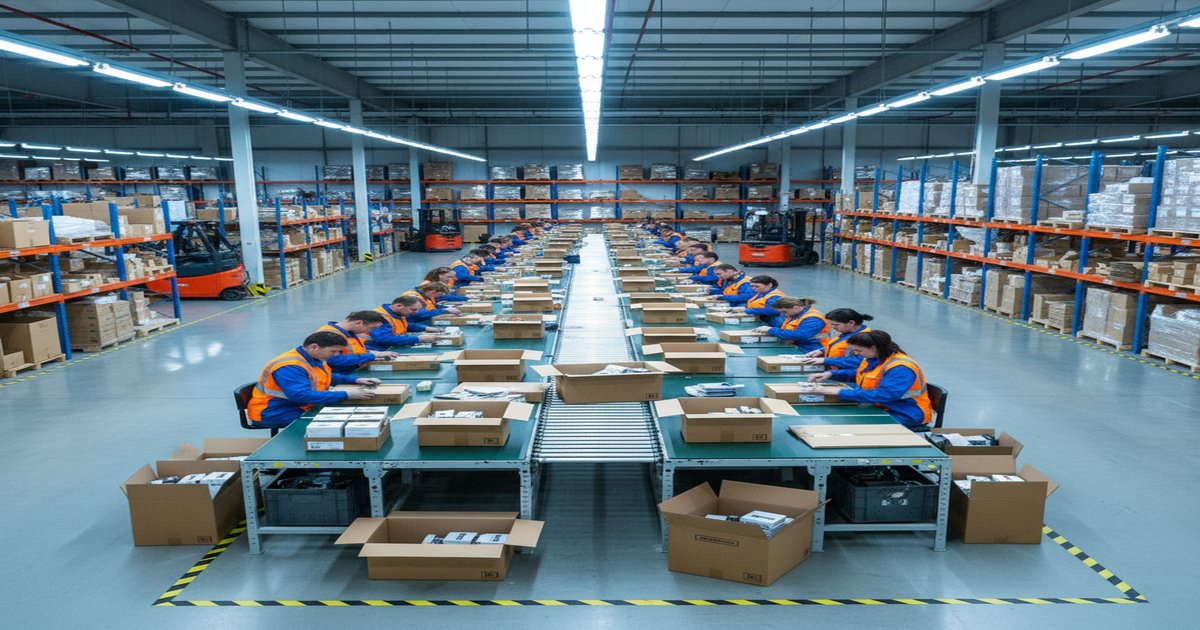
Kitting is not a commodity. Any 3PL will tell you they kit. What that actually means ranges from a few people at a folding table to engineered production lines running at 720 units per minute across programs shipping millions of units a year.
Productiv kits over 30 million units annually. Some programs run at 80,000 kits per day. Others require lot-controlled documentation across 75 regulated items per kit. The throughput, the setup, and the inventory discipline required are completely different — and yet they all fall under the same word: kitting.
Here's what it actually looks like across the programs we run — including the pricing, staffing, and launch timelines that most operators won't publish.
The Range Is Wider Than Most People Realize
When a brand says they need kitting, they could mean almost anything. The programs we run cover the full spectrum:
- A national direct-to-consumer subscription brand running up to 200,000 kits per month across 30 to 50 finished-good SKUs, with 7 to 10 unique items per kit — including print collateral and multiple product types at different weights and shapes. That program runs on conveyor lines augmented by cobots and humanoids at 720 units per minute.
- A major consumer brand's seasonal promotional gifting program — 3 to 5 million kits per year, over 15 items per kit, configuration changes every month. That program runs at over 100,000 kits per day at 3 seconds per item placed.
- A national retailer's loyalty program — roughly 20 million kits per year across several SKU varieties, multiple production lines running simultaneously at over 1,000 units per hour combined.
- A beverage brand's multi-pack conversion program — not just bundling finished goods but building sub-assembly components that then merge onto a main conveyor line into the finished multi-pack. That program requires line balancing across the sub-assembly and merge points, which slows units per hour but can't be skipped without creating a backup at the merge.
- A safety brand's first aid kits — up to 100 unique items per kit, each stuffed and placed into specific positions inside a pouch. Those kits require lot and batch control tracking across 75 regulated items, and if any item has a quality issue, we pull that lot, replace it with the correct lot number, and update the regulatory documentation before the job closes.
- Disaster relief meal programs for FEMA — 2.7 million meals packed into boxes in two weeks. During COVID, we ran emergency meal box programs for 100,000 boxes across five SKUs, including sourcing and procurement of the individual components against nutrition guidelines.
These are not variations of the same operation. They require different production setups, different staffing models, different quality protocols, and different inventory management approaches. The common thread is high volume, manual complexity, and accuracy requirements between 99.5% and 100% depending on the program.
What a Kitting Line Actually Costs
Most 3PLs won't publish kitting pricing. Here's how we structure it.
Kitting is priced on a per-item basis — typically $0.04 to $0.08 per item placed — plus a base kit fee of $0.25 to $0.75 per finished kit. The base fee accounts for the complexity factors that vary by program:
- Lot and batch control tracking — regulated items that require documentation at each step add cost because they add process steps
- Labeling and inspection requirements — special compliance labels, quantity verification, or retailer-specific requirements
- Packaging type — building and sealing a corrugated box is different from heat-sealing a poly bag or placing crinkle paper in a gift box
- Accuracy tolerance — a program that requires 100% zero-error accuracy (common for medical and regulated kits) requires additional verification steps that a 99.5% program does not
A 10-item kit at mid-complexity — no lot control, standard box build and seal — might run $0.65 to $1.05 all-in per kit. A simple 5-item subscription box at high volume runs lower. A 75-item regulated kit with lot documentation runs meaningfully higher. Everything is scoped and priced per unit upfront — there's no hourly billing, and the rate doesn't change based on how long the job takes.
If you want to scope a specific program, talk to our operations team — we'll quote it per unit within a few days.
How a Kitting Line Is Staffed
A standard conveyor kitting line runs with 10 operators. Those operators cover the full workflow from raw components to palletized finished goods: building the box, placing items in sequence, closing and labeling the box, cartonizing finished kits, palletizing, and material handling to move components in and finished goods out.
Headcount is the primary throughput lever. Adding operators means each person covers fewer operations and the line moves faster. Reducing headcount slows throughput but keeps the line running at a lower cost basis. For programs where daily volume varies — subscription programs with monthly peaks, seasonal gifting programs with a hard ship date — line staffing adjusts accordingly.
The right production model also shapes how a line is staffed:
Conveyor-based lines work best for programs with consistent item placement at high volume — subscription boxes, seasonal gift sets, multi-pack conversions. Workers (and robots, on programs where we've validated the SKUs) each place one or two items as the kit travels down the belt. Throughput is high; flexibility is lower.
Station-based assembly works best for complex kits where one operator needs to complete the full kit — first aid kits, advent calendars, regulated medical or safety products. These run at slower units per hour but allow for the precision placement, lot documentation, and item-by-item verification that complex kits require.
Sub-assembly with merge is the most complex model — components are assembled in parallel into sub-kits, then multiple sub-kit streams merge onto a main line into the finished product. Line balancing is essential here: if one sub-assembly line runs ahead or behind, the merge point backs up. Managing that balance across a live production run is a continuous operations problem.
How Long It Takes to Launch a New Program
The launch timeline depends primarily on what happens after kitting — where the finished kits are going and what systems need to be connected to get them there.
Back to a manufacturing site: 24 to 48 hours. Components arrive, we receive the BOM and work instructions into the system, build a First Article, and run it through First Article Inspection. We use ProQuality, a workflow tool we built internally, to auto-route First Article photos for client approval. Once approved, the line runs.
DTC fulfillment: About one week. The kitting setup itself is the same 24 to 48 hours — the additional time is IT integration: connecting the order management system to receive orders and push tracking and inventory updates back to the client portal.
B2B retail: 6 to 12 weeks. The kitting and fulfillment setup is straightforward. The timeline is driven by EDI — each major retailer requires its own EDI connection, and each connection requires testing cycles before the first shipment. We're pre-wired for 100+ retailers, which eliminates the mapping work, but the retailer testing cycle takes the time it takes.
For ongoing monthly programs, our account coordinator is in constant communication with clients to plan the production schedule. These programs often run multiple kitting jobs per day — planning the next configuration while the current one is still running is standard operating procedure.
The Part That Breaks Most Kitting Operations: Inventory Control
In ongoing kitting programs — where you're kitting from a live inventory pool that's also fulfilling DTC and B2B orders simultaneously — inventory accuracy is the hardest thing to maintain. Components are being pulled out of storage for kitting jobs and returned to inventory as finished goods, while at the same time being decremented for individual outbound orders. On a program with 100 different component SKUs, you can easily have 1,000 inventory movements in a single day.
The most common source of inventory error isn't an internal process failure — it's vendor concealed shortages. The packing list says 500 units; the carton contains 492. At receiving, we open at least one carton per pallet per SKU to catch these before they hit the production floor. Catching a short at receiving is a 10-minute fix. Catching it mid-run after inventory has already been committed to a job is a much bigger problem.
For ongoing programs, our process has four stages:
- Pick and confirm. Items are picked from inventory and verified on a scan gun before leaving the warehouse team's control.
- Supervised handover. The production floor supervisor signs off on the inventory at the handover point. This is when physical and digital custody formally transfers from the warehouse team to the production team.
- Production intake. The production team independently re-verifies the incoming components against the job order. This catches any discrepancy before kitting begins — not after.
- Post-job reconciliation. After the kit run, we document every finished kit, every extra component, every short, and every damage. Extras go back to inventory with the correct SKU decrements. Shorts are flagged, the missing item is pulled, and the system is updated before the job closes.
This is labor-intensive and it adds time to every job. It's also the reason we maintain inventory accuracy above 99% across programs running a thousand SKU movements per day. When we take over a program that previously ran somewhere else, it's common to receive pallets where 50% or more have count discrepancies. Getting those resolved can take weeks. Once it's in our system, we own it.
30M+ Kits Per Year
This Is the Operation Behind These Numbers
Conveyor lines, fixed per-unit pricing, our own trained workforce with 10+ years of tenure. See how we run kitting programs from 7-item subscription boxes to 100-item regulatory kits.
See How We Run Kitting at ScaleCan Any 3PL Do My Kitting?
For simple programs, yes. If you need two items put into a poly bag and heat-sealed, almost any 3PL with floor space and labor can do it. The question isn't whether they can kit — it's whether they can run your specific program without things breaking down over time.
Generic 3PLs typically handle kitting as a side operation. It's floor space they're not using for something else, a few extra people, and a simple job ticket. That works fine for low-item, low-volume, one-time programs. It breaks down when:
- Volume is high and the ship date is hard. A program running 80,000 kits per day to a retailer launch date has no margin for a slow start or a configuration problem on day one. Operators who run kitting at scale have standing infrastructure — production lines, scan gun configurations, trained supervisors — that a generic 3PL stands up fresh for every job.
- Item count exceeds 10 to 12 per kit. Above this threshold, line setup, component staging, and quality verification require dedicated production management — not just extra labor.
- Configuration changes monthly. A subscription program that changes its kit contents every month requires a formal change management process: updated BOM, revised work instructions, First Article Inspection for the new configuration. Generic 3PLs treat this as an ad hoc problem. It isn't.
- Kitting runs alongside active fulfillment. When the same inventory pool is feeding kitting jobs and outbound DTC or B2B orders simultaneously, inventory control becomes a specialized discipline. This is where most generic 3PLs lose accuracy — and most clients don't find out until month-end reconciliation reveals a significant discrepancy.
- The program includes regulated, medical, or food-adjacent items. Lot and batch control, regulatory documentation, and chain-of-custody requirements for these item types require documented processes and quality agreements — not just good intentions.
Scale Makes Specialists Cheaper, Not Just Better
There's a common assumption that a specialist kitting operation costs more than a generic 3PL. In practice, the opposite is often true — and it comes down to how the work is staffed and priced.
Most generic 3PLs can't quote fixed per-unit pricing on kitting because they don't have enough program history to know their costs. So they quote hourly and staff up with temp labor. That combination — hourly billing, temporary workforce — is the highest-cost, lowest-quality, slowest way to run a kitting program. The client absorbs all the inefficiency. When the line is slow, they pay for the slow hours. When quality misses, they pay for the rework.
An operator running tens of millions of kits per year has done the hard work of building the systems, processes, and flexible workforce strategy that makes fixed unit pricing possible. They know exactly how long a 10-item kit takes to run at a given accuracy target. They can quote a rate, hit it, and get faster over time — which is why per-unit pricing aligns incentives in the client's favor.
Productiv runs kitting with a Our own trained operators. Not temp labor. The line leads, supervisors, account coordinators, and site managers who run these programs average over 10 years of tenure. You don't get to 10 years running tens of millions of kits per year without building expertise that genuinely reduces cost per kit — through better line efficiency, fewer errors, faster changeovers, and less rework. That institutional knowledge doesn't exist in a temp workforce, and it can't be stood up in a week.
The short answer: if your kitting program could run on a folding table with temporary labor, a generic 3PL can handle it. If it has volume, variability, hard dates, or regulated items — a specialist operator is typically both more capable and more cost-effective than the hourly-temp alternative.
What to Ask a Prospective Kitting Partner
The question to ask is not "can you kit?" Everyone says yes. The questions that separate capable operators from commodity providers:
How do you handle inventory when kitting runs alongside active fulfillment? If the answer doesn't include a specific handover process with documented reconciliation at each stage, expect inventory drift.
What's your process when a kit configuration changes mid-program? Monthly changes to a seasonal program are normal. The answer should describe a specific change management process — BOM updates, work instruction revision, First Article for the new configuration — not a general commitment to flexibility.
How do you handle lot and batch control for regulated items? If the program includes any medical, food-adjacent, or safety product with regulatory documentation requirements, this question surfaces whether the operator has actually run compliant kitting or just thinks they can.
How is it priced, and what drives the rate? Per-unit pricing means the operator's incentives are aligned with your output. If the answer is hourly, their economics improve when the operation is slow. Ask specifically what factors move the per-kit rate — lot control, packaging type, accuracy tolerance — so you understand what you're buying.
If you're running or evaluating a kitting program — subscription, seasonal, regulatory, or otherwise — talk to our operations team. We'll tell you quickly whether it's something we've run before and what it would take to execute it.
Paul Baker is CFO and co-owner of Productiv. Productiv operates more than 1,200 operators across kitting, assembly, and fulfillment programs, executing over 30 million kits annually for consumer brands, retail program agencies, and manufacturers.
Key Takeaways
- →Productiv kits over 30 million units annually, with some programs running at 80,000 kits per day and cycle times of 720 units per minute.
- →Kitting is priced at $0.04–$0.08 per item plus a $0.25–$0.75 base fee per kit depending on lot control, labeling, packaging type, and accuracy requirements.
- →A standard conveyor kitting line runs 10 operators covering box build, item placement, closure, labeling, cartonizing, palletizing, and material handling — headcount scales up or down to control throughput.
- →New kitting programs launch in 24–48 hours for manufacturing returns, about one week for DTC, and 6–12 weeks for retail B2B requiring EDI setup and retailer testing.
- →The most common inventory accuracy problem in kitting is vendor concealed shortages — caught at receiving by opening at least one carton per pallet per SKU before production begins.
- →Specialist kitting operators are often cheaper than generic 3PLs — fixed per-unit pricing and a permanent in-house workforce beat hourly billing and temp labor on both cost and quality.
- →Productiv's line leads, supervisors, account coordinators, and site managers average over 10 years of tenure — institutional knowledge that reduces cost per kit through faster changeovers, fewer errors, and less rework.
Frequently Asked Questions
How much does kitting cost per unit?
Kitting is typically priced at $0.04 to $0.08 per item placed, plus a base kit fee of $0.25 to $0.75 depending on complexity factors: lot and batch control tracking, special labeling or inspection requirements, packaging type (box build and seal, heat-sealed bag, crinkle paper fill), and the required accuracy tolerance. A 10-item kit at mid-complexity might run $0.65 to $1.05 all-in per kit. Regulatory kits with 75+ lot-controlled items run significantly higher due to documentation and verification requirements at each step.
How many workers does a kitting line need?
A standard conveyor kitting line runs with 10 operators. Those operators cover the full workflow: building the box, placing items, closing and labeling the box, cartonizing, palletizing, and material handling. Headcount is adjustable — adding operators speeds the line by giving each person fewer operations; reducing operators slows throughput. A 10-person line is the baseline for most programs in the 7 to 15 item range.
How long does it take to launch a new kitting program?
Launch timeline depends primarily on what happens after kitting. If finished kits ship back to a manufacturing site, a program can be running within 24 to 48 hours of components arriving — that's enough time to receive the BOM, build a First Article, and pass inspection. DTC programs take about one week to set up the IT integrations for order intake and tracking. Retail B2B programs take 6 to 12 weeks because each major retailer requires its own EDI connection setup and testing cycle before the first shipment.
Is a specialist kitting 3PL more expensive than a general 3PL?
Not typically — and for complex programs, a specialist is usually cheaper. Generic 3PLs quote kitting hourly and staff it with temp labor because they don't have enough program history to know their own costs. That combination is the highest-cost, lowest-quality way to run kitting: the client absorbs all the inefficiency. Specialist operators running tens of millions of kits per year have the process history, systems, and permanent workforce to quote and deliver fixed per-unit pricing. Productiv runs all kitting with our own trained operators whose line leads, supervisors, and site managers average over 10 years of tenure — that institutional knowledge produces faster changeovers, fewer errors, and lower cost per kit than any temp agency setup.
Can any 3PL do kitting?
Simple kitting — putting two or three items into a bag and sealing it — can be handled by most 3PLs with available floor space and labor. Programs that require specialized capability include: kits with 10+ items, monthly configuration changes, lot and batch control for regulated items, kitting running alongside active DTC or retail fulfillment from the same inventory, and programs with hard ship dates at high daily volume. Generic 3PLs handle kitting as a side operation; at that complexity level, you need an operator that runs kitting as a core service with dedicated production infrastructure.
What is high-volume kitting in a 3PL warehouse?
High-volume kitting is the assembly of multiple individual items into a finished kit or bundle at warehouse scale — typically hundreds of thousands to millions of units per year. It requires dedicated production lines, trained operators, inventory management systems that track components in and out of kitting jobs, and quality control processes to maintain accuracy at speed. At 30 million kits per year, programs can run at cycle times of 720 units per minute on a single production line.
How do 3PLs maintain inventory accuracy during kitting?
The most common source of inventory error in kitting is vendor concealed shortages — cases where the packing list says 500 units but the carton contains 492. Productiv opens at least one carton per pallet per SKU at receiving to catch these before production begins. For ongoing programs, a four-stage handover process tracks inventory from warehouse pick through production completion: pick and scan confirmation, supervisor sign-off at handover, production team intake verification, and post-job reconciliation of finished kits, extras, and shorts. This process maintains inventory accuracy above 99% across programs running 1,000+ SKU movements per day.
What types of kitting programs are too complex for a generic 3PL?
Programs that exceed generic 3PL capability include: kits with 15+ items requiring monthly configuration changes, regulatory kits requiring lot and batch tracking across 75+ items, sub-assembly programs where components merge onto a main conveyor line, and programs combining kitting with active DTC and B2B fulfillment from the same inventory pool. Each requires specialized production setup, inventory discipline, and quality systems that commodity 3PLs are not built for.
How is kitting priced — per unit or per hour?
Productiv prices all kitting per kit, not per hour. A per-item rate of $0.04 to $0.08 covers the physical assembly; a base fee of $0.25 to $0.75 covers complexity factors like lot control, labeling, and packaging type. Per-unit pricing aligns incentives — Productiv's economics improve with faster, more accurate throughput, not with hours billed. Hourly pricing removes that alignment entirely.
30M+ Kits Per Year
Need a Kitting Partner That Can Handle Your Program?
We've run programs from 7-item subscription boxes to 100-item regulatory kits. If your kitting program is outgrowing your current setup, we're worth a conversation.
Talk to Our Operations Team