This piece expands on a conversation with Forbes contributor John Koetsier, published May 5, 2026, in Inside The Largest Humanoid Robot Data Factory In The United States. The metric I introduced in that interview — SKU coverage — has a definition page on this site at /sku-coverage.
We assemble more than 30 million kits a year. The average kit holds 10 to 15 items. Multiply those out and we are running roughly 500 million pick-and-place operations annually — across a SKU universe that exceeds 100,000 product types.
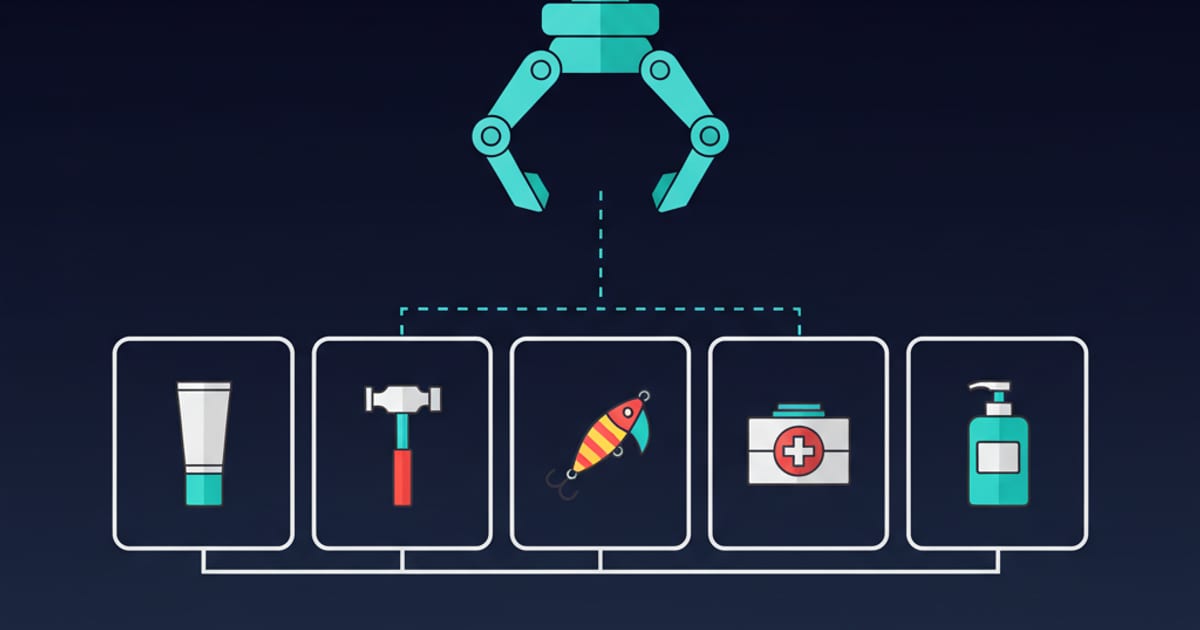
The items in that universe are not uniform. In any given week, our lines see band-aids, hammers, lip balm tubes, body wash bottles, fishing lures, and surgical kit components. Different shapes. Different weights. Different surface friction. Different packaging. A trained operator picks all of them without thinking about it.
That is the operational reality humanoid robots have to walk into. And it is the reason I introduced SKU coverage as the metric I use to evaluate every humanoid we deploy.
Why I named the metric
When John Koetsier asked me how we evaluate humanoid robots in our facility, I gave him the metric we actually use rather than the metrics vendors prefer. He told me he had not heard "SKU coverage" before. I told him that was probably because most people writing about humanoid robotics have never had to keep one busy for an eight-hour shift.
The metric is simple: out of every product type in the warehouse, what percentage can the robot reliably pick? The human hand operates at 100% by definition. Anything else is the robot trying to catch up.
I name it that way because the existing language — pick accuracy, takt time, throughput — measures the robot doing the work it can already do. Those metrics are real and important. We track them. But they describe robot performance on the slice of the SKU universe the robot has been validated for. They do not describe whether the robot can take meaningful coverage of a kitting line tomorrow morning. SKU coverage does.
The math: 500 million ops, 100,000 SKUs
Start with our 30 million kits a year. The average kit has 10 to 15 items in it. Some have 5. The big ones have 100. Multiply out the pick-and-place operations behind those kits and you land at roughly 500 million per year. That number sits across more than 100,000 distinct SKU types across all of our programs. Cosmetics. Tools. Subscription tackle. Personal care. Beauty gifting. Outdoor first aid. Surgical trays.
Every one of those product types is a separate validation problem for a robot. The robot has to grip a tube of lip balm differently than a hammer differently than a fishing lure differently than a body wash bottle differently than a band-aid box. It has to handle the bag deforming, the box twisting, the lure swinging on its barb. It has to hold each item firmly enough not to drop and gently enough not to crush.
That is the universe SKU coverage measures against. When I tell you our humanoid robots are at 5%, what I mean is that 5 of every 100 SKU types we run have been validated and are reliably picked by an end effector somewhere on our floor. The other 95% are still picked by humans.
What 5% feels like on a production floor
5% is small enough that it changes how we design lines around the robots. We sequence SKUs into the robot's validated subset so the robot stays busy. We schedule programs that lean on its strongest end effectors. We treat the robot as a specialty insert that frees humans to handle the long tail of variability.
5% is also large enough that the robots are doing real work — not lab demos, not pilots. We have logged more than 100,000 pick-and-place cycles in live production and assembled more than 10,000 kits with robot assistance. Pick accuracy on the validated subset is consistently in the high 90s, with runs at 99%+. Takt time on the validated subset is six seconds, down from twelve to fifteen when we started.
The constraint is not whether the robot can pick well. The constraint is how much of the SKU universe it can pick at all. That is SKU coverage.
If your SKU coverage is too low, we cannot keep the robot busy even for a shift. That is the operator-grade test of a humanoid: can it earn its hours on the line, or does it have to wait for the right SKU to come down the conveyor?
What 25%, 40%, and 100% would each mean
The economics of deploying a humanoid robot change fundamentally between coverage thresholds. Here is how I think about each one.
25% SKU coverage. The robot stops being a specialty insert. At this threshold the validated subset is wide enough that we can schedule full kitting programs around it without contorting the workflow to keep the robot busy. The robot is no longer waiting for the right SKU. It is taking the repeatable middle of the line and humans are flexing into the long tail.
40% SKU coverage. Deployment economics shift. At this point the cost-per-unit math on robot-led lines starts crossing fully human lines at meaningful volume. We can confidently quote programs around hybrid throughput rather than human throughput. Robots are no longer augmenting labor — they are setting the pace, and humans are the variability handlers.
100% SKU coverage. Robots match the human hand. The robot can pick anything in the warehouse without retraining. We are a long way off. I do not think this is the realistic threshold for any deployment decisions in the next several years, and I would not want to be the operator who plans capacity around it. But it is the right ceiling to keep in mind, because it tells you how far the technology still has to go.
The interesting threshold is 25%. At 5% we are running augmentation. At 25% we are running coverage. The leap between the two is a five-times improvement in how many product types the robot can pick — which is a long way of saying we have a lot of validation work in front of us.
Wheels beat legs
People keep asking whether the next generation of humanoid robots will walk on two legs. The framing I keep coming back to: I cannot think of any workflows in our warehouse that would require legs.
Our floors are flat. They are continuous. They are hard. The robot needs to move from a bin to a conveyor and back. It needs to do that fast and predictably. Wheels are faster than legs for that motion. Wheels are more energy-efficient. Wheels do not stumble. Wheels do not drift. Wheels do not require a humanoid form factor at all from the waist down.
The argument for legs is that they generalize across more environments — stairs, uneven ground, cluttered home settings. None of those exist in our warehouses. So when I evaluate humanoid platforms, the form-factor decision I care about is the end effector and the perception system, not the legs. Wheels are fine.
What we are running today
I want to keep this piece focused on the metric, not on individual vendors. But the metric does not exist in the abstract — it is the number we measure across every robotics partner we currently run in live production. Each of these has a different deployment status, and the framing here is factual rather than promotional.
Tutor Intelligence's Cassie palletizer. Cassie has been running in our production for approximately three months as of May 2026. Doing real work. Not a controlled pilot.
Avatar Robotics. Two Avatar humanoid units have been in live production since November 2025. Wheel-based. Currently teleoperated, with a roadmap toward increasing autonomy.
Blue Sky Robotics. 13 Blue Sky Robotics cobots have been on our kitting lines since August 2025. They are the foundation of our hybrid line model and the partner we have the most production data with.
Each of those deployments is at a different SKU coverage rate, and each is on a different trajectory. I am not going to break out the individual numbers here — that is partner data. The aggregate number across all of them is what matters for evaluation, and that aggregate is approximately 5%.
Why this matters for anyone evaluating humanoid robots
If you are an operator looking at humanoid robotics today, the demos will be impressive. The accuracy numbers will be impressive. The takt times will be impressive — at least on the validated subset.
The question that actually determines whether the robot earns its place on your floor is the one nobody on the vendor side wants to lead with: what percentage of my SKU universe can your robot reliably pick?
If the answer is 1%, the robot is a science project. If the answer is 5%, the robot is augmentation — useful, but you need to design the line around it. If the answer is 25%, the robot is line coverage. If the answer is 40%, the robot is changing your unit economics. If the answer is anywhere close to 100%, you are buying from someone five years from now.
That is the framework. It applies to every humanoid platform on the market and every cobot deployment too. It is the number I evaluate every partner against — including the partners we currently run in our facility.
What we are doing about it
We are growing our number through three levers. The first is end-effector breadth — more gripper types, more suction profiles, more validated combinations against more product shapes. The second is partner engineering iteration — training models on real production data from our Dallas facility so the next deployment starts higher than the last. The third is process design — sequencing SKUs so robots see their validated subset more often, which earns the line more reliable hours and gives the partner more cycles to learn from.
Going from 5% to 25% is the next operational threshold. It is going to take time. We are not going to get there by demoing robots in a controlled environment. We are going to get there by running them on live kitting lines with real product, real lighting, real packaging variability, and real shift pressure — which is what we have been doing in Dallas for almost a year.
That is the work. SKU coverage is how we measure it.
Read the canonical definition of the metric at /sku-coverage, the operational metrics behind it at our pick-and-place metrics post, and the broader humanoid robotics thesis at our humanoid robotics page. If you are running operations and want to walk the line in person, talk to our team.
Paul Baker is CFO and co-owner of Productiv, a tech-enabled 3PL operating more than 1,200 operators across kitting, assembly, and fulfillment. Productiv deployed its first cobots in August 2025 and humanoid robots in November 2025. Paul introduced the SKU coverage metric in Forbes (Koetsier, May 5, 2026).
Key Takeaways
- →Productiv runs ~500M pick-and-place operations annually across 100,000+ SKU types — band-aids, hammers, lip balm, body wash bottles, fishing lures, surgical kit components.
- →SKU coverage is the share of that SKU universe a humanoid robot can reliably pick. Human hands operate at 100% by definition; today's humanoid robots in our production sit at approximately 5%.
- →25% SKU coverage is the threshold where robots stop being a specialty insert and become meaningful line coverage. 40% changes deployment economics.
- →Wheels beat legs for warehouse work. I can't think of any workflows in our facility that require bipedal locomotion.
- →Tutor Intelligence's Cassie palletizer has been running in our production for ~3 months. Avatar humanoids are wheel-based and on a teleoperation-to-autonomy roadmap. Blue Sky Robotics cobots have been live since August 2025.
Frequently Asked Questions
What is SKU coverage in warehouse robotics?
SKU coverage is the percentage of a facility's total SKU universe that a robot can reliably pick and place with its end effector. The human hand achieves 100% by definition. In live humanoid robot production at Productiv today, SKU coverage sits at approximately 5% — meaning 5 out of every 100 product types in the warehouse can be picked by the robot.
Who coined the term SKU coverage?
Paul Baker, CFO and co-owner of Productiv, introduced the term in a conversation with John Koetsier of Forbes published May 5, 2026. The metric reflects how Productiv evaluates humanoid robotics partners against operational reality rather than vendor benchmarks.
What's the difference between SKU coverage and pick accuracy?
Pick accuracy measures whether a robot completes a single pick correctly when it can pick the item at all. SKU coverage measures how many different items the robot can reliably attempt in the first place. A robot can have 99% pick accuracy on a narrow product set and still have only 5% SKU coverage.
What SKU coverage do humanoid robots need to replace warehouse workers?
Realistically, robots need 25 to 40 percent SKU coverage to take meaningful line coverage on high-mix kitting work, and roughly 100 percent to fully replace human pickers. At 5 percent coverage today, robots augment humans on the repeatable middle of the work; humans handle the long tail. That mix is unlikely to invert in the near term.
Why is SKU coverage harder than it looks?
Each SKU has a unique shape, weight distribution, packaging format, and surface friction. Validating one SKU requires testing multiple end effectors — grippers, claws, suction cups in various sizes — against the actual product, sometimes under varying lighting and orientation conditions. A facility with more than 100,000 SKU types has a long validation backlog.
Why does Productiv prefer wheels over legs for humanoid robots?
Warehouse floors are flat, hard, and continuous. Wheels are faster, more energy-efficient, and more reliable than bipedal locomotion for the workflows we run — kitting, pick and pack, labeling, display building. We can't think of a single task in our Dallas facility that requires legs to complete.
Which humanoid robots is Productiv currently running?
As of May 2026, Productiv is running Tutor Intelligence's Cassie palletizer for approximately three months in live production, Avatar Robotics humanoids that began deployment in November 2025, and 13 Blue Sky Robotics cobots that have been live since August 2025. All three operate on hybrid lines alongside human workers.
How does Productiv plan to grow SKU coverage?
Three levers: end-effector breadth (more gripper types validated against more product shapes), partner engineering iteration (training models on real production data from our Dallas facility), and process design (sequencing SKUs so robots see their validated subset more often). Moving from 5 percent to 25 percent is the next operational threshold we're working toward.
Robotics in Live Production
Want to See What 5% SKU Coverage Looks Like?
We run cobots and humanoid robots in live kitting production in Dallas. If you're evaluating warehouse robotics, we'll walk you through the SKU validation work in person.
Talk to Our Operations Team