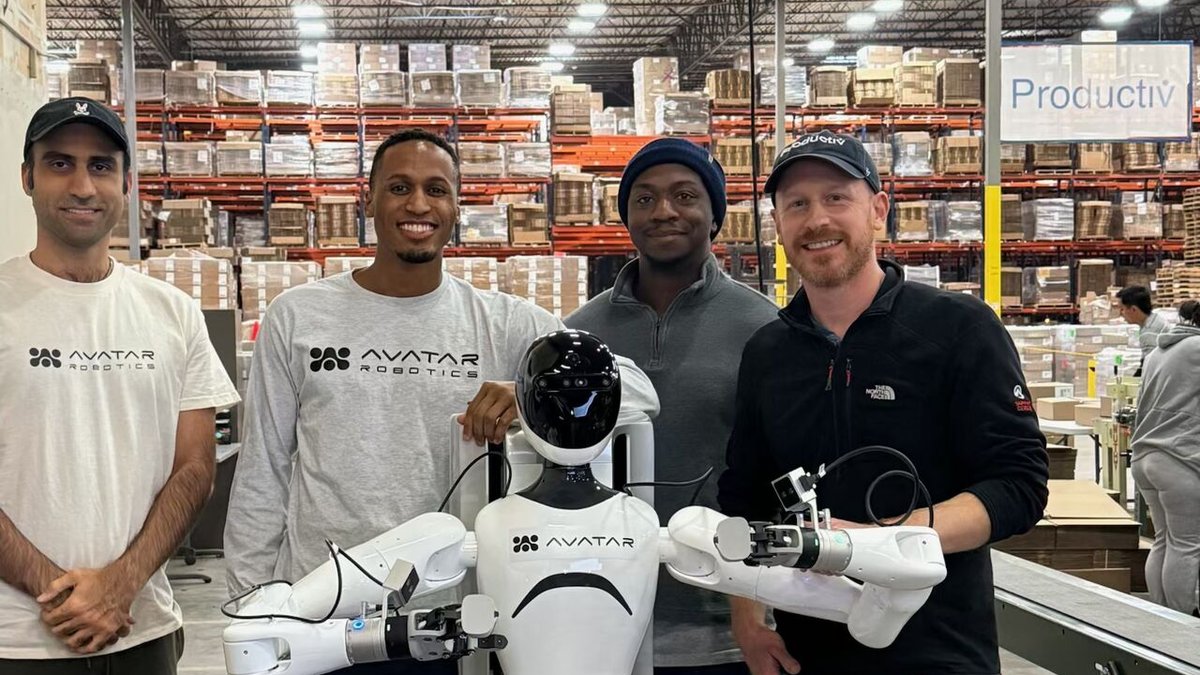
This piece expands on a conversation I had on The Manufacturing Executive Podcast and adds six months of live production data we've collected since.
Most robotics content is about demos. Ours is about data.
We deployed our first 13 cobots into live production in August 2025. Our first humanoids followed in November 2025. Since then, we've completed over 10,000 kits and logged more than 100,000 pick-and-place cycles — not in a lab, not in a controlled test environment, but on active kitting lines shipping real product to real customers.
Here's what we're actually measuring, and what it tells us about where warehouse robotics actually is right now.
How the Lines Run: Human + Robot, Not Human vs. Robot
Before the numbers make sense, you need to understand the setup.
Our kitting lines run on conveyors. Humans build the box, open pouches, or unzip bags and place them onto the belt. The robots pick individual items — Chapsticks, body washes, fishing lures, things with different weights, textures, form factors, and even center-of-gravity shifts when picked up — out of bins and place them into the open receptacle moving down the conveyor. Humans handle the items the robots can't yet, then close and finish the process.
This is not full automation. It's human-augmented execution where robots take on the repeatable pick-and-place cycle so people can do the higher-judgment work. That hybrid model is the only thing that makes robotics viable in high-SKU-variety kitting today.
We're running this for cosmetics and sporting goods clients — both categories have exactly the kind of SKU variability that makes fixed automation fail and makes programmable robots interesting.
The Three Metrics We Track
We evaluate our robotics program on three metrics. These are not vendor KPIs — they're the metrics that matter to us as an operator with real SLA commitments.
1. SKU Validation Rate
Definition: Out of the full universe of SKUs in our facility — which can exceed 100,000 item types in a given year — what percentage can a robot successfully pick with its end effector?
This matters because a robot that can only pick 30% of your product mix isn't a line solution. It's a specialty device.
Where we started: 0%. Every SKU had to be validated from scratch.
Where we are: 5%.
That sounds low, and it is — relative to what a human hand can do. We're using multiple end effector types: grippers, claws, suction, each in different sizes. Each new SKU shape, weight distribution, or packaging format is a validation project. We're actively expanding this number, but the honest state of warehouse robotics right now is that the human hand is extraordinarily capable and robots are early in closing that gap.
The public-facing version of this number is what I introduced in Forbes earlier this year as SKU coverage — the percentage of a warehouse's SKU universe a robot can reliably pick. SKU validation rate and SKU coverage describe the same thing: the share of the universe the robot has actually been validated against. Five percent today, with twenty-five percent as the next operational threshold.
2. Pick and Place Accuracy
Definition: When a box comes down the conveyor, does the robot pick its item and place it into the correct position on the first attempt? Humans do this at 100%. That's our benchmark.
Where we started: Below 80%. At that level, robots create as much rework as they eliminate — a human has to catch and correct nearly every fifth pick.
Where we are: Consistently in the high 90s, with runs hitting 99%+.
This is the number we're most focused on. Getting from 80% to 90% happened relatively quickly once the engineering teams — ours and our robotics partners' — iterated on the environment. Getting from 90% to 95% was harder. Every percentage point above that requires solving edge cases: the bag that arrives slightly twisted, the item that shifted in transit, the lighting condition nobody anticipated at 2pm when the sun angle changes.
That last point surprised us. Warehouse lighting conditions — shadows from overhead fixtures, angle changes throughout the day — had a significant impact on visual accuracy. We cycled through multiple setup configurations before getting it dialed in. It's the kind of variable that a demo environment never surfaces.
Why 99% isn't enough yet: Our end-of-line accuracy target for kitted items is 99.5% to 99.9%. Robots in the high 90s get us close, but humans are still handling the edge cases that push accuracy to that final tier. That's by design. The hybrid model means we don't need robots to hit 100% — we need them to handle the high-volume middle while people manage the exceptions.
3. Takt Time
Definition: How long does one pick-and-place cycle take?
A human doing this repetitively over a shift averages about 3 seconds per pick.
Where we started: 12 to 15 seconds per pick, with accuracy below 80%.
Where we are: 6 seconds per pick.
We could push faster — it's technically achievable. But speed and accuracy trade off against each other. At this stage we're not willing to sacrifice accuracy percentage points to cut cycle time. We'll optimize speed once we're consistently at 99.5%+ accuracy.
At 6 seconds, robots are running at about 50% of human speed. That's not yet a labor replacement argument. It's a labor augmentation argument: robots handle repetitive volume without fatigue, turnover, or attendance variability, while humans flex into higher-judgment roles.
What Surprised Us
How much the warehouse environment matters. Lighting conditions, shadows, and ambient changes throughout the day had a measurable impact on pick accuracy. This is not something that shows up in a vendor demo or a controlled pilot. You only find it after thousands of cycles in live production. We had to iterate through multiple fixture configurations and calibration setups before we stabilized accuracy. Plan for it.
How fast improvement happened once it was moving. When we were operating at sub-80% accuracy, it was genuinely unclear whether we were too early. The gap between demo performance and production performance felt wide. Then the engineering teams — working in our environment, on our product mix, with our data — started closing it quickly. The jump from 80% to 90% happened faster than expected. Getting from 90% to 95% is harder, and each percent after that carries a longer tail of edge cases. But the rate of improvement per iteration stays steep, because humans are handling the exceptions while robots accumulate reps on the solved cases.
The honest summary: the early days are harder than vendor demos indicate. The improvement curve is steeper than the skeptics assume.
What This Means for Operators Evaluating Warehouse Robotics
The business metrics that matter flow from these three operational numbers. Cost per unit is the ultimate output — and it reflects wages for direct labor plus the indirect costs of supervision, QC, and throughput management. As SKU validation rates climb and accuracy reaches consistent 99.5%, the cost per unit on augmented lines will cross the fully human line at increasing volume levels.
We are not there yet. But we are inside the inflection.
Don't evaluate on vendor benchmarks. SKU validation rates, accuracy under real conditions, and takt time under production variability are the numbers that matter. Get them from operators running live production, not from demo environments.
Plan the hybrid model from day one. Full automation of a high-SKU-variety kitting line is not the current state of the technology. Human-augmented lines — where robots handle the repeatable majority and people manage exceptions — are what's working. Design your process around that reality.
The environment is a variable. Lighting, floor conditions, overhead fixtures, product orientation variability — these affect accuracy in ways that lab conditions don't surface. Budget time for physical setup iteration after go-live.
The improvement curve is real, but requires investment. Sub-80% accuracy in month one does not mean the system won't reach 99% in month six. But it requires active engineering partnership, real production data, and iteration. Passive deployment doesn't close the gap.
Where We're Going
Current focus: stability at 99%+ accuracy before pushing for takt time improvement. Once accuracy is consistent, we'll work to bring the 6-second cycle closer to 4 seconds — narrowing the gap with human speed while protecting quality.
We're also expanding the SKU validation program. Getting from 5% to 25% of our validated SKU universe is the next significant threshold — that's where robotics starts to take on meaningful line coverage rather than a specialty insert.
Paul Baker is CFO and co-owner of Productiv, a tech-enabled 3PL operating more than 1,200 operators across kitting, assembly, and fulfillment. Productiv deployed its first cobots in August 2025 and humanoid robots in November 2025. Paul appeared on The Manufacturing Executive Podcast alongside Avatar Robotics CEO Colin Webb to discuss what operators are learning from live humanoid robot deployments.
Key Takeaways
- →Pick and place accuracy improved from sub-80% to 99%+ in six months of live production — but the jump from 90% to 99% is harder than 80% to 90%.
- →SKU validation rate sits at 5% today. The human hand can pick nearly anything. Robots are early in closing that gap.
- →Takt time improved from 12–15 seconds to 6 seconds per pick — still 2x slower than a human, but valuable for consistency and availability.
- →Warehouse lighting and shadows had a bigger impact on visual accuracy than we expected. Plan for setup iteration after go-live.
- →The hybrid model — humans and robots on the same conveyor line — is the only viable approach for high-SKU-variety kitting today.
Frequently Asked Questions
What is pick and place accuracy in warehouse robotics?
Pick and place accuracy is the percentage of cycles where a robot successfully picks an item and places it into the correct position on the first attempt. In production kitting, the benchmark is 100% — the rate at which a trained human operator completes the same task. Warehouse robots in live production typically start between 75–85% accuracy and improve toward 99%+ over months of real production cycles, depending on SKU complexity, end effector configuration, and environmental factors like lighting.
How long does it take warehouse robots to reach production-level accuracy?
In our live kitting operations, robots started below 80% pick accuracy and reached the high 90s within six months. The timeline depends on active engineering partnership, production volume, and the physical environment. Lighting conditions and product variability are the most common variables requiring iteration. The jump from 80% to 90% tends to happen faster than the improvement from 90% to 99% — edge cases slow the final push.
What is SKU validation rate and why does it matter?
SKU validation rate is the percentage of a facility's total SKU universe that a robot can reliably pick with its end effector. A robot with a 5% validation rate can only pick 5% of product types in the warehouse, limiting which kitting programs it can work on. Expanding this number requires testing multiple end effector types against each product's shape, weight, and packaging format. Current warehouse robots are closing the gap with the human hand, but it remains the most significant operational constraint.
What is takt time for pick and place robots versus humans?
In kitting operations, a trained human worker averages approximately 3 seconds per pick-and-place cycle. Our robots began at 12–15 seconds and have improved to 6 seconds. Speed and accuracy trade off — we're prioritizing 99.5% accuracy before optimizing cycle time further. At current speeds, robots are most valuable for their consistency and availability — no fatigue, turnover, or attendance variability — rather than raw throughput.
How do you run a hybrid human and robot kitting line?
In our setup, humans build the box, open pouches or bags, and place them on the conveyor. Robots pick items from bins and place them into the open receptacle moving down the belt. Humans handle items the robots can't yet pick reliably, then close and finish the kit. The robot handles the repeatable, high-volume center of the operation. Humans handle the variation and judgment on either side. The key is designing the workflow so robots and people are working in parallel — neither waiting on the other.
Robotics in Live Production
Want to See This on a Production Floor?
We run cobots and humanoid robots in live kitting operations in Dallas. If you're evaluating warehouse robotics, we're open to showing you what it actually looks like.
Talk to Our Operations Team