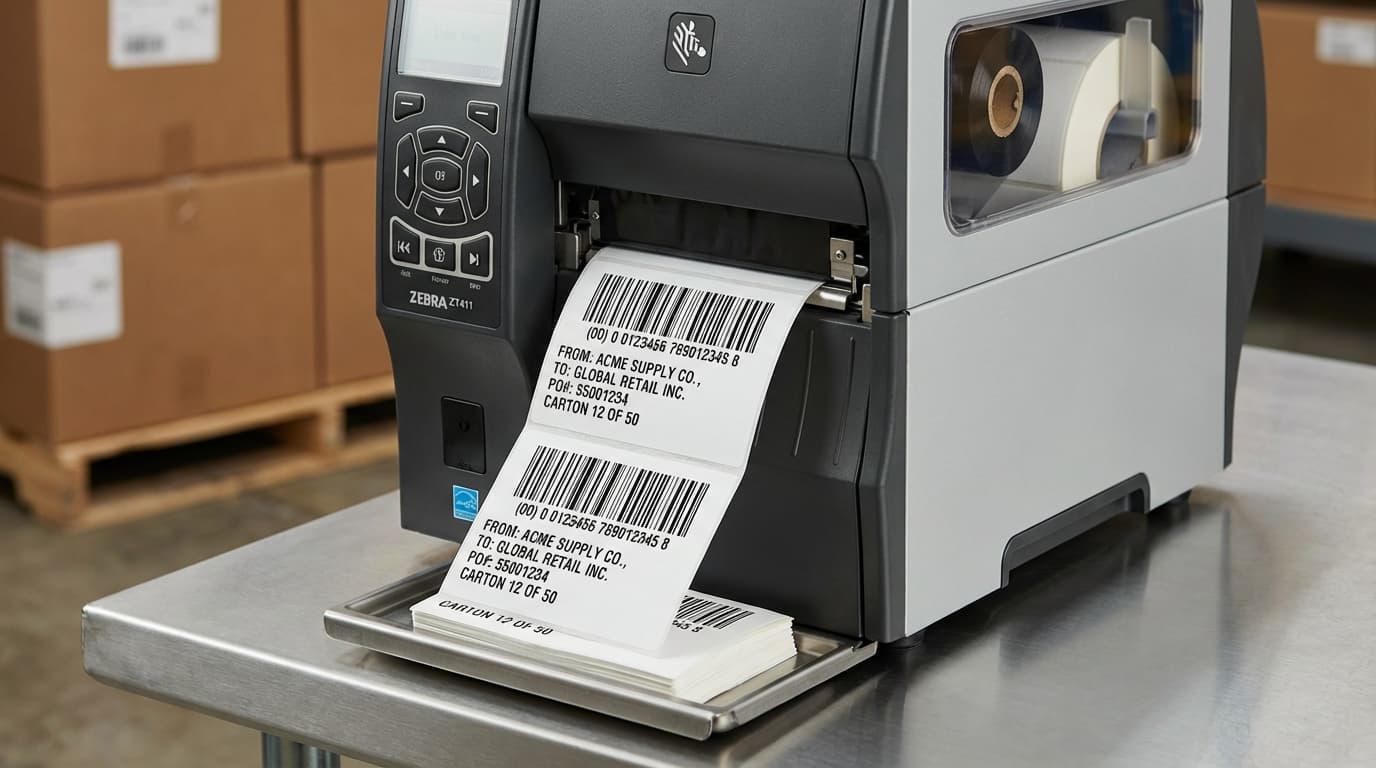
Labeling is where retail compliance becomes physically visible. Every carton that ships to a major retailer must carry a barcode label that uniquely identifies the carton, describes its contents, and links it to the electronic shipping data (ASN) that the retailer uses for automated receiving. Get the label right, and the DC scans, verifies, and puts away your product without intervention. Get it wrong, and every carton on every shipment generates a chargeback until someone diagnoses the root cause.
After two decades of configuring retail labels for 60+retailers, we can tell you that labeling failures are among the most persistent compliance problems because they are systemic. A bad template, incorrect printer settings, or wrong placement procedure affects every carton. The fix is always the same: get the configuration right before the first shipment, validate it with test labels, and maintain quality control as an ongoing process.
This guide explains the barcode standards used in retail supply chains, what each major retailer requires, and the operational details that determine whether your labels pass or fail at the DC.
The Retail Barcode Hierarchy
Retail supply chains use multiple barcode standards at different levels. Understanding which barcode does what prevents the confusion that leads to labeling errors.
UPC (Universal Product Code)
The UPC is the product-level barcode—the one consumers see on store shelves and cashiers scan at checkout. It identifies a specific SKU: this exact product, in this exact size, in this exact variant. UPCs are assigned through GS1 US and are unique to each product. If you are selling to retailers, your products already have UPCs. The UPC is not what goes on your shipping labels—it identifies the product, not the shipping carton.
GTIN-14 (Global Trade Item Number)
The GTIN-14 identifies a case or inner pack of products. If you ship 12 units of a product in a case, the GTIN-14 tells the retailer's system “this is a case of 12 units of product X” without anyone needing to open the case. Target is notable for offering vendors GTIN-14 as one of three barcode options for shipping labels, alongside SSCC-18 and UPC-A.
SSCC-18 (Serial Shipping Container Code)
The SSCC-18 is the carton-level identifier that most major retailers require on shipping labels. Unlike UPC (which identifies a product type) or GTIN-14 (which identifies a case configuration), the SSCC-18 uniquely identifies a specific physical carton. No two cartons anywhere in the global supply chain should share the same SSCC-18.
The 18-digit structure is: extension digit (typically 0) + GS1 Company Prefix + serial reference number + check digit. Your WMS or labeling system assigns serial reference numbers sequentially and calculates the check digit using the Modulo 10 algorithm. The SSCC-18 on the physical label must exactly match the SSCC-18 in your EDI 856 ASN—this match is what enables automated receiving at the DC.
GS1-128 (UCC-128): The Barcode Symbology
GS1-128 is the visual encoding format—the symbology—used to represent SSCC-18 and other data on retail shipping labels. When retailers say they require “GS1-128 labels” or “UCC-128 labels” (an older term for the same thing), they mean labels printed in the GS1-128 barcode symbology carrying structured shipping data.
GS1-128 uses Application Identifiers (AIs) to define what each piece of data represents. AI (00) identifies the SSCC-18. AI (02) identifies the GTIN of the items in the carton. AI (37) indicates the quantity. These AIs are part of the barcode data and tell the scanner how to interpret each field.
What Retailers Require: Label Content by Retailer
Every retailer specifies different label content, formatting, and layout. Here is what we configure for three major retailers based on their current routing guides.
Walmart
Walmart requires specific WMIT field data on shipping labels and mandates STOP labels on mixed master packs (cases containing multiple SKUs). STOP labels must use Arial Bold 48pt font with three labels per carton placed on designated faces. Walmart's labeling requirements are detailed in their 408-page Supply Chain Packaging Guide. Barcode placement rules prohibit barcodes on the top of cases, and labels must be scannable through any shrink wrap covering the pallet.
Target
Target offers vendors three barcode options: SSCC-18, GTIN-14, or UPC-A. This flexibility is unusual among major retailers and reflects Target's approach to vendor accommodation. However, the choice must be consistent —you cannot mix formats across shipments. Target requires a formal label approval process before your first shipment, where sample labels are submitted for review and sign-off. Label placement follows standard right-side positioning with specific rules for cartons under 6 inches (label on top).
Dick's Sporting Goods
Dick's has some of the most detailed labeling requirements we have encountered. They use a zone-based label system with mandatory content in Zones A (vendor name and address), B (DC or store address), E (PO number with department number and name in 14-point bold—this must be the largest text on the label), and I (SSCC-18 barcode). The barcode specifications are precise: 4×6 inch label, 3.02-inch barcode length, 1.25-inch barcode height, 2:1 width-to-narrow ratio, with 0.25-inch quiet zones.
Dick's also requires thermal transfer printing —ink jet and laser are explicitly prohibited, and standard direct thermal does not produce labels durable enough for their scan requirements. New vendors must get label approval by mailing sample labels to Dick's Vendor Relations in Coraopolis, PA. And any vendor internal barcodes with 20 digits must be defaced with a vertical stripe if they do not match the UCC-128 label.
Label Placement Rules
Correct label placement is as important as correct label content. A label with perfect data and print quality will still generate a chargeback if it is in the wrong position on the carton.
The common pattern across most retailers: labels go on the right side of the carton when the carton is oriented with the opening facing up. Position the label 2 inches from the natural base (bottom edge) and 2 inches from the right vertical edge. For short cartons (typically 4 to 6 inches tall, with the exact threshold varying by retailer), the label goes on top, 2 inches from the right corner. For non-conveyable or oversized cartons (typically exceeding 48 inches in the longest dimension), the label goes on the end.
Universal placement rules that apply across most retailers: labels must never fold over a corner or edge, labels must never overlap a taped seam (the tape adhesive can interfere with scanning), labels must not be placed under shrink wrap or stretch film where the wrap creates wrinkles or distortion over the barcode, and if multiple labels are required on the same carton (some retailers require labels on two faces for non-conveyable items), they must all be identical.
Need compliant labeling set up for your retailers?
We maintain pre-built label templates for 60+retailers, validated against each retailer's scan systems. Thermal transfer printing capability included.
Talk to our teamPrint Quality: Why It Matters More Than You Think
A barcode that scans perfectly in your warehouse can fail at the retailer's DC. The difference is environment and equipment. Your warehouse scanner may be newer, closer to the label, and in controlled lighting. The DC scanner may be automated, scanning from a fixed position as cartons move down a conveyor at speed, under different lighting conditions.
This is why retailers specify ANSI barcode quality grades. The ANSI verification process evaluates multiple parameters: symbol contrast (the difference between the bars and spaces), minimum reflectance (how dark the bars are), modulation (consistency across the barcode), defects (voids in bars or spots in spaces), and decodability (how close the barcode is to the theoretical ideal). A barcode graded ANSI C might scan 80% of the time in ideal conditions but only 60% of the time on a fast-moving conveyor—which means 40% of your cartons need manual processing.
Print quality is determined by four factors: printer settings (darkness/heat, speed, and resolution), label media quality (the face stock and adhesive), print head condition (worn heads produce degraded output), and printing method. Thermal transfer printing generally produces higher and more consistent ANSI grades than direct thermal because the wax or resin ribbon creates a more defined image that does not degrade over time.
Common Labeling Failures and How to Prevent Them
SSCC-18 Mismatch Between Label and ASN
The most common labeling compliance failure is not a printing problem—it is a data problem. The SSCC-18 on the physical label does not match the SSCC-18 in the EDI 856 ASN. This happens when the label generation and ASN generation processes are not synchronized. The fix is ensuring both systems pull from the same data source at the same point in the fulfillment workflow.
Faded or Degraded Barcodes
Labels that scan perfectly when printed but fail at the DC are typically direct thermal labels that have degraded during transit. Heat exposure in truck trailers, friction from cartons rubbing together, and UV exposure through trailer walls can all fade direct thermal images. The prevention is thermal transfer printing for any supply chain with transit times exceeding a few days or temperature exposure risk.
Incorrect Label Template
Using a Walmart label template for a Target shipment (or vice versa) happens when WMS configuration does not properly map retailer-specific templates to destination retailers. Automated template selection based on the retailer identified on the purchase order prevents this. Manual label template selection by warehouse staff creates ongoing error risk.
Wrong Placement
Labels placed on the wrong face of the carton, too close to the edge, over a seam, or folding over a corner. This is a training and standard work instruction issue. The routing guide placement specifications must be translated into visual work instructions with photos showing correct and incorrect placement for each carton size category.
Labeling as Part of the Compliance System
Labeling does not exist in isolation. The label content comes from the EDI purchase order data. The SSCC-18 on the label must match the ASN data. The label placement must follow the routing guide. And label quality must be maintained through the printer and media specifications in the routing guide. A labeling failure is often a symptom of a process failure upstream—incorrect EDI data, desynchronized ASN generation, or routing guide specifications that were not built into warehouse procedures.
We maintain label templates for 60+ retailers. When a new client onboards, we activate and validate the template for their specific retailers, print test labels, verify barcode quality with ANSI verification equipment, and confirm placement meets the routing guide before the first live shipment. That validation process prevents the systematic labeling failures that generate chargebacks on every carton until diagnosed.
If you are setting up retail labeling for the first time or experiencing labeling-related chargebacks, talk to our team. We can review your current setup, identify the root causes, and configure compliant labeling for your specific retailers.
Running a labeling self-audit before peak? Work through the 3PL compliance checklist — labeling infrastructure, EDI capability, and SLA accountability in one pass.
Paul Baker
CFO, Productiv
Paul co-leads Productiv alongside Doug Legan, bringing two decades of hands-on experience in 3PL operations, kitting, fulfillment, and embedded manufacturing. Clients reference Paul by name when describing the direct leadership access that sets Productiv apart from enterprise providers. Paul is leading Productiv's push into AI and robotics to give Productiv's clients the greatest competitive advantage against their competitors as we enter the age of AI.
Frequently Asked Questions About GS1 Labeling for Retail
What is the difference between UPC, SSCC-18, GTIN-14, and GS1-128?
These are different barcode standards used at different levels of the retail supply chain. UPC (Universal Product Code) identifies an individual product SKU — it is what the cashier scans at checkout. GTIN-14 (Global Trade Item Number) identifies a case or inner pack of products — it tells the retailer what is inside a case without opening it. SSCC-18 (Serial Shipping Container Code) uniquely identifies a specific physical carton in the supply chain — no two cartons anywhere share the same SSCC-18. GS1-128 is the barcode symbology (the visual encoding format) used to represent SSCC-18 and other data on shipping labels. When retailers say they require 'GS1-128 labels' or 'UCC-128 labels,' they mean labels using the GS1-128 barcode symbology carrying SSCC-18 identifiers plus additional shipping data like PO numbers and item information.
Why do retailers require GS1-128 labels instead of standard shipping labels?
GS1-128 labels enable automated receiving at retailer distribution centers. When a carton arrives at the DC, the receiving team scans the SSCC-18 barcode, which cross-references against the Advance Shipping Notice (ASN) data transmitted via EDI 856. This automated verification confirms that the right product in the right quantity arrived at the right DC — without opening the carton. Standard shipping labels (like UPS or FedEx labels) only identify the package for carrier tracking; they do not carry the structured supply chain data that retailers need for automated receiving, put-away, and inventory management.
What is an SSCC-18 and how is it generated?
An SSCC-18 (Serial Shipping Container Code) is an 18-digit number that uniquely identifies a specific carton or pallet in the global supply chain. The structure is: 1 digit for extension (typically 0), your GS1 Company Prefix (assigned when you register with GS1), a serial reference number (assigned by your system to each carton), and a check digit calculated from the previous 17 digits. Your WMS or labeling system generates SSCC-18 numbers sequentially and must ensure no number is ever reused. The SSCC-18 from the physical label must exactly match the SSCC-18 in your EDI 856 ASN — any mismatch triggers a compliance chargeback at receiving.
What barcode print quality do retailers require?
Most major retailers require ANSI A or B grade barcode quality. ANSI grading evaluates barcode readability across multiple parameters: symbol contrast, minimum reflectance, edge contrast, modulation, defects, and decodability. Grade A is the highest; Grade D is the minimum scannable quality. Retailers specify A or B because lower grades may scan correctly in your warehouse but fail under the different lighting, angles, and scanning equipment at the retailer's DC. Print quality depends on printer settings (darkness, speed, resolution), label media quality, print head condition, and the printing method. Thermal transfer printing generally produces higher and more consistent ANSI grades than direct thermal because the image is more durable and resistant to degradation.
What is thermal transfer printing and why do some retailers require it?
Thermal transfer printing uses a heated print head to melt ink from a ribbon onto label material. The result is a durable image resistant to heat, UV light, abrasion, and moisture. Direct thermal printing, by contrast, applies heat directly to chemically treated paper — the image appears where the print head touches, but it fades when exposed to heat, light, or friction. Dick's Sporting Goods explicitly requires thermal transfer printing because direct thermal labels can degrade during transit, rendering barcodes unscannable by the time they reach the DC. Other retailers may not explicitly mandate thermal transfer, but their ANSI grade requirements effectively require it for consistent compliance, especially in supply chains with longer transit times or temperature exposure.
How do label content requirements differ between retailers?
Each retailer specifies different data fields, formatting, and zone layouts for GS1-128 labels. Walmart requires specific WMIT (Walmart Item and Transport) field data and mandates STOP labels on mixed master packs using Arial Bold 48pt font with three labels per carton. Target offers vendors three barcode options (SSCC-18, GTIN-14, or UPC-A) and requires formal label approval before the first shipment. Dick's Sporting Goods uses a zone-based system with mandatory fields in Zones A (vendor address), B (DC/store address), E (PO/department with 14pt bold department name as the largest text), and I (SSCC-18). The department number formatting, sort letter placement, and mixed-UPC handling vary by retailer. This is why label templates must be configured per retailer — a single generic template will not pass compliance for any major retailer.
Where exactly do GS1-128 labels go on the carton?
Label placement varies by retailer and carton size, but a common pattern is: labels go on the right side of the carton, 2 inches from the natural base and 2 inches from the vertical edge. Short cartons (typically 4 inches or shorter, though the threshold varies by retailer) get the label on top, 2 inches from the right corner. Non-conveyable or oversized cartons (typically exceeding 48 inches in length) get the label on the end. Universal rules: labels must never fold over a corner or edge, must never overlap a taped seam, and must never be placed under shrink wrap or stretch film where scanning would be obstructed. Incorrect placement causes scan failures at the DC even when the label data and print quality are perfect.
Do I need to register with GS1 to ship to retailers?
Yes. To generate valid SSCC-18 numbers, you need a GS1 Company Prefix, which is obtained by registering with GS1 US (or your country's GS1 organization). The Company Prefix is part of every SSCC-18 your system generates, and retailers validate that the prefix is legitimately assigned. GS1 US membership fees are based on annual revenue and the number of unique products. If you are working with a 3PL, the 3PL may generate SSCC-18 numbers using their own GS1 prefix for the shipping labels, while your products carry UPCs registered under your own prefix. This is a common arrangement — the shipping label SSCC-18 identifies the carton in the supply chain, while the product UPC identifies the item at retail.
What happens when a barcode fails to scan at the retailer's DC?
When a barcode fails to scan, the receiving process breaks down. The DC cannot automatically verify the carton against the ASN, which means manual intervention — someone must physically identify the carton contents, match them to the PO, and update the receiving system. This manual process is exactly what GS1-128 labels are designed to eliminate. Scan failures generate chargebacks under labeling non-compliance categories. More importantly, repeated scan failures can trigger increased scrutiny on all your shipments, with more cartons pulled for manual verification. The root causes of scan failures are typically: low ANSI grade print quality, label damage during transit (common with direct thermal), incorrect barcode dimensions, insufficient quiet zones around the barcode, or labels obscured by shrink wrap or tape.
How does a 3PL handle GS1-128 labeling for multiple retailers?
A retail-experienced 3PL maintains a library of retailer-specific label templates — one for each retailer, configured with the correct data fields, barcode format, zone layout, and placement rules. When the WMS processes a purchase order, it identifies the destination retailer and automatically loads the correct template. The system generates the SSCC-18 numbers, populates the label with PO data and item information from the order, and prints the label on the correct media using the correct print method. We maintain pre-built templates for 60+ retailers. When a new client onboards, we activate and configure the existing templates for their specific products and retailers rather than building from scratch — that is the difference between a 2-week label setup and a 2-month development project.
Labels Failing at the Retailer's DC?
When a GS1-128 label gets flagged—wrong format, bad placement, a barcode that won't scan—the root cause is almost always the template or the printer, and it repeats on every carton until someone fixes it. We have pre-built label templates for 60+ retailers, thermal transfer printing capability, and ANSI verification equipment. We'll find what's failing and fix the configuration, not just the symptom.
Diagnose My Labeling Failures