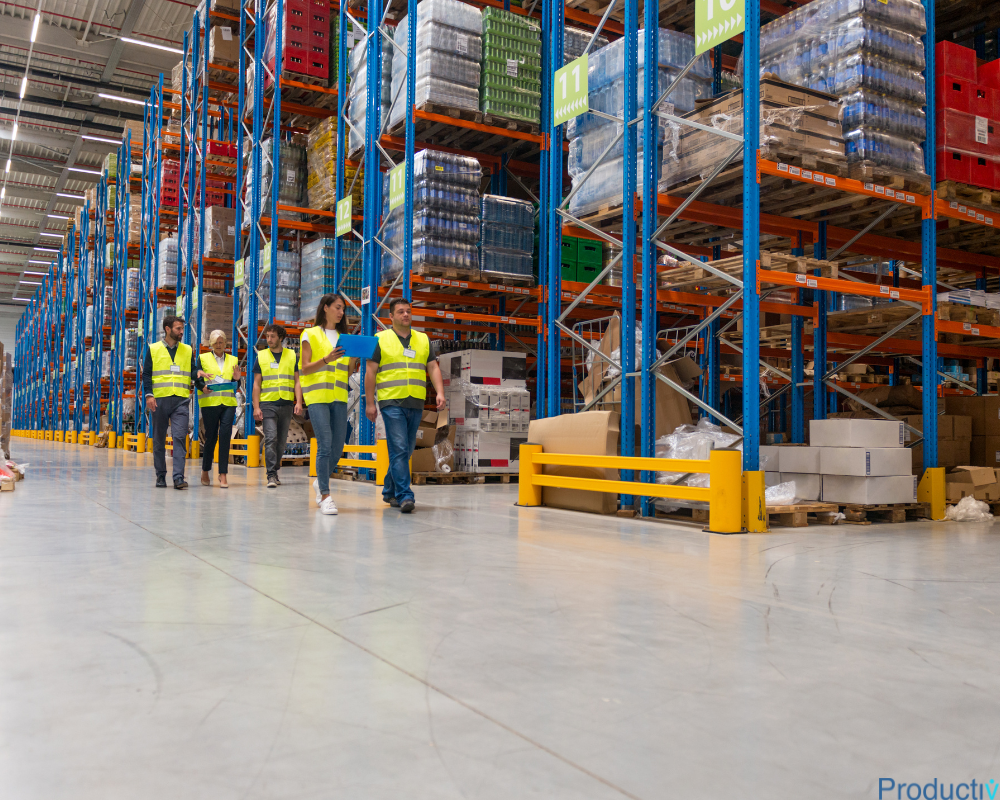
The Kinetic Center: Transforming Logistics from Static Storage to Programmable Motion
Subtitle: We are no longer waiting for the future of logistics—we are building it. Here is how Productiv is moving beyond the "Digital Twin" to deploy real-world AI applications that transform static warehouses into intelligent Kinetic Centers.
Introduction: The End of Stasis
In the legacy world of supply chain management, the warehouse was a "holding pen." It was a static node where inventory sat, waited, and gathered dust until an order came through. Success was defined by capacity: How much can we store?
But in the Autonomous Age, stasis is the enemy.
We are no longer operating in a world where static storage generates value. We have entered the Intelligent Logistics Era, where value is generated by velocity, customization, and predictive precision. We are moving away from the "Warehouse" and entering the era of the "Kinetic Center."
But how do you build a facility that moves at the speed of thought? The answer lies in a philosophy recently crystallized by tech visionaries like Nvidia’s Jensen Huang and Tesla’s Elon Musk: The Two-Factory Model.
In 2026, if you want to survive the volatility of global supply chains, you need two distinct production engines running in perfect synchronization. Factory 1 handles the atoms—kitting, assembly, and movement. Factory 2 handles the bits—intelligence, prediction, and control.
While Silicon Valley talks about "Digital Twins" and theoretical simulations, at Productiv, we focus on Digital Execution. We aren't simulating the future; we are writing the code that drives it today. Here is how that revolution looks when it hits the warehouse floor.
Part 1: What the Two-Factory Model Really Means for Logistics
Coined by Nvidia's Jensen Huang, the Two-Factory Model posits that every forward-thinking company must operate two distinct production engines simultaneously.
Factory 1: The Physical Backbone (The Muscle) This is your Kinetic Center. It includes your physical infrastructure: the kitting lines, the embedded staffing, the autonomous mobile robots (AMRs), the flighted conveyors, and the loading docks. It represents the "bits to boxes" flow. Its metric is Throughput.
- Legacy View: A place to store pallets.
- Kinetic View: A high-speed processor where raw components are kitted, customized, and shipped in hours, not days.
Factory 2: The Intelligent Brain (The Mind) This is where Productiv is differentiating itself. While others wait for "off-the-shelf" software to catch up, we built our own. Factory 2 is our ProSuite—a proprietary stack of AI-driven applications that orchestrate every movement in Factory 1. Its metric is Optimization.
- Legacy View: A reactive IT team fixing printers and maintaining a WMS.
- Kinetic View: A proactive Engineering team building custom AI agents that staff the floor, schedule the docks, and verify quality in real-time.
Part 2: The Evolution of IT – From Maintainers to Builders
To understand why Productiv is different, you have to look at our IT department.
In a traditional 3PL, the IT team is a "support function." They spend their days maintaining the Warehouse Management System (WMS), building EDI connections, procuring expensive SaaS software, and answering help desk tickets. They are "Keep the Lights On" workers.
At Productiv, our IT team has morphed into a Product Development Engine. We realized that the speed of logistics was outpacing the speed of traditional software vendors. We couldn't wait 12 months for a WMS update to give us a new feature. So, we started building our own.
The "Lovable" Revolution Leveraging next-gen development platforms like Lovable, our IT and Operations teams now sit side-by-side. We take manual workflows—processes that used to be trapped in spreadsheets or emails—and we turn them into fully deployed applications in days, not months. We aim to move supply chain product development forward at the pace of other rapidly changing industries like healthcare, automotive, and aerospace.
- The Result: We are no longer beholden to a software vendor’s roadmap. If a client has a unique problem, we build a unique solution. This shift allowed us to launch getproductiv.ai and our entire ProSuite.
Sidebar: Three Hard Trade-Offs We’ve Already Made (And Why They Paid Off)
Vision requires discipline. Here are the painful choices we made to secure our current advantage.
- Trade-off #1: Internal Dev vs. WMS Upgrades We postponed a major WMS migration (an 18-month ROI) to double down on in-house Lovable development capacity. Result: We now deploy new features in days instead of quarters, and we own the IP that differentiates us from every SaaS-dependent 3PL. Early payback: 40% faster client onboarding cycles.
- Trade-off #2: Hybrid Lines vs. Lights-Out Automation We chose to build flexible, human-cobot hybrid lines rather than chasing the "Lights Out" warehousing fantasy. Result: While competitors are stuck with rigid, CapEx-heavy systems that can’t handle SKU variability, our lines adapt to new packaging profiles in hours, not weeks.
- Trade-off #3: The Orchestrator vs. Point Solutions We refused to integrate "Best of Breed" point solutions for staffing and quality, choosing instead to build ProVantage as a single orchestrator. Result: We avoided the "API Spaghetti" trap. Our data lives in one unified model, allowing our AI to see the correlation between staffing levels and quality defects instantly.
Part 3: Factory 2 in Action – The ProSuite
Because our IT team transformed into builders, we were able to launch a comprehensive "AI Brain" that powers our facilities. This is Factory 2. It is not a simulation; it is the operating system of the Kinetic Center.
1. ProPallets (Retailer Compliance Engine) Retail compliance is complex, demanding a unique and accurate identification label on every logistics unit. One wrong label or a missed ASN can result in massive chargebacks. ProPallets pulls B2B orders directly from the WMS into a dedicated portal, enabling "Scan for UCC" functionality that forces operators to verify the exact label against the retailer's routing guide.
- Strategic Choice: We built this because standard WMS modules are designed for storage, not the complex, penalty-laden reality of modern retail routing guides.
2. ProShift (AI-Driven Staffing) Managing a workforce of 1,000+ people is chaos if done manually. ProShift is a Supervisor-driven platform that links our workforce directly to daily production requirements. Its AI automatically staffs the schedule based on the "suitableness" of the team, maximizing throughput.
- Strategic Choice: We chose to let the supervisor drive this, not HR, because staffing decisions made 24 hours out are guesses; decisions made on the floor are tactical.
3. ProDocks (Agentic Dock Scheduling) The loading dock is the bottleneck of the supply chain. ProDocks is a lightweight dock scheduling software powered by AI Agents. It enables picture capture of the Bill of Lading (BOL) and damage reports, automatically attaching them to orders without scanning or emailing.
- Strategic Choice: We deliberately kept ProDocks lightweight and API-first so any brand or carrier could adopt it as a standalone layer without ripping out their existing TMS—turning what is usually a 12-month integration into a 2-week pilot.
4. ProQuality (Vision-Based QC) You cannot inspect quality into a product; you have to build it in. ProQuality moves QC to the edge, automating First Article Inspections (FAI) and utilizing Computer Vision on the line to verify kit components (e.g., "Is the instruction manual included?") and generate auditable logs.
- Strategic Choice: We moved quality to the edge because by the time a report hits a manager’s desk, it’s too late to save the batch.
5. ProVantage (The Orchestrator) This is the "Brain of Brains." ProVantage connects ProPallets, ProShift, ProDocks, and ProQuality. It is the AI layer that aligns the production schedule (Factory 1) with the staffing roster and robotic capacity.
- Strategic Choice: We prioritized orchestration over reporting—because a dashboard tells you what went wrong, but an orchestrator prevents it.
Part 4: The Kinetic Flow – From Yard to Dock to Robot
So, what does it look like when Factory 1 (Muscle) and Factory 2 (Brain) work in unison?
A Reality Check: Progress Over Perfection This is what our Kinetic Center looks like in January 2026—not perfectly autonomous, but 35% more autonomous than it was in January 2025. Inbound trucks still require a human to confirm the final back-in, but everything from dock assignment to vision-based receiving to AMR put-away to hybrid-line staffing happens without human intervention. The gaps we’re closing next quarter: fully autonomous fork-truck trailer entry and end-to-end vision handoff from receiving to kitting.
The Current State Flow:
The Future State of Receiving: It starts before the truck even hits the gate.
- The Arrival: An AI Agent in ProDocks has already scheduled the inbound truck based on the "Must Arrive By" (MABD) date of the inventory inside.
- The Check-In: As the truck pulls up, it doesn't stop at a guard shack. A vision system scans the Truck ID number, matches it to the appointment, and directs the driver to "Dock 14" via a digital signboard.
- The Unload: The truck backs in. Instead of a human driving a forklift, an Autonomous Fork Truck (AFT) enters the trailer. Using SLAM navigation, it unloads the pallets.
- The Receipt: As the AFT pulls the pallet out, it passes through a Kargo.ai vision tower. This system instantly scans the barcode, measures the dimensions, and checks for damage—receiving the item into inventory in milliseconds without a human pulling a trigger.
The Put-Away & Production:
- The Scheduling: This receipt data feeds instantly into ProVantage. The system knows the inventory has arrived and updates the production schedule.
- The Staffing: ProShift sees the updated schedule. It realizes Line 4 needs to run tomorrow to hit the retailer deadline. It automatically messages the "A-Team" for Line 4 (the best-rated kitting staff) and schedules the necessary Cobots.
- The Movement: An AMR (Autonomous Mobile Robot) picks up the pallet from the receiving dock and drives it to the kitting line, timing the delivery exactly when the line is ready for replenishment.
The Outbound & Shipping:
- The Assembly: Humans and Cobots build the kits on a variable speed conveyor.
- The Check: A vision camera performs a Six Sigma quality check on every single unit.
- The Ship: Finished goods are palletized by a robot. An AMR takes the wrapped pallet to the shipping dock. ProDocks has already scheduled the outbound truck to match the retailer's delivery window. The ASN (Advance Ship Notice) flows automatically to the client.
This is not science fiction. This is the Kinetic Center in motion. Learn more about Productiv’s AI tech stack.
Part 5: Factory 1 Deep Dive – The Automation Ladder
While Factory 2 provides the intelligence, Factory 1 provides the muscle. But not all muscle is created equal. We view automation as a ladder, and we help our clients climb it.
Level 1: Mechanizing the Repetitive (The Basics) This is the table stakes for any Kinetic Center. We deploy "dumb" but powerful machines to handle the simple, high-repetition tasks.
- Tape Machines & Case Erectors: Eliminating the manual folding of boxes.
- Automated Pallet Wrappers: Ensuring load stability without dizziness.
- Variable Speed Conveyors: Controlling the flow of product to match the pace of the operator.
Level 2: Flexible Autonomy (The Movers) This is where we detach the machine from the floor.
- Palletizing Robots: Industrial arms that take the back-breaking work of stacking 40lb boxes off the human.
- AMRs (Autonomous Mobile Robots): Smart carts that move inventory from receiving to kitting, reducing the miles our associates walk each day.
Level 3: AI-Enabled Automation (The Future is Now) This is where Factory 1 and Factory 2 merge.
- Vision-Enabled Cobots: We use collaborative robots equipped with machine vision to pick and place items. They don't just move blindly; they "see" the item, adjust their grip, and place it with precision.
- 3D Printing (Additive Manufacturing): We print custom "End Effectors" (robot hands) on-site. If a client has a new shampoo bottle shape, we don't buy a new robot; we print a new hand in hours.
- Humanoids: We are moving toward Tele-Operated and AI-Enabled Humanoids. These bipedal robots can step into existing brownfield workflows—walking up stairs, reaching high shelves—without us needing to rebuild the facility.
The Hybrid Line: We don't believe in "Lights Out" warehousing. We believe in "Hybrid Lines." Our production lines combine humans, cobots, and machines. You might see a Case Erector build the box, a Human place the complex item, a Cobot insert the manual, a Tape Machine seal it, and a Palletizing Robot stack it. And overseeing it all? ProShift, which is now staffing not just the humans, but assigning tasks to the Cobots and Humanoids as if they were just another rostered employee.
Part 6: The Jobs Angle – Automation Creates Capacity
There is a fear that this Two-Factory revolution kills jobs. At Productiv, we are seeing the exact opposite.
Automation Creates Capacity, Capacity Creates Growth. Because we have increased our throughput using AMRs and Cobots, we have been able to take on more clients. More clients means more volume. More volume means we need more people, not fewer.
The Upskilling of the Workforce: We are transforming the nature of the "Warehouse Job."
- The Mechanic: We need more skilled mechanics to maintain the cobots and conveyors.
- The Electrician: We have a massive demand for electricians to handle power drops and air setups for new lines.
- The Technologist: We have floor associates who used to pack boxes now working as "Robot Wranglers," troubleshooting the AMRs.
- The Tele-Operator: We are creating roles where staff can operate forklifts or humanoids remotely, removing them from physical danger.
From RF Guns to AI Agents: Years ago, the big training challenge was teaching someone to use an RF Scan Gun. Today, our associates are upskilling to use ProQuality tablets and ProShift AI tools. They are moving from "Manual Laborers" to "Tech-Enabled Operators." We aren't just upgrading the facility; we are upgrading the careers of the people inside it and Anthropic, the makers of Claude, agree that “instead of putting people out of work, AI is mostly helping them do their jobs”.
So here’s the question every CEO should be wrestling with today: In three years, will the most valuable people in your operation be the ones who used to pack boxes, or the ones who can design, troubleshoot, and continuously improve AI-enabled kinetic lines? We’ve already placed our bet.
Conclusion: The Kinetic Reality
The Kinetic Center is not a theory. It is happening right now on our floor.
While the industry talks about the "future of work," we are building it.
- We moved our IT team from the server room to the lovable builder.
- We moved our Quality Control from paper binders to Computer Vision.
- We moved our staffing from phone calls to AI orchestration.
This is the power of the Two-Factory Model. By building the AI Brain (ProSuite) and connecting it to the Robotic Muscle (Factory 1), we have created a logistics platform that is faster, smarter, and more human than anything that came before it.
Three Decisions You Can Make in Q1 2026:
- Pick one painful manual workflow (dock scheduling, quality checks, staffing) that is currently slowing you down.
- Pilot a rapid-build tool like Lovable or Cursor. Do not wait for a SaaS vendor roadmap; build a custom app to replace that workflow in days, not months.
- Go fully paperless. Commit to a "Scan Everything" mandate. If a movement isn't tracked digitally today, it cannot be automated by AI tomorrow.
The future isn't just coming. It's already shipped.
Want to build the future Kinetic Center with us, reach out at www.getproductiv.com .
20 Years of Kitting Excellence
Ready to Streamline Your Supply Chain?
Join industry leaders achieving 99%+ SLA performance with flexible kitting, fulfillment, and 3PL solutions.
Get in Touch