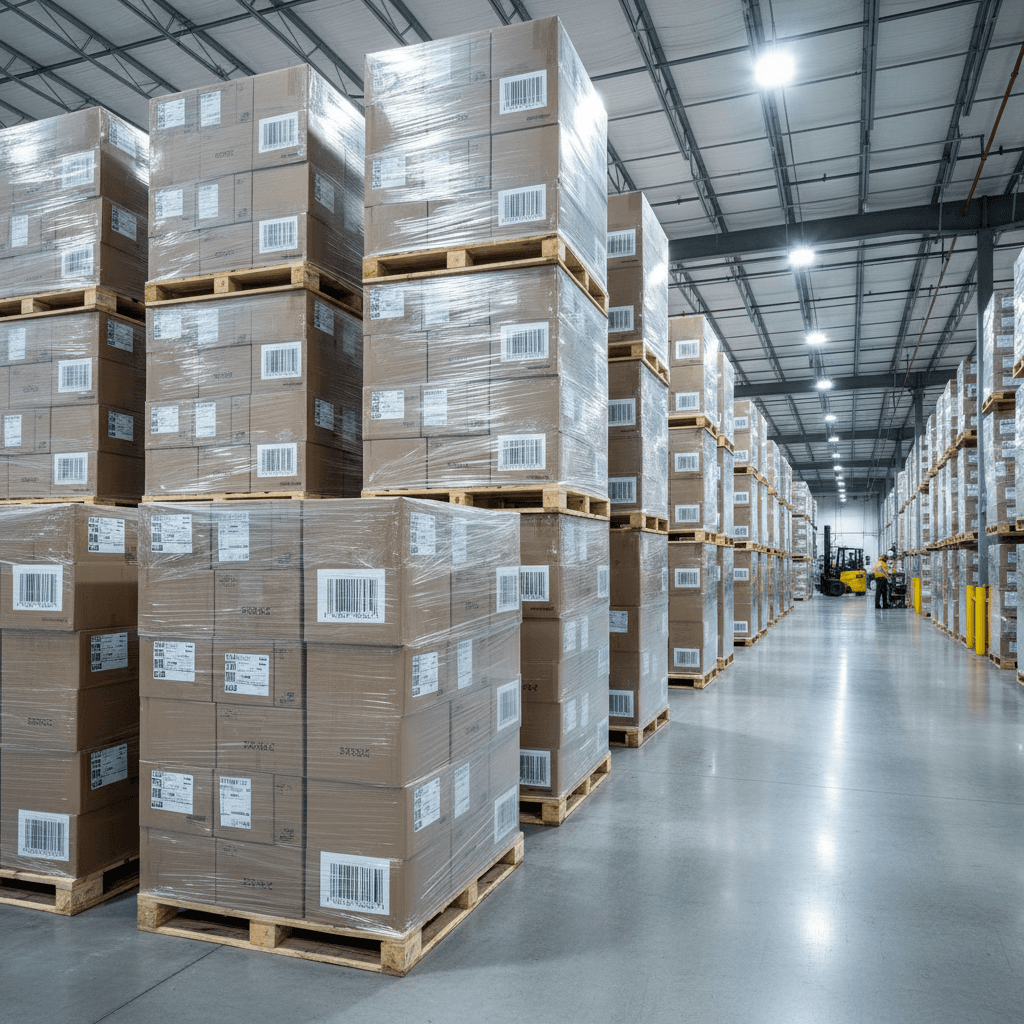
Costco is not like other retailers. Where Walmart uses standardized EDI and published OTIF thresholds, Costco operates a buyer-driven model with its own operational requirements. Club-pack packaging, cross-dock depot delivery, and buyer-managed vendor status all require specific expertise.
Costco depots move product fast — often within 24 to 48 hours from inbound dock to club floor. A compliance failure creates immediate ripple effects across multiple club locations. There is no learning curve. Precision is required from the first shipment.
This guide covers what we have learned working with Costco vendors across product categories — the specific requirements that determine whether you keep your vendor status or face penalties.
Why Costco Is Different: The Club Store Model
Costco runs the opposite strategy from most retailers. Key differences:
- Narrow assortment, high volume. A typical Costco location carries 3,500–4,000 SKUs versus 100,000+ at a traditional retailer. For each SKU, volume per location is significantly higher.
- No vendor portal. Costco buyers identify and contact vendors directly. Getting in requires a buyer relationship — not a portal registration or RFP submission.
- Relationship-managed. The buyer is your primary contact throughout the vendor lifecycle. Operations, compliance, and expansion all flow through them.
- Fewer orders, larger commitments. Costco does not do continuous replenishment. Orders are larger and less frequent — which requires strong inventory forecasting on your side.
A successful Costco relationship can deliver massive volume with relatively low retailer-management complexity. The tradeoff is that the compliance bar is high and enforced quickly.
Costco's Vendor Onboarding Process
Unlike retailers with formal vendor portals and standardized onboarding, Costco vendors typically work directly with their assigned buyer. The buyer coordinates the initial setup, specifies requirements, and assigns Costco's vendor number once contracting is complete. The buyer also specifies initial order quantities and cadence.
During onboarding, the buyer will typically specify:
- Club-pack configuration. The exact multi-pack format, pallet configuration, and case quantities required for the product category. This is non-negotiable and often reflects Costco's strategic vision for how the product should be presented on the club floor.
- Delivery location. The specific Costco depot or depots that will receive the product, and any region-specific requirements. Costco's depot network is organized by region, and some suppliers serve multiple regions with coordinated shipments.
- EDI requirements. Whether EDI is required from the start or will be phased in, and the contact information for Costco's EDI support team. Costco specifies the format and transmission timing for 850s, 856s, 810s, and 997s.
- Compliance standards. Specific requirements around pallet configuration, labeling, delivery scheduling, and any product-specific certifications or documentation. These details differ by product category and often reflect health, safety, or shelf-life considerations.
The buyer remains the primary relationship contact throughout the vendor lifecycle. Operational issues, requests for volume changes, new product discussions, and compliance questions all route back to the buyer. This is a significant operational difference from mass retailers where vendor communication typically flows through a centralized vendor portal.
EDI Requirements and Setup for Costco
Costco requires EDI for major volume suppliers, but the specifications and formats are Costco-proprietary. The required transaction sets include the 850 (Purchase Order), 856 (Advance Shipping Notice), 810 (Invoice), and 997 (Functional Acknowledgment). The data mapping must follow Costco's exact specifications, which differ from both Walmart and Target in specific fields and segment structures.
The 856 (ASN) is particularly critical because Costco relies on the ASN to schedule depot receiving. An ASN that arrives late, carries incorrect data, or is missing entirely will disrupt Costco's receiving timeline. Costco depots operate on tight schedules because of their cross-dock model—the depot must receive, sort by destination club, and stage for outbound within hours. An inaccurate ASN means the depot has no advance notice of what is arriving, which creates receiving delays that cascade to multiple club locations.
Smaller vendors may start with manual purchase orders transmitted through Costco's vendor portal and manual ASNs communicated via email. As volume grows, EDI becomes the standard. The transition to EDI typically requires several weeks of testing and validation to ensure that the mapping is correct for every PO type and order scenario that Costco may generate.
Club-Pack Packaging and Display-Ready Requirements
Club-pack packaging is where many suppliers encounter their first Costco surprise. A club pack is a multi-unit bundle designed for display and sale directly to club members. Unlike traditional retail where a case contains individual items that are shelved one at a time, a Costco club pack is a retail-ready package designed for display on the club floor.
Key requirements for club packs include:
- Display-ready packaging. The club pack carton must open or peel to reveal product that is immediately ready for customer purchase. The packaging must be attractive on the club floor—Costco members expect premium presentation.
- Robust packaging. Club packs sit on the sales floor and are handled by customers. Packaging must withstand handling without damage. Weak containers, broken cases, or product falling through the packaging result in chargebacks and reduced reorders.
- Quantity specification. Costco specifies the exact number of units per pack. A club pack might be 6-packs, 12-packs, or larger quantities depending on product category and Costco's strategy for that item. All packs must be identical and meet the specified quantity exactly. Under-packs or over-packs both result in chargebacks.
- Pre-packing at source. Club packs must be assembled before the product arrives at your facility if you are using a 3PL. If the supplier pre-packs, the 3PL receives already-packed club packs. If the 3PL performs the packing, that adds operational complexity but keeps your supplier's packaging simpler. Either way, the club packs must be 100% ready for shelf when they arrive at Costco.
The distinction between club-pack and traditional retail packaging cannot be overstated. Many suppliers attempt to apply traditional retail cases to Costco and discover that Costco rejects them because the presentation does not meet club store standards. Successful Costco vendors invest in packaging engineering that is specific to the club model.
Pallet Specifications and Configuration
Costco requires standard 48×40 GMA pallets with highly specific configuration requirements. These specifications reflect the cross-dock model: pallets must be built for rapid handling, automated or manual scanning, and secure transport without product damage or shifting.
Key pallet requirements include:
- Pallet base and layer specifications. Pallets must use standard 48×40 inch GMA pallets with wood decking and stringers, not block construction. The pallet itself must be in good condition with no broken boards, splintering, or discoloration. Used pallets are acceptable if they meet condition standards, but heavily worn or damaged pallets are rejected at receiving.
- Layer integrity. Cases must not lean more than 0.5 inches from the pallet base. Layers that tilt or shift indicate improper stacking or insufficiently supportive cases. Costco receiving teams physically check layer alignment during unload.
- Weight limits per layer. No single layer can exceed 500 pounds. This limit ensures that the pallet does not become unstable or difficult to handle during manual or automated depot processing.
- Overhang and underhang control. Cases cannot extend beyond the pallet footprint (overhang). Underhang is monitored to ensure the pallet is compact and secure. Excessive underhang can cause cases to shift during transport.
- Overall height. Pallet-plus-freight height should not exceed 60 inches (Costco will specify the exact height limit per category). Pallets that are too tall cannot stack effectively in trailers or depots.
- Display pallet configurations. Costco often uses half pallets and quarter pallets for on-floor display. These require different pallet bases and configurations. Display pallet specifications must be reviewed with the buyer during setup.
Pallet quality problems are among the most common reasons for receiving delays or refusals at Costco depots. A shipment that arrives with visibly damaged cases, leaning layers, or unstable pallets will be flagged immediately. Correcting the problem requires coordinating with the depot to restack or replace the load, which creates delays across multiple club locations.
GS1-128 Labeling for Costco
Every pallet and case shipping to Costco must carry SSCC-18 labels using GS1-128 barcode format. Costco uses these labels for receiving identification, automated sorting at the depot, and audit tracking. Label accuracy and scan quality directly impact depot throughput.
Costco's labeling requirements include:
- SSCC-18 barcode format. The Serial Shipping Container Code is a 20-digit number that uniquely identifies each pallet. The SSCC must be generated in GS1-128 barcode format with proper check digits. The barcode must be scannable on the first attempt.
- Label placement. Labels must be placed on two adjacent sides of the pallet for redundancy. If one label is damaged during transport or handling, the second label ensures the pallet can still be scanned at receiving.
- Required data fields. The label must include the SSCC, vendor number, PO number, item information, quantity, weight, and destination information. All fields must be legible and correctly formatted according to Costco's specifications.
- Print quality. Labels must be printed using thermal transfer or similar durable printing technology. Direct thermal labels that fade during transit will cause scan failures at the depot. A faded or unreadable barcode is treated as a compliance failure.
- Accuracy. The SSCC on the label must match the SSCC in the ASN. A mismatch between physical label and electronic advance notice creates receiving discrepancies. Costco scanning systems will flag the mismatch immediately.
SSCC labeling defects are one of the most common chargebacks at Costco. Supplies using incorrectly formatted SSCCs, faded barcodes, or single-side labeling (instead of the required two sides) can expect penalties on every shipment until the issue is corrected. Preventing labeling problems requires validated label templates and rigorous quality checks before any shipment leaves your facility.
Cross-Dock Delivery and Depot Scheduling
Costco operates cross-dock distribution centers designed for ultra-fast product flow. Unlike traditional DCs where product may sit in inventory for days or weeks, Costco depots receive inbound product, sort by destination club, and stage for outbound shipment within 24 to 48 hours. This fast-flow model creates tight receiving schedules and minimal tolerance for non-compliant shipments.
How cross-dock delivery affects vendor compliance:
- Appointment scheduling is critical. You must schedule a delivery appointment before arriving at the depot. Costco does not accept walk-in deliveries. The appointment must be scheduled within a specific date and time window defined by Costco. Missing the appointment results in a refused delivery and a penalty chargeback.
- ASN must precede physical arrival. Costco requires the 856 ASN to arrive before the physical shipment reaches the depot. The ASN gives the depot advance notice so they can schedule receiving dock space and plan the sorting workflow. An ASN that arrives after the truck arrives creates chaos at the depot.
- Early arrivals are rejected. If your truck arrives before the scheduled appointment time, Costco may refuse unload until the appointment window opens. Early arrival does not speed up processing — it creates delays and potentially results in missed appointments.
- Compliance is non-negotiable in fast-flow. Because Costco depots move product quickly, there is no time to hold shipments for correction. A pallet with improper labeling, wrong configuration, or quantity discrepancies will be flagged immediately and may be refused. The onus is on the supplier to ensure every shipment is compliant before arrival.
- Transit time must be factored into planning. When scheduling your shipment, calculate backward from your delivery appointment to determine your pickup date. This must account for carrier transit time plus safety buffer. Missing the appointment because of carrier delays or scheduling miscalculation results in penalties and potential order cancellation.
Successfully managing Costco deliveries requires real-time visibility into carrier pickup, in-transit status, and estimated arrival. A 3PL that cannot provide this visibility cannot reliably meet Costco delivery appointments.
Costco Chargebacks and Compliance Penalties
Costco enforces vendor compliance through a chargeback system similar to traditional retailers but with a key difference: the chargebacks are more often assessed individually rather than as a standardized percentage. This makes the impact of each failure potentially larger and more variable.
Common chargeback categories include:
- Late or refused delivery. Charges for missing the delivery appointment or arriving with non-compliant shipments. These charges reimburse Costco for the operational disruption at the depot and the cascading delays to clubs.
- Labeling defects. Charges for incorrect SSCC labeling, faded barcodes, missing labels, or incorrect label placement. These charges reflect the time spent at the depot to identify, correct, or manually process the shipment.
- Pallet configuration errors. Charges for improper stacking, lean, overhang, underhang, or damaged pallets that require depot staff to restack or reconstruct the load.
- Quantity discrepancies. Charges for receiving a different quantity than specified on the PO or ASN. This includes over-shipments and under-shipments.
- Packaging or product damage. Charges for damaged cases, compromised product, or packaging that does not meet club standards. Costco customers expect pristine product on the club floor.
Repeated chargebacks or compliance failures trigger vendor review with the assigned buyer. The outcomes of vendor review can range from corrective action plans to volume reductions to termination. Unlike some retailers where vendors can absorb chargebacks and continue as normal, Costco relationships are more relationship-based, and poor compliance affects the buyer's perception of the vendor.
Shipping to Costco and looking for fulfillment expertise?
We work with brands selling to Costco across multiple product categories and understand the club-pack model, cross-dock delivery logistics, and compliance standards specific to Costco depots. Let us assess your current setup.
Talk to our teamCommon Compliance Failures in Costco Shipments
Based on our experience working with Costco vendors, here are the most common failure modes that lead to chargebacks and compliance issues.
Pallet Configuration Problems
The most common failure. Suppliers assume "a standard pallet" is fine and miss Costco's specifics:
- Layer lean exceeding 0.5 inches from pallet base
- Single layers over 500 lbs
- Case overhang or underhang outside Costco's tolerance
- Overall pallet height exceeding category limit
Fixing a rejected pallet means rebuilding the entire load at the depot — which creates receiving delays across multiple clubs.
SSCC Labeling Errors
Common errors that trigger chargebacks:
- Labels placed on only one pallet side (two adjacent sides required)
- Faded or unreadable barcodes from direct thermal labels that degraded in transit
- Walmart label templates applied to Costco shipments — formats differ
- SSCC on label does not match SSCC in the ASN
Appointment Scheduling Failures
Costco does not accept walk-in deliveries. A truck that arrives without a scheduled appointment is turned away — with a failure chargeback and cascading delays to multiple clubs. Schedule the appointment well in advance and confirm with both the carrier and the depot.
ASN Timing Issues
The ASN must be transmitted after the shipment departs and before the truck arrives at the depot. Too early (before actual departure) risks a mismatch if the load changes. Too late means the depot has no advance notice and cannot schedule receiving. Automate ASN generation from the shipment event — not the PO.
Club-Pack Configuration Mismatches
Shipping traditional retail cases instead of club packs — or shipping the wrong pack size (6-pack vs. 12-pack) — is caught at the depot and results in chargebacks and potential order cancellation. Confirm club-pack specifications directly with the buyer before the first shipment. The buyer is the only source of truth.
How a 3PL Handles Costco Compliance
A 3PL fulfilling Costco orders owns every operational variable that determines compliance:
- Receiving inbound inventory and storing in club-pack configuration
- Picking and packing against Costco purchase orders
- Generating accurate ASNs to Costco's EDI specifications
- Creating SSCC-18 labels with correct format, placement, and barcode quality
- Building pallets to Costco's exact stacking and weight specifications
- Scheduling delivery appointments and managing carrier selection
- Monitoring delivery compliance and flagging exceptions before they become chargebacks
Because Costco is buyer-managed, the 3PL also needs to support communication with the buyer on inventory levels, order status, and compliance issues. Direct buyer engagement is not optional — it is how the relationship stays healthy.
A 3PL with Costco experience has already solved the hard problems: EDI mapping validated, label templates built to spec, pallet standard work documented, ASN generation automated. A 3PL without it learns on your account — and every mistake risks your vendor status.
Evaluating whether your fulfillment setup is Costco-ready? Work through the 3PL compliance checklist — EDI, labeling, pallet standards, and SLA accountability in one self-audit.
Paul Baker
CFO, Productiv
Paul co-leads Productiv alongside Doug Legan, bringing two decades of hands-on experience in 3PL operations, kitting, fulfillment, and embedded manufacturing. Clients reference Paul by name when describing the direct leadership access that sets Productiv apart from enterprise providers. Paul is leading Productiv's push into AI and robotics to give Productiv's clients the greatest competitive advantage against their competitors as we enter the age of AI.
Frequently Asked Questions About Costco Vendor Compliance
How do you become a Costco vendor, and does Costco use SPS Commerce like other retailers?
Costco buyers identify and contact vendors directly — there is no standard supplier portal or unsolicited application process. Getting in requires a buyer relationship, typically built through trade shows, referrals, or direct outreach from Costco's buying teams. Once a buyer engages, they handle negotiations and contracting. Costco also manages EDI through its own infrastructure, not SPS Commerce like most mass retailers.
What is a Costco club pack, and how does it differ from traditional retail packaging?
A club pack is a multi-unit bundle designed for display and direct sale on the club floor — not a case of individual items to be shelved separately. Club packs are 6-packs, 12-packs, or larger quantities depending on the product. They must be display-ready (carton opens to reveal product with no stocking work), durable enough to withstand floor handling, and attractive enough for the club environment. Costco requires club packs to be pre-built before shipping.
What are Costco's pallet requirements, and why are they so specific?
Costco requires standard 48×40 GMA pallets but with specifications that go beyond dimensions. Pallets must be properly configured for cross-dock handling — Costco's depots move product through quickly, often within 24 to 48 hours. Cases must not lean more than 0.5 inches from the pallet base, and layers cannot exceed 500 pounds. Overhang and underhang are carefully controlled. Costco display pallets — half pallets and quarter pallets designed for club floor display — are also common and require specific configurations depending on the product type. The pallet configuration must support Costco's automated and manual handling systems without product damage, product shifting, or receiving delays.
Does Costco require EDI, and what transaction sets do they use?
Costco requires EDI for major volume suppliers. The required transaction sets include the 850 (Purchase Order), 856 (Advance Shipping Notice), 810 (Invoice), and 997 (Functional Acknowledgment). Costco uses proprietary specifications that differ from industry standards — the EDI mapping must follow Costco's exact requirements. Smaller vendors may operate with manual purchase orders and ASNs through Costco's vendor portal, but as volume grows, EDI becomes necessary. The 856 ASN is particularly critical because Costco relies on advance notice to schedule depot receiving. An ASN that is late, inaccurate, or missing will disrupt Costco's receiving timeline and may result in refused or delayed delivery acceptance.
What is a Costco cross-dock facility, and how does it affect delivery schedules?
Costco depots are fast-flow cross-docks, not traditional DCs. Inbound product is received, sorted by destination club, and staged for outbound within 24–48 hours. There is no inventory buffer. Your delivery appointment must align exactly with the depot's receiving schedule — and the shipment must be fully compliant on arrival. Late deliveries, non-compliant pallets, and missing ASNs all back up the receiving dock and create cascading delays to multiple clubs.
What chargebacks does Costco issue for compliance failures?
Costco charges for non-compliance including shipping delays, labeling failures, pallet configuration errors, incorrect quantity, and late deliveries. The chargeback structure varies by the type of failure: late or refused delivery charges, labeling defect charges (for incorrect SSCC-18 labels or placement), pallet configuration charges (for improper stacking, lean, overhang, or underhang), and quantity discrepancy charges. Unlike Walmart's standardized 3% COGS penalty, Costco's chargebacks are applied on a case-by-case basis depending on the violation type. Repeated failures can result in vendor review and potential removal from Costco's approved vendor list.
How are Costco's OTIF requirements different from other mass retailers?
Costco measures on-time delivery extremely strictly because of their cross-dock model. A late delivery to a Costco depot can cause cascading delays to multiple club locations. Early deliveries are also problematic — if a depot is not prepared to receive, the truck may be turned away. Costco requires delivery within a narrow appointment window, not a range. The penalty for missing the appointment is swift and includes both chargeback fees and reduced future order allocations. Costco does not publish a specific OTIF percentage threshold like Walmart's 98%, but vendors who consistently miss appointments face vendor review.
What is GS1-128/SSCC-18 labeling, and what are Costco's specific requirements?
SSCC-18 (Serial Shipping Container Code) labels using GS1-128 barcode format are required on every pallet and case shipping to Costco. The label must include specific data fields — SSCC number, PO number, vendor number, item information, and quantity — in Costco's specified format. Labels must be placed on two adjacent sides of each pallet for scanning at receiving. Label print quality is critical — barcodes must be scannable on the first attempt. Poor label placement, faded barcodes, or missing labels result in chargebacks. The SSCC must be unique per pallet and must be included in the ASN for Costco to match the physical label to the electronic advance notice.
How does Costco's club store model affect the volume and frequency of orders?
Costco's club model creates a fundamentally different order pattern than traditional retail. Costco carries far fewer SKUs than Walmart or Target — a typical Costco location stocks around 3,500 to 4,000 items versus 100,000+ at a traditional retailer. However, for each SKU that Costco carries, the volume per location is significantly higher. This means fewer, larger orders that require exactly the right quantity and configuration. A Costco order for 500 units of a product is intended to move quickly through the club, not sit in back stock. Orders also come with less frequency — Costco does not do constant replenishment like traditional retailers. This requires careful inventory management and forecasting on the supplier side.
What role does a 3PL play in Costco vendor compliance?
A 3PL handles every operational variable: club-pack storage, picking and packing to PO spec, ASN generation to Costco's EDI format, SSCC-18 label creation, pallet configuration, appointment scheduling, and carrier management. Beyond operations, the 3PL also needs to support buyer communication — Costco relationships are managed through the buyer, not a vendor portal. Brands consistently find that Costco success requires a 3PL with specific Costco experience, not a generic retail provider.
Talk to an Operator About Your Costco Chargebacks
If deductions are showing up on your Costco remittance — pallet rejections, SSCC labeling charges, missed depot appointments — tell us what Costco is charging you and we'll tell you which failures are preventable. We build club packs, run Costco EDI, and hit depot appointment windows every week. You'll talk to someone who runs the floor, not a sales script.
Talk to an Operator