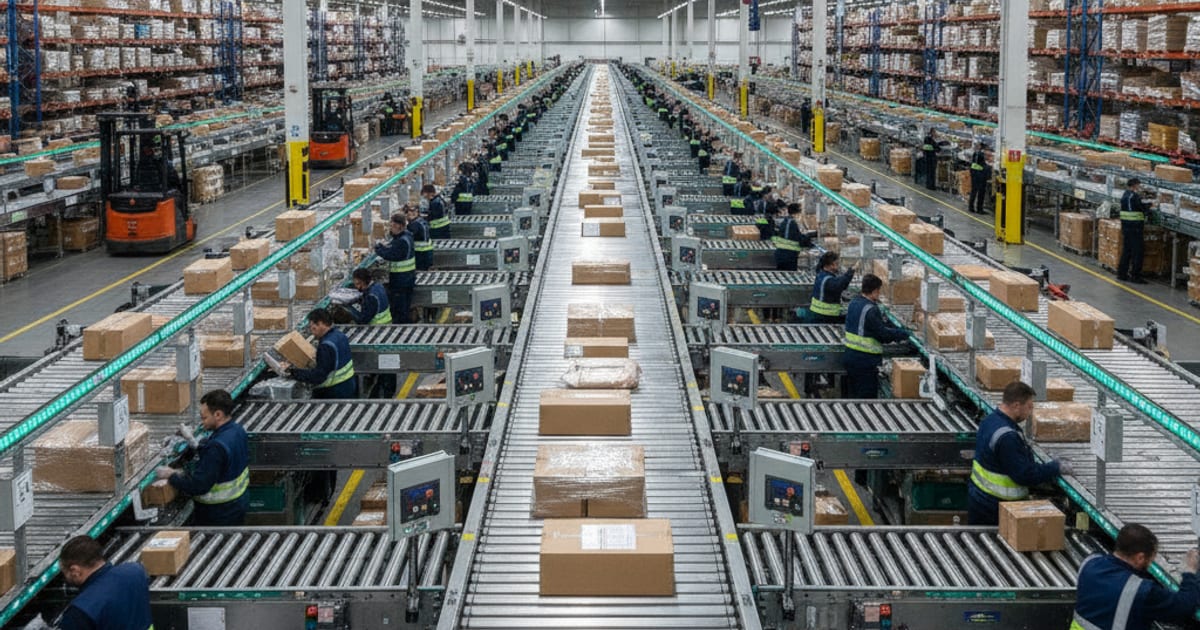
If your Q4 forecast is 3–5x your summer volume, the question that matters isn't whether your 3PL is performing well right now. It's whether they can absorb a spike that size without your SLAs going down with it. Peak failures almost never happen because a partner suddenly gets worse — they happen because of three limits that were sitting there all year: labor that couldn't be recruited fast enough, space that was already committed to other clients, and per-line throughput ceilings nobody asked about in July.
All three limits are visible in advance if you know where to look. This post covers the concrete signals that separate a 3PL with a real surge model from one that's planning to figure it out in October — and the questions that surface the difference while there's still time to act on the answer. It's one piece of a larger question; our peak season fulfillment readiness guide covers the full Q4 preparation sequence from inventory positioning through contingency planning.
Why Peak Volume Breaks Fulfillment Operations — and Where It Breaks First
A 3–5x volume spike stresses a warehouse in a predictable order.
Labor breaks first. Picking, kitting, packing, and shipping are labor-intensive work, and volume growth translates almost linearly into headcount needs. A facility running 100 operators at baseline needs somewhere between 250 and 400 people-equivalents of output at peak — through some combination of new hires, added shifts, and overtime. Recruiting, screening, and training that many people takes weeks, which is why the labor plan has to exist months before the volume does.
Space breaks second. Peak doesn't just mean more orders going out — it means more inventory coming in first. Brands forward-position 6 to 10 weeks of stock ahead of November, and that inventory needs racking, staging, and dock capacity at exactly the moment every other client of the facility is doing the same thing. A 3PL that hasn't reserved space for your peak inventory by late summer is planning to improvise with yours or someone else's.
Throughput ceilings break last and hurt the most. Every line has a physical maximum — a function of stations, takt time, and staffing. A kitting line that comfortably produces baseline volume cannot clear 4x that volume by running harder; it clears it by adding lines, shifts, or both. This is the least visible limit because it never shows up until the backlog does, and by then every day of backlog compounds into the next.
The rest of this post takes those three limits in order, plus the fourth signal that ties them together: what the partner's SLA record actually looked like under load.
The Labor Ramp Model: How a 3PL Recruits and Trains Surge Staff
The labor ramp model is the strongest single predictor of peak performance, because it's the limit that breaks first and the one with the longest lead time to fix.
There are two structurally different approaches, and they behave very differently under load. The first is the temp-agency model: when volume rises, the 3PL calls staffing agencies and takes whoever is available. It's fast on paper and unreliable in practice — no-show rates spike during peak because every warehouse in the market is pulling from the same pool, and workers who arrived Tuesday are packing your retail orders Wednesday with minimal training. The second is the owned-workforce model: the 3PL recruits, hires, trains, and supervises its own people, and scales by running a hiring engine it controls. Productiv runs the second model — our own trained operators, not temp labor — with line leads and supervisors averaging 10+ years of tenure, which means surge hires are absorbed into crews run by people who have done many peaks before.
What does a credible ramp look like from the outside? One VP of Operations at a global medical device manufacturer put it this way about working with us: "Their ability to go out and find talent for us in short order has just always been, honestly, pretty shocking to me. If I told Productiv I needed 20 people in three weeks, I guarantee they'd have 20 people in three weeks." That's the standard worth holding any partner to — not a promise that labor will appear, but a demonstrated mechanism for producing it on a clock, in whatever market the facility sits in.
When you ask a prospective or current partner about their labor ramp, listen for specifics: where surge staff come from, how long training takes before someone touches your product, what the supervisor-to-new-hire ratio is during ramp, and what the attendance plan is for the two weeks that matter most. A good answer sounds like a process. A weak answer sounds like a reassurance.
Q4 readiness
Not sure your current partner can ramp for Q4?
Bring us your peak forecast and we'll show you the labor, space, and line plan it would take to hit it.
Get a Capacity AssessmentSpace Flex and Throughput Ceilings: The Physical Limits to Ask About
Labor scales in weeks. Buildings don't scale at all — which is why space and line capacity have to be evaluated as fixed constraints, not soft ones.
On space, the question is simple: how much of the facility is committed to other clients' peaks, and how much is reserved for yours? A multi-client 3PL runs one building through everyone's Q4 simultaneously, so the honest answer involves dates — when your inventory reservation locks, what happens if you need 20% more pallet positions than forecast, and whether overflow can move to another facility in the network. A network matters here: Productiv operates 5 warehouses with 1,200+ operators, which means a program that outgrows one building has somewhere to go. A single-facility partner has no equivalent move, and it's worth knowing that before you need it. For a deeper look at how facilities plan this, see our guide to warehouse capacity planning.
On throughput, ask for the ceiling in numbers: units per hour per line for work like yours, and how many lines can be stood up. Any operator who runs high-volume programs knows these figures cold, because per-line throughput is how the work gets scheduled. As a reference point for what engineered kitting capacity looks like at the top end, single programs at Productiv run as high as 80,000 kits per day at peak — a number that only happens with multiple parallel lines, staffed shifts, and a line design built for the specific kit. Your program probably doesn't need that ceiling. But a partner who can tell you exactly what your program's ceiling is, and show the math, is a partner who has actually planned your peak.
What an SLA Track Record Under Load Should Show
Annual SLA averages hide peak. A partner can run 99% for ten months, fall apart for six weeks in Q4, and still show you a very comfortable yearly number. So ask for the record differently: what was SLA performance last November and December, specifically, on programs with volume profiles like yours?
Two reference points help calibrate what good looks like. First, ramp speed: Productiv's standard across new program launches is 99%+ SLA performance reached within 30 days of onboarding — meaning the operation is at full reliability well before it's asked to absorb a surge, not still stabilizing when the surge arrives. Second, sustained performance as volume scales, in the client's words rather than ours. Kelli Overson, EVP of Operations at Pourri, describes it this way: "We are hitting all the SLAs over and over again. Productiv has led the charge and brought so many improvements to the table over the last two years. There's nothing glaring that stands out anymore and now we are just fine tuning."
Whatever partner you're evaluating, the pattern to look for is the same: peak-period data offered without hedging, and references from clients whose Q4 looks like yours.
The Questions to Ask — and What Good Answers Sound Like
Pulling it together, five questions surface almost everything that matters. Ask them in July, in writing, and compare the answers against your peak-week forecast:
- "How will you staff our peak — where do the people come from, and are they in-house or temp?" Good answer: a named recruiting process, a training timeline, and a direct answer on employment model. Weak answer: "We partner with several staffing agencies."
- "What's the throughput ceiling of the lines running our program?" Good answer: units per hour per line, number of lines available, and the shift plan that gets to your number. Weak answer: "We've never had a capacity problem."
- "How much space is reserved for our peak inventory, and when does that commitment lock?" Good answer: pallet positions and a date. Weak answer: "We'll make it work."
- "What was your SLA performance last November and December?" Good answer: actual peak-period numbers, plus a reference client with a similar surge profile. Weak answer: an annual average.
- "What happens if we beat forecast by 30%?" Good answer: a specific overflow mechanism — added shifts, an additional line, a second facility. Weak answer: a pause, then optimism.
None of these questions is adversarial. A capable partner welcomes them, because they're the same questions their own operations team already answered internally.
What This Looks Like in Practice
The reason we can be prescriptive about these signals is that this is the work we build for. Productiv runs high-volume kitting, assembly, and fulfillment across 5 warehouses with a 1,200+ operator workforce that is our own from the floor up — and seasonal surge projects are a core program type, not an exception we absorb reluctantly. The labor engine, the parallel-line design, and the network overflow options exist precisely because peak is when our clients' businesses are won or lost.
That's also why we'd rather have the capacity conversation in July than in October. A forecast reviewed now gets a real plan — lines, people, space, dates. A forecast that shows up in Q4 gets whatever is left.
The Bottom Line
Peak capacity isn't a feeling, it's three checkable facts: a labor ramp model with a track record, physical space and line ceilings that clear your forecast with headroom, and SLA data from previous peaks — not annual averages. Ask the five questions above while the calendar is still on your side, and weigh the specificity of the answers as heavily as their content.
If you're pressure-testing your Q4 plan, start with the full peak season readiness guide — or talk to an operations expert and we'll review your peak forecast against a real capacity plan.
Key Takeaways
- →A 3PL's average-month performance says almost nothing about peak capacity — Q4 failures trace to labor ramp speed, space that's already committed, and per-line throughput ceilings.
- →The labor ramp model is the single strongest predictor of peak performance: a 3PL with its own trained workforce and a documented surge-hiring process behaves very differently under load than one that calls a temp agency in October.
- →Every kitting or fulfillment line has a measurable throughput ceiling — a partner who can quote units per hour per line, and how many lines they can stand up, has done the math; one who answers in vague reassurances hasn't.
- →Ask for SLA data from last year's November and December specifically, not annual averages — peak-period performance is the only track record that predicts peak-period performance.
- →Productiv runs single programs as high as 80,000 kits per day at peak, with 1,200+ operators across 5 warehouses and 99%+ SLA performance reached within 30 days of onboarding.
Frequently Asked Questions
How do I know if my 3PL can handle peak season volume?
Look at three things: their labor ramp model (how they recruit and train surge staff, and whether that workforce is in-house or temp-agency), their space and line flex (documented peak capacity per line and facility, not general reassurance), and their SLA track record during previous peak periods specifically. A capable partner can show you a written ramp plan with dates and numbers. If the answer to 'how will you staff our Q4?' is 'we always figure it out,' that's the signal to dig deeper.
How much extra capacity should a 3PL have for Q4?
Plan against your peak-week forecast, not your monthly average — for most consumer brands Q4 peak weeks run 3–5x baseline volume. Your 3PL should be able to state the specific throughput ceiling of the lines assigned to your program and show how they add shifts, lines, or facilities to clear your forecast with headroom. Capacity that exists only as a shared pool across all clients isn't capacity you can count on.
What questions should I ask a 3PL about peak season readiness?
Five questions do most of the work: How do you recruit and train surge labor, and is it in-house or temp? What is the throughput ceiling of the lines running my program, in units per hour? How much space is reserved for my peak inventory, and when do I have to commit? What was your SLA performance last November and December? And what's the overflow plan if my volume beats forecast? Good answers include numbers and dates. Weak answers include the word 'typically.'
Why do 3PLs fail during peak season?
The most common failure mode is labor: surge staff hired too late, trained too little, or sourced through temp agencies with high no-show rates. Space is second — inventory arrives for peak and the facility is already full. Throughput ceilings are third and least visible: a line that comfortably runs baseline volume simply cannot physically clear 4x that volume, no matter how many hours it runs. All three are checkable in July; none are fixable in November.
Is an in-house warehouse workforce better than temp labor for peak season?
For surge execution, yes — and the difference shows up in accuracy and absenteeism exactly when volume peaks. A 3PL that hires, trains, and supervises its own trained workforce controls quality through the ramp; a 3PL that leans on temp agencies is subcontracting your peak to whoever shows up. Productiv runs its own trained operators — not temp labor — with line leads and supervisors averaging 10+ years of tenure.
When should I start evaluating my 3PL's Q4 capacity?
July. Labor ramps take weeks to execute and space commitments at good 3PLs are made by late summer. If you wait until September to ask these questions, the honest answer from most partners will be that peak capacity is already spoken for. A July conversation gives you time to either confirm your current partner's plan or stand up an overflow option.
Peak capacity, verified
Want a straight answer on whether your Q4 volume can be absorbed?
We run peak programs as high as 80,000 kits per day across 5 warehouses with a 1,200+ operator workforce — and we'll walk you through exactly how the ramp works before you commit.
Talk to an Operations Expert