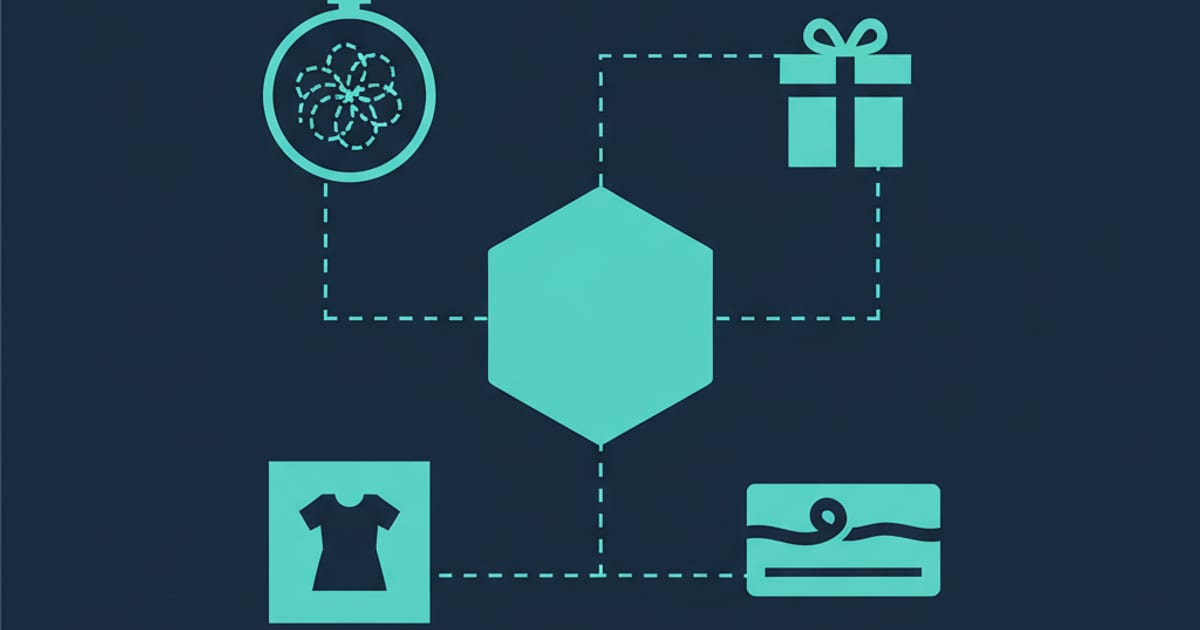
Personalization used to be a premium add-on. It's now a baseline expectation across DTC ecommerce and loyalty programs — monogrammed merchandise, custom-printed apparel, gift cards paired to the right occasion, branded gift wrap that matches the program. Brands that don't offer it feel transactional next to brands that do.
The operational problem is that personalization inverts every assumption baked into a high-throughput fulfillment workflow. A stock pick-and-pack operation runs on SKU lookup tables, batched picks, and equipment optimized for repetition. A personalization operation runs on customer-specific input data, one-of-one production, and equipment that has to reconfigure between every order. The two are structurally opposite — and the customer doesn't care. The SLA window for a monogrammed sweatshirt is the same as the SLA window for a stock sweatshirt.
That gap — between one-to-one production economics and batch-fulfillment SLAs — is the problem we've spent the last year solving. This is what we built, why we built it, and what it took to get embroidery, DTF (direct-to-film) printing, gift cards, and gift wrapping running at the same SLA performance as our stock fulfillment lines.
Why Personalization at Ecommerce Scale Breaks Traditional Workflows
Take a stock fulfillment line. An order comes in, the WMS assigns a pick path, an operator pulls SKU 12345 from a known bin, the order moves to pack, label, ship. The system is optimized around the assumption that the SKU is a known quantity. Every operation on it can be batched, automated, or templated.
Personalization breaks that assumption at the first step. The "SKU" the customer ordered — a sweatshirt with the name "Henley" embroidered in cursive on the left chest — doesn't exist until the order itself defines it. Every part of the production sequence has to be generated specifically for that one unit.
Each service line has its own version of the same problem:
- Embroidery — every order needs a digitized stitch file generated from the customer's text input, font choice, color, and placement specification. Manually digitizing one embroidery file takes a skilled operator 15–30 minutes. At any meaningful volume, that's the bottleneck.
- DTF printing — every order needs a print file composed at the correct scale and position for the substrate. The press itself is fast; the file preparation upstream is what eats the time.
- Gift cards — each card has to be activated and serialized against the customer's order, paired correctly during pack-out, and reconciled against the brand's loyalty or financial system. A mispairing isn't a quality issue — it's a financial issue.
- Gift wrapping — program-specific paper, ribbon, card, and tag combinations that vary by occasion, brand, and season. Often layered on top of one of the three services above.
Stack these problems together — and most personalization programs run more than one of them at the same time — and you've turned what looked like a fulfillment operation into a per-order production sequence. With no SLA forgiveness from the customer. This is why personalization usually shows up as a value-added service on a 3PL's capabilities page rather than as a core fulfillment workflow — the operational engineering is fundamentally different.
What Most 3PLs Do, and Why It Falls Apart at Scale
Most 3PLs that say they "can do personalization" handle it as a special-project carve-out. The order routes out of the main fulfillment line into a personalization area, an operator or coordinator preps the file manually, the work runs, and it comes back into the pack flow. That works fine at 50 orders a day. It works at 200 if the team is good.
It breaks at 1,000+. The file-prep step starts queueing. The coordinator becomes the bottleneck. SLA misses begin showing up on the personalized subset of orders even though the rest of the operation is on time. The brand's customers don't see "your personalized order is late" — they see "this brand is unreliable." And the standard 3PL response is to add headcount, which is the wrong fix because it doesn't change the throughput-per-operator math.
The real fix is to remove the manual steps from the per-order critical path. That's the workflow tooling we built.
The AI Workflow We Built
The workflow sits between order intake and the floor. It has five components, and the value comes from how they interlock, not from any one of them being especially novel on its own:
1. Input validation and rendering. When a customer submits a personalization (text, image, font, color), the workflow renders a preview against the substrate and validates that it will produce correctly. Submissions that won't render — text too long for the placement, image resolution below threshold, color combinations that won't stitch — get flagged before they hit production. This single check eliminates the most common cause of personalization rework: catching the problem on the floor instead of at intake.
2. Auto-digitization for embroidery. Given a text string, a font, a color, and a placement specification, the workflow generates a production-ready stitch file without a human digitizer touching it. The Barudan machines run on files generated this way; VeriStitch Delta handles the format requirements. What used to be a 15–30 minute manual step per new design becomes seconds. This is where embroidery shifts from "we can do it" to "we can run thousands a day."
3. Auto-composition for DTF printing. Same principle, different output: the workflow assembles the customer's artwork at the correct scale, position, and color profile for the DTF press. The substrate-specific parameters are encoded once per program, not re-derived per order.
4. Smart routing across stations. Given current queue depth at each station, equipment availability, and the SLA deadline on each order, the workflow assigns each order to the right station in the right sequence. A late order doesn't sit behind ten in-window orders waiting their turn — it gets prioritized. An order that needs both embroidery and gift wrap routes through both stations in the order that minimizes total handling time.
5. First Article approval routing. When a new program kicks off or a new design enters production, the first article photo gets routed to the client for sign-off automatically through our internal tool. A coordinator no longer has to email a photo, wait for response, and chase approval. We call this layer ProQuality internally; the function is closing the loop between production and client approval without a human shuttle in the middle.
None of these components replaces operators. They remove the parts of the workflow that used to require a coordinator per order — file prep, queue management, approval routing — so the operators on the equipment can focus on running the equipment.
What This Lets Us Run Today
Four service lines, run as a single integrated capability:
- Embroidery — Barudan commercial equipment, VeriStitch Delta digitizing, auto-generated stitch files
- DTF (direct-to-film) printing — substrate-flexible, suitable for apparel and soft goods
- Gift cards — activation, serialization, and order pairing integrated with brand loyalty and financial systems
- Gift wrap — program-specific paper, ribbon, card combinations executed as a pack-out station
All four run through the same orchestration layer, and most live programs combine two or three of them — embroidery plus gift wrap for a corporate loyalty gift, DTF print plus gift card pairing for a seasonal DTC drop, the full stack for a retail gifting program. The bundling matters operationally because the per-order setup work happens once across all four stations rather than four times.
The volume picture: across our kitting and assembly programs combined, we run 30M+ kits annually for 100+ retailers. The personalization-specific volume is a subset of that, but it's the fastest-growing subset right now. Our SLA standard across new program launches is 99%+ within 30 days of go-live, and the personalization lines hold to the same target.
The named live deployment is Kenna Group, which runs custom merchandise and loyalty programs through this stack. Multiple DTC brands also run on-demand gifting through the same workflow.
What This Means for Brands Evaluating 3PLs for Personalization
If you're evaluating fulfillment partners for a personalization program — whether that's a loyalty program rollout, a holiday gifting campaign, or a permanent capability on your ecommerce site — the questions worth asking aren't about whether the 3PL "can do" embroidery or DTF. Every 3PL with a piece of equipment will say yes. The questions worth asking are about the workflow underneath:
- How are embroidery stitch files generated — manually per order, or auto-generated from the customer's input?
- What's the input-validation step? At what point in the process do you catch a customer submission that won't render correctly?
- How does the SLA hold up when 30% of the order volume is personalized? How about 80%?
- How is routing prioritized across stations when SLA deadlines vary order-to-order?
- What happens to throughput when one piece of equipment goes down — does the workflow re-route, or does the queue stall?
- How does First Article approval get to the client and back? How long does that loop take?
The answers to those six questions tell you whether the partner has engineered personalization as a production capability or is running it as a special project. The economics diverge sharply between the two as volume grows. Most brands don't realize which one they have until the program is already live and the SLA misses start landing on the personalized orders.
The Bottom Line
Personalization at ecommerce scale is a workflow problem, not an equipment problem. Anyone can buy a Barudan and a DTF press. What determines whether a 3PL can hold SLAs at scale is the orchestration between order intake and production — the file generation, the validation, the routing, the approval loops. Those layers compound. Get them right and personalized throughput looks like stock throughput. Get them wrong and the personalization line becomes the one that pulls down the SLA report.
Our bet over the last year was that the workflow layer would matter more than the equipment layer. That's been right so far. Personalization is one of the fastest-growing parts of our business, and the SLA numbers are holding.
If you're running or planning a personalization program — DTC gifting, loyalty merchandise, retail seasonal kits — and you want to talk through the workflow questions in detail, reach out.
Key Takeaways
- →Personalization at ecommerce scale inverts every assumption baked into traditional 3PL workflows. Every order is one-of-one, but SLA windows don't relax for it.
- →Embroidery, DTF printing, gift cards, and gift wrapping share the same structural challenge: customer-unique data drives each unit, so the batching efficiencies that make stock fulfillment work disappear.
- →The gap between 'we can do personalization' and 'we run personalization as a production capability' comes down to the workflow stack — specifically, the AI orchestration handling input validation, file generation, and station routing.
- →Productiv runs four personalization service lines (embroidery, DTF, gift cards, gift wrap) through a custom AI workflow that holds SLAs comparable to stock-SKU fulfillment.
- →Our personalization stack is in production with Kenna Group across multiple loyalty and custom merchandise programs, alongside DTC brands running on-demand gifting.
Frequently Asked Questions
Can a 3PL realistically run embroidery on demand for ecommerce orders?
Yes — if it's engineered as a production capability and not handled as a special request. The technical pieces are commercial embroidery equipment (Productiv runs Barudan), digitizing software (we use VeriStitch Delta), and an orchestration layer that auto-generates stitch files from the customer's submitted text rather than manually digitizing each order. The orchestration is the part most 3PLs skip, and it's the part that determines whether SLA holds when order volume scales.
What's the SLA difference between personalized orders and stock-SKU orders?
In a well-engineered personalization workflow, there shouldn't be one. The SLA window for an embroidered item or a DTF-printed item runs the same as a stock pick-and-pack — same-day or next-day ship, depending on the program's cut-off times. The workflow has to absorb the per-order setup time (file generation, validation, station routing) through automation; if any of that is manual per order, the SLA gap widens fast as volume grows.
How does AI help with personalization fulfillment specifically?
AI handles the parts that don't scale linearly with operators. Input validation catches customer-submitted data that won't render correctly before it hits production. Auto-digitization generates embroidery stitch files from text-and-font inputs without a human digitizer per order. Print-file composition assembles DTF artwork at the right scale and placement. Routing logic prioritizes orders across stations based on queue depth and SLA deadlines. None of this replaces the operators running the equipment — it removes the bottlenecks that used to require a coordinator per order.
Can the same 3PL handle embroidery, DTF printing, gift cards, and gift wrap together?
Yes, and we'd argue it should. The four services share a structural commonality — customer-unique data driving each unit — so the same workflow orchestration handles all four. Splitting them across vendors means re-engineering the same problem four times and managing four SLAs against a single customer expectation. Brands running personalization programs typically need the bundle, not the pieces.
What technologies are involved in running personalization fulfillment at scale?
On the equipment side: commercial embroidery (Productiv runs Barudan), DTF (direct-to-film) printers, gift card activation and serialization tooling, and packaging stations sized for the program. On the software side: digitizing software (VeriStitch Delta in our case), order management integration with the brand's ecommerce platform, and the AI orchestration layer that connects customer input to production output. The orchestration is what most operators underinvest in — and it's where SLAs are won or lost.
How fast can a personalization program be live with Productiv?
Most DTC personalization programs are operational within about a week, since the integration work centers on the brand's ecommerce platform and the program-specific personalization rules. Programs requiring EDI integration with retailers run 6–12 weeks because of retailer testing cycles. The personalization workflow itself doesn't change the timeline — it's the upstream integrations that drive go-live.
Run personalization at scale
Need a fulfillment partner that handles personalization as production, not a side project?
We run embroidery, DTF printing, gift card serialization, and gift wrap as engineered production lines — with the AI orchestration to hold SLA when every order is one-of-one.
Talk to an Operations Expert