Kitting and assembly get used interchangeably on 3PL websites, in RFP templates, and in quote requests — but they are different operations with different labor models, different pricing structures, and different compliance requirements. Kitting gathers multiple finished SKUs into a single new sellable unit: the items stay what they are, but the combination becomes something new, with its own SKU. Assembly combines components into a finished product that didn't exist as a sellable item before the work: the components lose their individual identity in the output. If you're scoping a program and the quotes coming back don't line up with each other, this distinction is usually why.
This post goes deep on kitting versus assembly specifically — where each sits in the supply chain, how the work differs on the floor, how pricing differs, and how to brief a partner on each. For the broader picture of how kitting works end to end, including types of kitting and how bundling fits in, see our full guide to what kitting is and how it works.
What Is Kitting?
Kitting is the process of gathering multiple individual SKUs and combining them into one new sellable unit — a kit — that carries its own SKU. Nothing is manufactured or transformed. A skincare gift set is a cleanser, a moisturizer, and a serum placed together in a presentation box: each item is exactly what it was before, but the set is a new unit that gets picked, stocked, and sold as one thing.
Common kitting programs: subscription boxes, gift sets, retail promotional packs, sample kits, first aid and medical kits, and loyalty program packages. The defining trait is that the value of the work is in the selection and combination — the right items, in the right configuration, verified accurate — not in fabricating anything.
Scale reference point: Productiv assembles 30M+ kits annually across programs, and single programs run as high as 80,000 kits per day. Kitting at that volume is a line operation, not a table with a checklist — which matters for the labor discussion below.
What Is Assembly?
Assembly physically combines components into a finished product. The verbs are different: attach, fasten, insert, fold, glue, wire, torque. The output didn't exist as a sellable item before the work — a floor display built from corrugate parts, a tool packed onto a carded blister, a device with hardware installed, a fixture constructed from a bill of materials.
Where a kit's components remain individually recognizable, an assembly's components are consumed into the product. That single fact drives most of the downstream differences: assembly requires work instructions, fixtures, and build verification, because the question isn't "are the right items in the box?" — it's "was the product built correctly?"
Where Each Sits in the Supply Chain
Kitting sits downstream, after production and close to the demand signal. Kits are configured against a merchandising calendar, a subscription cycle, or a retail program window — which is why kitting programs change configuration frequently (monthly, in many subscription and loyalty programs) and why they surge seasonally. The inputs are finished goods; the trigger is a sales or program decision.
Assembly sits closer to manufacturing — functionally, it's a final production step that happens to be outsourced. The inputs are components, the governing document is a bill of materials, and the trigger is a production plan. When a manufacturer sends display components or a brand sends carded packaging parts to a 3PL, they're extending their production line into the 3PL's building rather than extending their fulfillment operation.
This is why the two operations fail differently. A kitting problem shows up as an accuracy or availability problem: wrong item in the kit, kit not ready for the ship window. An assembly problem shows up as a quality problem: display that won't stand, blister that won't seal, unit that fails inspection.
How the Work Differs on the Floor
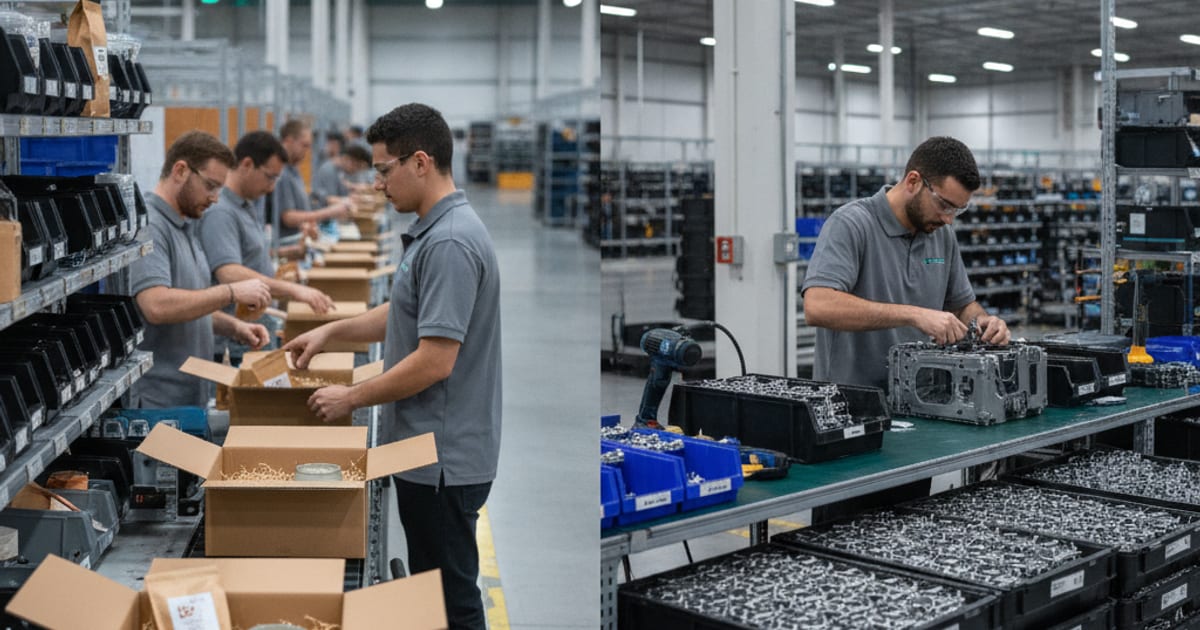
A kitting line is designed for sequential item placement at speed. A standard conveyor kitting line at Productiv runs 10 operators covering box build, item placement, closure, labeling, cartonizing, palletizing, and material handling — and headcount scales up or down to control throughput. The line design question for kitting is takt time per item placed: how do items flow to the line, how many placement stations, where does verification happen.
Assembly runs on workstations or cells rather than a placement line, because the work content per unit is heavier and less uniform. A display build might involve folding, gluing, tray insertion, and header attachment — steps that need fixtures, jigs, cure time, or two sets of hands. Assembly cells are balanced around the build sequence, not around item count, and quality checks live inside the process rather than at the end of the line.
The practical consequence: throughput on a kitting line scales close to linearly with operators, while throughput on an assembly operation scales with cells — each of which has to be set up, fixtured, and first-article-approved before it produces sellable units.
How Pricing Differs Between Kitting and Assembly
Kitting pricing follows a per-item structure. At Productiv, kitting runs $0.04–$0.08 per item placed plus a base kit fee of $0.25–$0.75 — with the base fee driven by lot/batch control requirements, special labeling, packaging type (box build and seal, heat seal, crinkle paper), and the accuracy tolerance the program requires. A 10-item mid-complexity kit with no lot control and a standard box build prices at $0.65–$1.05 all-in per kit. Everything is priced per unit, not per hour.
Assembly is also priced per unit, but the quote is built from work content rather than item count: the number and difficulty of build steps, fixture and equipment requirements, cure or set time, and the inspection burden. Two assemblies with identical component counts can carry very different rates if one is a fold-and-tuck and the other involves gluing, hardware, or torque specs. That's why assembly quotes require a physical sample or a detailed build spec, while kitting quotes can often be modeled from a component list.
For a full breakdown of kitting pricing — including what moves the base fee and how volume affects rates — see our kitting and assembly cost guide.
Compliance Implications: Accuracy vs. Build Verification
Kitting compliance is about accuracy and traceability. Standard kitting accuracy targets run 99.5–99.95%, and regulated programs run at 100%. The demanding version looks like the first aid kit program we run for an outdoor safety brand: up to 100 items per kit, lot and batch control across 75 regulated items, and regulatory documentation produced for every job. If a component is recalled, the lot records have to show exactly which kits it went into.
Assembly compliance is about build verification. The gate is First Article Inspection — the first completed unit gets documented and approved against spec before the run proceeds. At Productiv, that loop runs through ProQuality, an internally built AI workflow tool that auto-routes first-article photos to the client for approval, so the line isn't idle waiting on an email chain. In-process checks then hold the build to the approved standard through the run.
When you brief a partner, name the compliance regime explicitly — lot control and documentation for kitting, first-article and inspection requirements for assembly — because both drive pricing and line design, and both are expensive to retrofit after launch.
When a Program Needs Both: Displays, PDQs, and Gift Programs
Plenty of programs are both operations run in sequence. The clearest case is retail display and PDQ work: the display unit gets assembled — corrugate folded and glued, trays and header fitted — and then it gets kitted, with product loaded into the configured positions and the finished unit packed retail-ready. Manufacturers outsource this constantly because factory lines aren't designed for display builds, and seasonal reset volume would disrupt core production.
Seasonal gift programs follow the same pattern when the presentation packaging has to be constructed before products go in: build the box or tray (assembly), then place, verify, and finish the set (kitting). If your program looks like this, the single most useful thing you can do at the RFP stage is scope it as two operations with one handoff — it makes quotes comparable and surfaces which vendors can actually run the sequence under one roof.
How to Brief a 3PL on Kitting vs. Assembly
For a kitting program, a partner can quote accurately if you provide:
- Kit configuration — items per kit, number of SKUs in the program, and how often the configuration changes
- Volume and cadence — units per day or per month, seasonality, and hard ship windows
- Packaging spec — box build, heat seal, crinkle paper, inserts, labeling
- Compliance requirements — lot/batch control, documentation, and the accuracy tolerance the program carries
For an assembly program, the brief centers on the build:
- Bill of materials and build sequence — every component and every step, ideally with a physical sample
- Fixtures, equipment, and cure times — anything that constrains cell design or throughput
- Quality spec and first-article process — what "built correctly" means and who signs off
- Output packaging — how finished units carton and palletize, especially for retail-ready delivery
On timelines: at Productiv, manufacturing-return programs launch in 24–48 hours, DTC programs in about a week (IT integration is the driver), and retail B2B programs in 6–12 weeks because of EDI setup and retailer testing cycles. The line itself is rarely the long pole — the integrations are.
What This Looks Like in Practice
Productiv runs both operations on the same floors — 30M+ kits a year alongside display builds, carded packaging, and finished-product assembly — through our 3PL kitting and assembly services. Programs that need the full sequence (assemble the unit, kit the product, ship retail-ready) run it as one flow with one accountability line, which is where the accuracy and timeline risk of a two-vendor handoff disappears.
One related distinction worth keeping straight: if your question is about selling products together — combined pricing, virtual bundles, whether the warehouse even needs to change — that's bundling, not assembly. We cover that boundary in kitting vs. bundling.
If you're scoping a program and want a second set of eyes on whether it's kitting, assembly, or both — and what each would cost — talk to an operations expert. Bring the component list or a sample; we'll tell you how we'd run it.
Key Takeaways
- →Kitting gathers multiple finished SKUs into one new sellable unit with its own SKU; assembly combines components into a finished product that didn't exist as a sellable item before the work.
- →Kitting is priced per item placed — typically $0.04–$0.08 per item plus a $0.25–$0.75 base kit fee — while assembly is quoted per unit from the work content of the build.
- →A 10-item mid-complexity kit with no lot control and a standard box build typically prices at $0.65–$1.05 all-in per kit.
- →Display and PDQ programs need both operations in sequence: assembly builds the display unit, then kitting loads it with product.
- →Productiv assembles 30M+ kits annually, with single programs running as high as 80,000 kits per day, and launches programs in 24–48 hours to 12 weeks depending on channel.
Frequently Asked Questions
Is kitting the same as assembly?
No. Kitting gathers multiple finished SKUs into one new sellable unit — the items stay what they are, but the combination gets its own SKU. Assembly physically combines components into a finished product, so the components lose their individual identity in the output. Many programs use both: components get assembled into a unit first, then that unit gets kitted with other items.
Does kitting cost more than assembly?
Neither is categorically more expensive — they're priced differently. Kitting follows per-item economics: typically $0.04–$0.08 per item placed plus a $0.25–$0.75 base kit fee, so a 10-item mid-complexity kit runs $0.65–$1.05 all-in. Assembly is quoted per unit from the work content of the build — number of steps, fixtures required, fastening or gluing time — so a complex assembly can cost several times what a kit with the same item count would, and a simple one can cost less.
Can the same 3PL do both kitting and assembly?
Some can, and for certain programs it's a requirement rather than a convenience. Display and PDQ programs need assembly (building the display) and kitting (loading it with product) in sequence, and splitting them across two vendors adds freight, handling, and a coordination seam where accuracy problems hide. Ask a prospective partner for volume evidence on both operations specifically — a line running thousands of kits per day is a different capability than a cell building displays.
Does kitting create a new SKU?
Yes. A finished kit gets its own SKU, and the component items are consumed against it through a bill of materials. That's part of what separates kitting from bundling, which can exist purely as a pricing arrangement in your e-commerce platform with no new physical unit. Inventory planning has to account for both levels: component stock feeding the kit, and finished-kit stock available to promise.
How fast can a kitting or assembly program launch with a 3PL?
At Productiv, manufacturing-return programs launch in 24–48 hours, DTC programs in about a week (the IT integration is the driver), and retail B2B programs in 6–12 weeks because of EDI setup and retailer testing cycles. The physical line setup is rarely the bottleneck — the upstream integrations and retailer compliance cycles are what set the timeline.
What's an example of a program that needs both kitting and assembly?
A retail PDQ or floor display program is the classic case. The display itself gets assembled from corrugate components — folded, glued, fitted with trays and headers. Then the display gets kitted: product placed in the configured positions, the loaded unit packed for retail-ready delivery. Seasonal gift programs work the same way when the presentation packaging has to be constructed before the products go in.
Kitting + assembly under one roof
Scoping a program and not sure whether it's kitting, assembly, or both?
We run 30M+ kits a year and build displays, fixtures, and finished products on the same floor. Walk us through the program and we'll tell you how we'd structure it — line design, pricing model, and launch timeline.
Talk to an Operations Expert